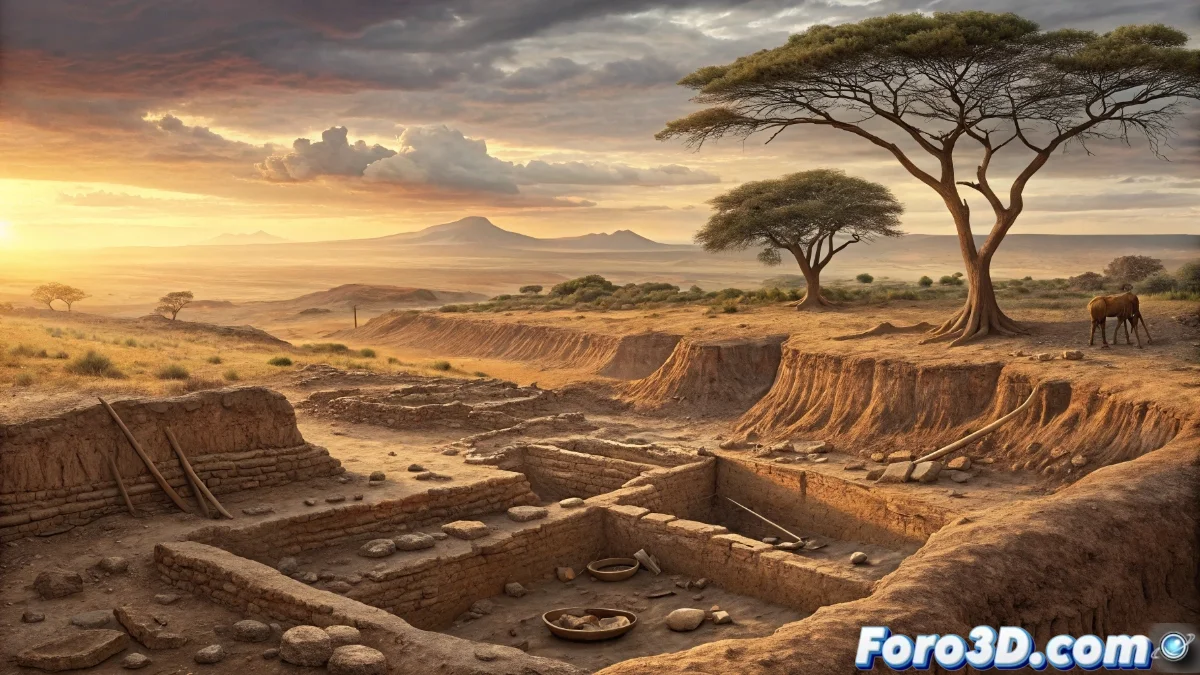
The Omo-Turkana Basin: An Archaeological Window into Our Origins
The Omo-Turkana region in Africa stands as a true archaeological sanctuary that continues to reveal fundamental findings about our ancestors. This vast territory preserves fossil and technological evidence spanning more than three hundred millennia, providing unique perspectives on the early stages of human evolution. International scientific teams work tirelessly in this area to decipher the lifestyles, adaptation strategies, and technical advances of our predecessors, linking each discovery to the intricate mosaic of our collective history 🌍.
A Millennial Archive Under the African Sky
Excavation campaigns in the basin recover not only ancient skeletal remains but also lithic tools that document technological progression through the ages. These objects, from basic cores to sophisticated utensils, evidence the inventiveness and survival capacity of the species that inhabited the area. Each field season can reveal new vestiges that challenge established paradigms, broadening our perception of the variety of hominins and their ecosystem relationships, solidifying the region as a world-reference paleontological laboratory.
Highlights of the Discoveries:- Continuous record spanning from the Middle Pleistocene to recent times
- Lithic technology showing transitions from Oldowan to Acheulean
- Evidence of adaptation to extreme climatic fluctuations
"Every bone fragment and every recovered tool constitute pages of the great book of our prehistory, constantly rewriting what we thought we knew about the human journey" - Turkana Research Team
Implications for the Contemporary Evolutionary Narrative
Recent findings in Omo-Turkana have allowed for adjustments to the chronologies of human expansion and adaptive responses, demonstrating how environmental transformations shaped the development of precursor species. This constant flow of information contributes to reconstructing migratory patterns, dietary regimes, and social dynamics, crucial factors for understanding the attributes that define us as humans. The basin functions not only as a repository of the past but as an active resource that continues to supply concrete evidence for scientific discussions on natural selection and resilience in extreme contexts.
Key Contributions to Paleoanthropology:- Refinement of human dispersal routes out of Africa
- Understanding of subsistence strategies in arid environments
- Documentation of the coexistence of multiple hominin species
The Meticulous Work Behind the Discoveries
While we occasionally lose our car keys, imagine the patience required to locate a 300,000-year-old fossil in the middle of the African desert. The dedication of these archaeologists deserves monumental recognition, or at the very least a refreshing beer after exhaustive days under the relentless sun. Their meticulous work transforms grains of sand into essential chapters of our collective existence, reminding us that every fragment of the past holds lessons for the future 🏜️.