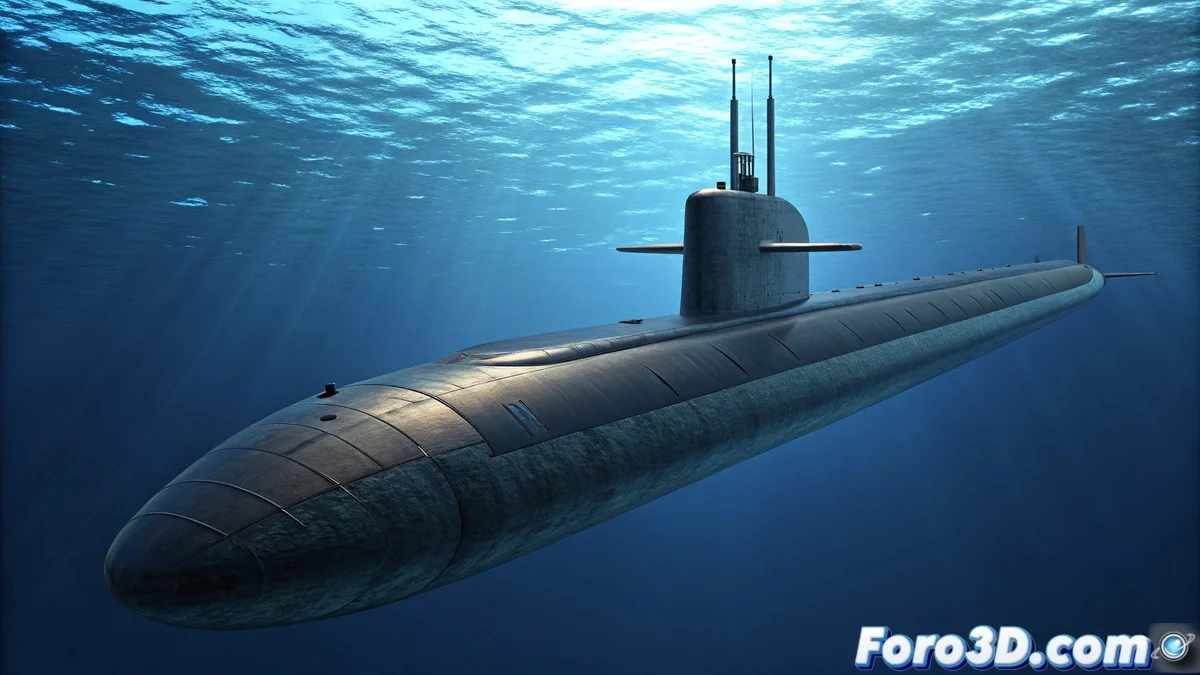
The Ohio-class nuclear submarine: features and 3D modeling
The Ohio class represents the pinnacle of technology in nuclear-powered submarines, with colossal dimensions including 170 meters in length, 13 meters in beam, and 11 meters in draft. Its displacement ranges between 16,700 and 18,800 tons depending on whether it operates on the surface or submerged, powered by a S8G nuclear reactor that drives a variable-pitch propeller to reach speeds of 20-25 knots submerged. These capabilities allow prolonged patrols with 155 crew members, ensuring continuous strategic deterrence 🌊.
Technical specifications and armament
The offensive heart of these submarine colossi lies in their 24 missile tubes, although some modified examples carry 20 units according to international treaties, specifically designed to house Trident missiles that require precise internal volumes for alignment and launch. As complementary defense, they incorporate four 533 mm torpedo tubes integrated into a hydrodynamically optimized cylindrical hull for maximum operational stability ⚓.
Main structural features:- Elongated cylindrical configuration with a central sail housing navigation systems
- Upper deck with subtle curvature over the missile section
- Strategically positioned access systems and hatches
Precision in the 3D modeling of these submarines requires understanding their dual architecture: strategic deterrence platform and masterpiece of naval engineering.
Considerations for digital recreation
For faithful recreations in 3D environments, it is crucial to capture the cylindrical hull geometry with its central sail containing periscopes and communication antennas. The upper deck shows a gradual curvature over the missile tubes, while access elements must be modeled with functional precision. Internal details, particularly the arrangement of silos and compartments, demand exact scales for visual authenticity in technical representations 🎯.
Critical elements for modeling:- Hull line and sail with integration of navigation systems
- Precise arrangement of missile tubes and launch systems
- Hatches and access systems with realistic operational functionality
Operational and technical perspective
Although operating with 155 crew members and nuclear armament capable of altering geopolitical balances, these submarines represent the pinnacle of modern naval engineering. Their design combines strategic capabilities with prolonged autonomy, requiring in 3D modeling not only dimensional precision but also an understanding of their operational functionality. Successful digital recreation must convey both their imposing physical presence and their sophisticated internal technology 💻.