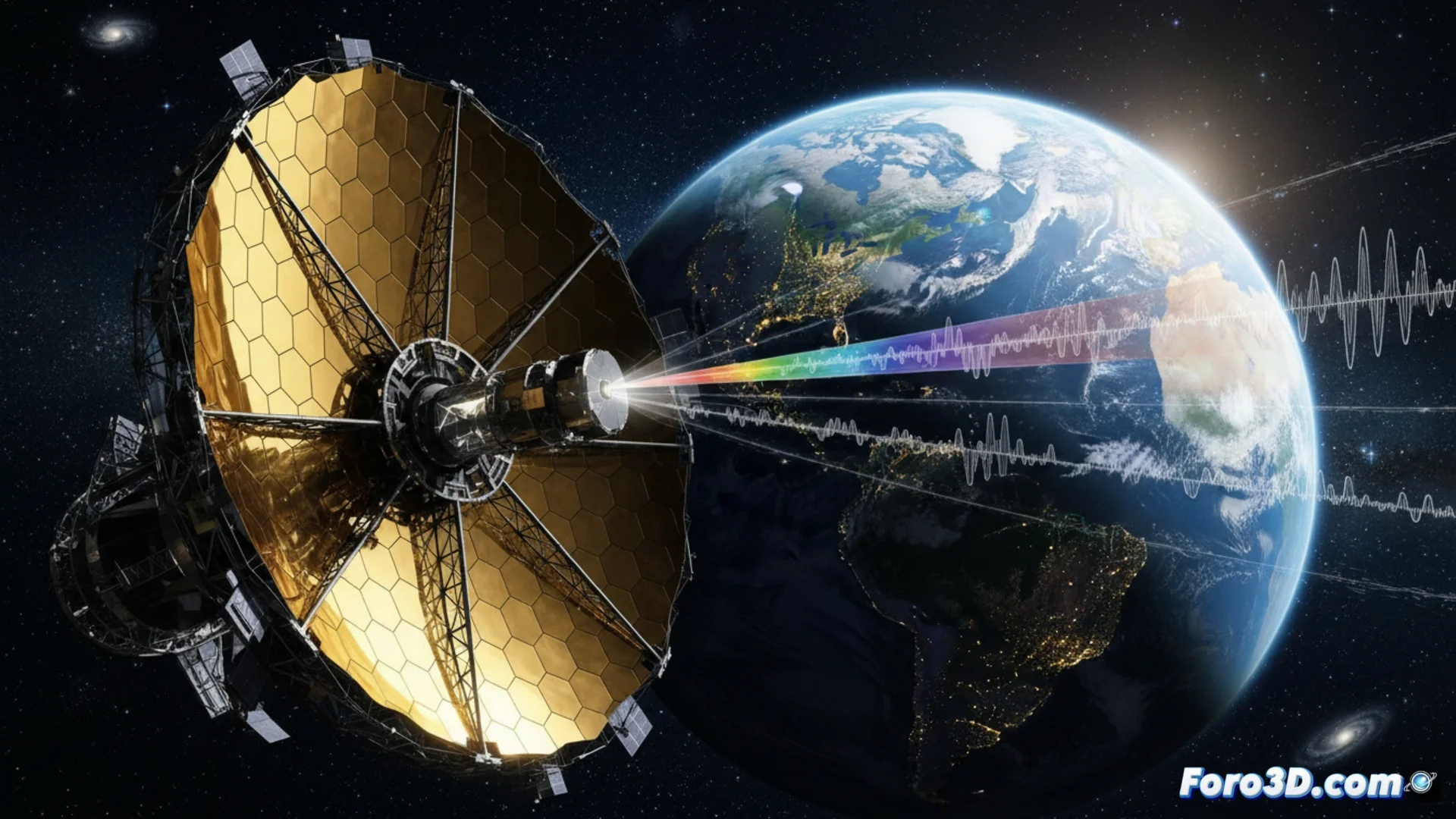
The Habitable Worlds Observatory Boosts Exoplanet Science with Polarimetry
The next major mission to search for life beyond our solar system, the Habitable Worlds Observatory (HWO), is preparing for a launch in the 2040s. Its main goal is to directly examine the atmospheres and surfaces of rocky planets in the habitable zones of other stars. To achieve this, it will employ high-contrast reflection spectroscopy, a technique that decomposes the light reflected by a planet across a broad spectrum, from ultraviolet to near-infrared. This analysis seeks to identify indicator molecules such as oxygen, ozone, water vapor, carbon dioxide, and methane. Additionally, it could detect surface signs of life, such as the characteristic "red edge" of vegetation or the glints of oceans. 🪐
Polarimetry Clears the Uncertainty of Planetary Clouds
One of the biggest obstacles to studying an exoplanet is its clouds. These not only shape the world's climate but also mask and confuse observations based solely on light brightness. This is where spectropolarimetry emerges as a complementary and powerful tool. This methodology measures how the polarization state of light changes with wavelength and the planet's orbital position. It is exceptionally sensitive to the properties of particles in the atmosphere, such as their size, chemical composition, shape, and how they are distributed in vertical layers, as well as the type of underlying surface.
Key Advantages of Spectropolarimetry:- Allows distinguishing between light scattering effects by clouds and absorption by gases in the atmosphere.
- Helps determine the nature of aerosol particles, whether they are water droplets, ice crystals, or dust.
- Provides data to refine atmospheric and surface models, resolving ambiguities that other methods cannot.
Integrating polarimetric capability into the HWO's instruments would substantially improve the mission's scientific return, enabling a more precise and robust characterization of the observed worlds.
A Window of Opportunity for Scientific and Technological Leadership
The instrument suite planned for the HWO includes a coronagraph to block starlight and a high-resolution imager. The proposal to add a high-resolution spectropolarimeter represents a strategic opportunity. Numerous studies already demonstrate the unique value of this technique for characterizing a wide range of exoplanets, from gas giants to terrestrial worlds. This context opens a clear path for the scientific community, particularly in the United Kingdom, to take a leading role.
Areas of Impact and Leadership:- Develop the cutting-edge instrumentation necessary to measure polarization with extreme precision from space.
- Create and refine the theoretical and computational models that interpret complex polarimetric data.
- Ensure that the HWO reaches its full potential in the search and assessment of the habitability of other worlds.
Looking Beyond Alien Clouds
The path to finding a truly habitable, and even inhabited, world requires seeing beyond the cloudy layers that might conceal it. Space polarimetry is positioned as the key to solving this "terrestrial problem" on an interstellar scale. By combining the power of traditional spectroscopy with the unique information provided by polarization, the HWO will be better equipped to unravel the secrets of distant atmospheres and search for the long-sought biosignatures. Thus, while we anticipate the discovery of extraterrestrial oceans, we must first perfect our ability to observe through their cloudy skies. 🔭✨