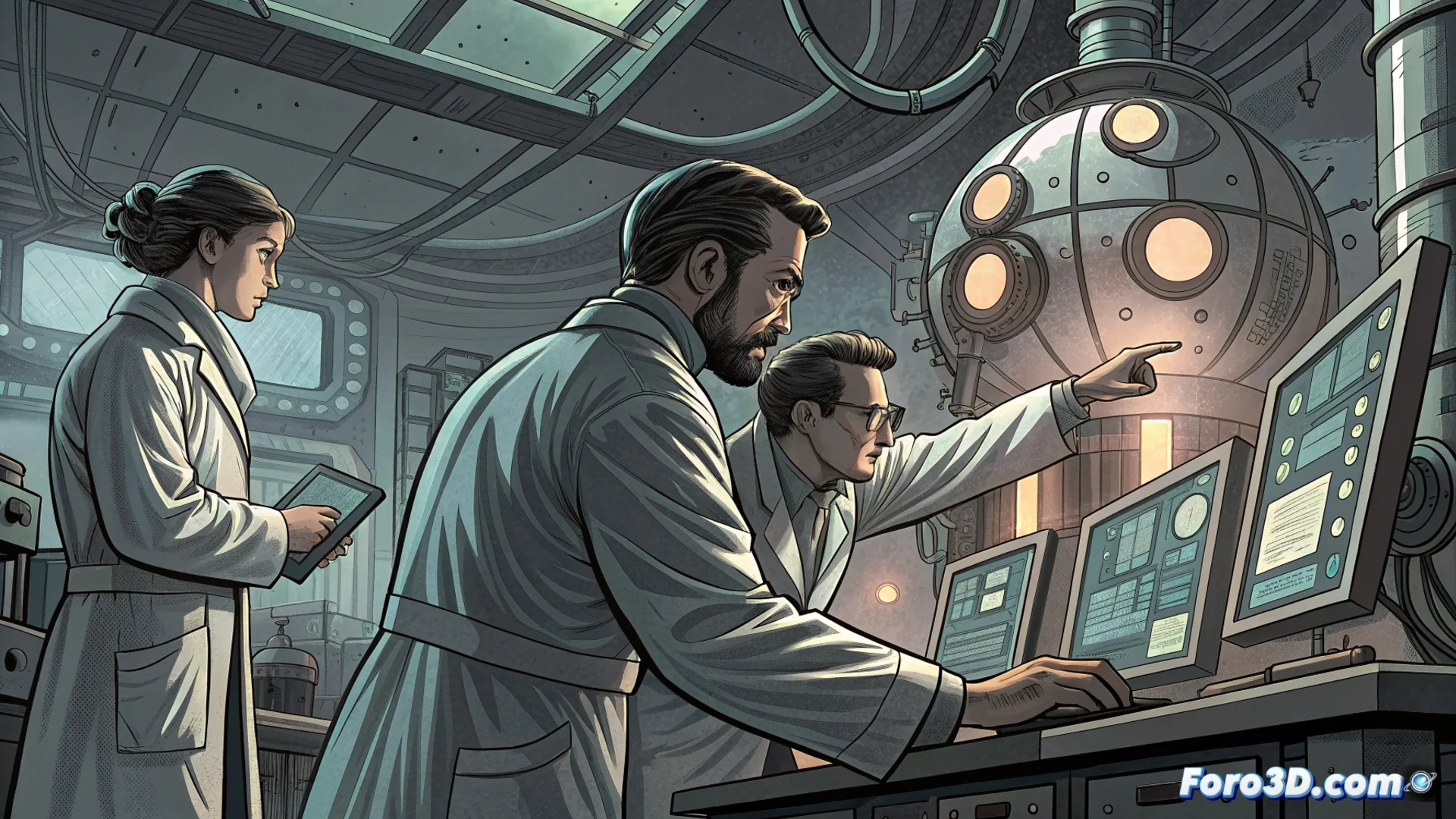
The novel The Gods Themselves imagines an interdimensional exchange
In his work The Gods Themselves, Isaac Asimov presents a science fiction scenario where humanity accesses an apparently infinite energy source. This achievement is accomplished through a revolutionary device called the electron pump, which allows the transfer of matter between our universe and a parallel one. The plot becomes complicated when physicist Frederick Hallam deduces that this exchange alters the fundamental constants of our reality and could destabilize the Sun, generating an existential crisis. 🌌
An alien civilization with a radical biology
The central section of the book shifts to the parallel universe, where Asimov constructs a society of beings with a tripartite nature. These aliens exist in three differentiated genders: the Rationals, the Emotionals, and the Parentals. To reproduce, they must form triads, and their perception of reality and social structure are completely alien to humans. The author uses this system to explore how their desperate need for energy leads them to interact with our dimension, without fully understanding the repercussions of their actions.
Key elements of the parallel society:- Tripartite structure: Existence is based on the union of three genders with specific roles to form a functional family unit.
- Distinct perception: Their way of experiencing reality, space, and energy differs radically from the human model.
- Energetic motivation: Collaboration with the human universe arises from a need for survival, not malice.
The irony lies in the fact that the solution to one world's energy problem could mean the end of the other.
The conflict arises from the inability to communicate
The plot advances when individuals from both universes must face the cosmic threat generated by the exchange. On the human side, the conflict arises between those who prioritize the immediate benefit of free energy and those, like Hallam, who try to stop the process. In the parallel universe, a dissident member of a triad, named Dua, perceives the danger and tries to alert her own kind. The novel thus examines the enormous difficulty of cooperating when the very bases of existence and communication are incompatible.
Conflicting factions:- Complacent humans: Characters who ignore the scientific warning due to attachment to the comfort provided by the new energy.
- Aware humans: Scientists who understand the risk and seek a solution, often facing general incomprehension.
- Alien dissident: Dua, who from her unique reality tries to prevent catastrophe for both dimensions.
A reflection on responsibility and knowledge
The Gods Themselves transcends the simple adventure story to offer a profound reflection. Asimov explores the responsibility of knowledge and the dangers of acting without fully understanding the consequences of powerful technologies. The outcome underscores that survival may depend on overcoming selfishness and ignorance, even when cooperation seems impossible. The work remains relevant as a warning about the ethical limits of progress. ⚖️