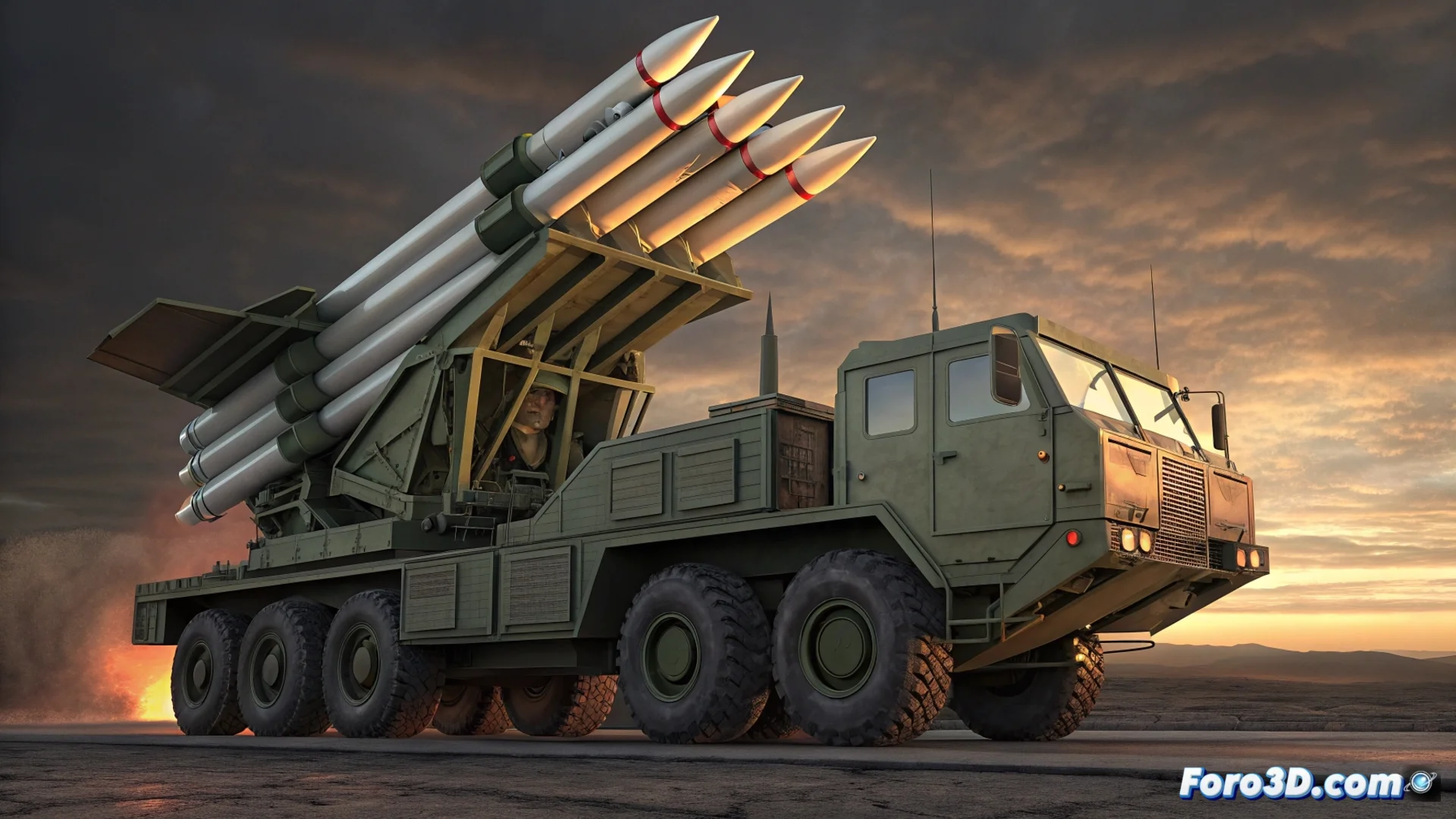
The NASAMS System: Norwegian-American Modular Air Defense
The Norwegian Advanced Surface to Air Missile System (NASAMS) represents a key collaboration between Norway and the United States to create a medium-range air shield. Its main purpose is to defend strategic points from modern aerial attacks, including manned aircraft, unmanned aerial vehicles, and cruise missiles. 🛡️
Networked Modular Architecture
What distinguishes NASAMS is its modular architecture, which allows the system to be configured according to the specific needs of each mission. It does not operate as an isolated unit, but as a synchronized network of specialized components that exchange data in real time. This flexibility makes it highly versatile for armed forces to deploy in various terrains and tactical scenarios.
Main system components:- AN/MPQ-64 Sentinel Radar: Mounted on a vehicle, this radar detects and tracks targets in three-dimensional space, providing continuous data.
- Fire Control Center: Receives radar information, processes it, and coordinates the launchers' response to intercept threats.
- Mobile Launchers: Transportable platforms, either on trucks or trailers, that house and fire the missiles. A typical launcher measures 5.2m long, 2.2m wide, and 2.4m high.
For the 3D modeler, capturing the functional and robust aesthetic of a military system is an interesting challenge, where every angle and protrusion has a defined purpose.
Armament and Operational Range
The power of NASAMS lies in its ability to integrate different missile families, which greatly expands its spectrum of action. It does not rely on a single type of ammunition, but can select the most suitable missile for each identified threat type.
Missiles it can employ:- AIM-120 AMRAAM: Active radar missile with extensive range, ideal for engaging targets at greater distances.
- AIM-9X Sidewinder and IRIS-T: Infrared-guided missiles, designed for close combat and against agile maneuvering targets.
- This combination allows the system to neutralize a wide range of threats, from high-speed approaching targets to those flying at low altitude.
Challenge for Illustration and 3D Modeling
Representing NASAMS in 3D involves more than replicating its shapes; it requires understanding and conveying its military function. The modeler must pay attention to the details that define its operability: the angular geometry of the launcher, the arrangement of its six tubes, and the integration of all its components into a mobile and cohesive unit. The result must communicate robustness, technology, and a design where utility takes precedence over ornamentation. 💻