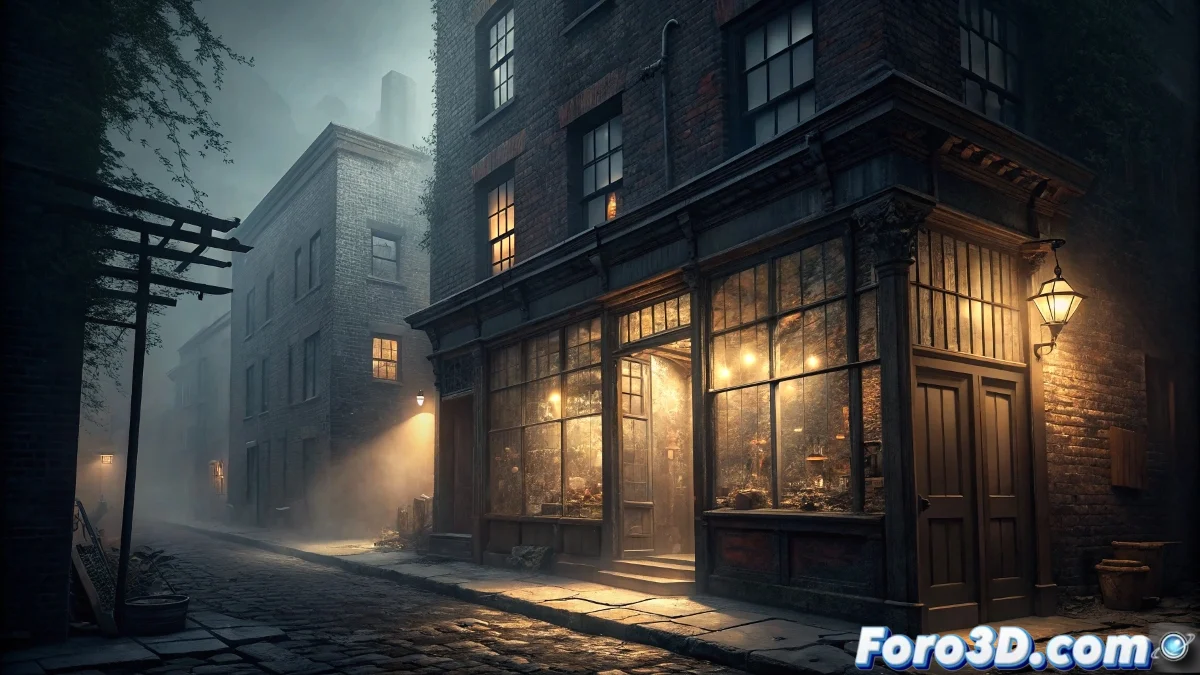
The Myth of the Disappearing Antique Shop and Its Visual Representation
The urban myth of the antique shop that mysteriously appears and disappears has its roots at the end of the 19th century, coinciding with the accelerated urban expansion worldwide. The first written mentions are found in intimate diaries from London and Paris, where travelers recounted casual encounters with establishments that local inhabitants denied knowing. This phenomenon was associated with the creation of interstitial spaces in cities, where collective memory became particularly vulnerable. The essence of these stories always followed a recurrent pattern: the shop only became visible for brief moments and in locations that defied conventional urban organization 🏙️.
Historical Evolution and Cultural Adaptation
Throughout the 20th century, the legend spread globally, adapting to each metropolitan environment. In New York, versions placed the shop in Brooklyn alleys, while in Tokyo it was located in passageways between Shinjuku district skyscrapers. The main characteristic was consolidated: any object bought in this place transformed into a cursed artifact whose origin only the buyer remembered. The stories circulated through various urban subcultures, from 1960s countercultural movements to paranormal enthusiast communities on internet forums in the early 21st century. Each generation incorporated nuances into the narrative, but the core of the myth remained unchanged.
Key Elements of the Myth:- Temporal manifestation in urban interstitial spaces
- Acquired objects that become artifacts with hidden stories
- Transmission through subcultures and digital media
The real mystery is not finding the shop, but explaining to your bank why you spent 500 euros on an object that technically never existed.
Project Preparation and Initial Setup
Start by creating a new document in Photoshop with dimensions of 4000x3000 pixels and a resolution of 300 ppi. Set the color mode to 16-bit RGB to achieve a greater dynamic range during editing. Organize a layer structure with main groups for the background, architecture, lighting, and effects. Import reference textures of urban alleys and old facades to ensure visual coherence. Prepare the workspaces with brushes, adjustments, and layers panels visible to optimize the creative workflow throughout the process.
Essential Initial Setup:- 4000x3000 pixel document at 300 ppi
- 16-bit RGB color mode for advanced editing
- Layer structure organized into thematic groups
Modeling and Main Structure
Use the pen tool to trace the perspective lines of the alley, creating a vanishing point that adds dramatic depth. Develop the shop facade using vector shapes that allow non-destructive adjustments. Apply warp transformations to give irregularity to the architecture, simulating time wear. Use layer masks for the windows displaying antique objects with interior blur. Apply custom textured brushes to add details of rotten wood and rusted metal on the main entrance and faded sign.
Lighting and Materials
Set up a curves adjustment layer to create dim lighting with high contrast. Apply a radial gradient from the shop entrance outward, simulating a warm internal light source. Use blending modes like overlay and soft light for areas lit by urban streetlamps. Generate clipping masks with aged surface textures using multiply blending mode for shadows and overlay for highlights. Adjust brush flow opacity to gradually build time- and weather-eroded surfaces.
Advanced Lighting Techniques:- Use of curves adjustment layers for dramatic contrast
- Radial gradients to simulate internal light sources
- Blending modes for ambient lighting effects
Special Effects and Final Rendering
Incorporate a low fog layer using lens blur filters and soft light blending mode. Create a dark vignette effect in the corners to direct attention toward the shop entrance. Use particle brushes to simulate dust floating in visible light rays. Apply selective saturation adjustments, reducing color in peripheral areas while maintaining warm tones near the shop. For the final render, export in 16-bit TIFF format preserving all layers and then generate an optimized JPEG version for web.
Impact and Cultural Legacy
This urban legend embodies contemporary anxiety about the transience of memory in metropolitan environments. It symbolizes how urban spaces can generate voids in collective recollection and how material objects can carry hidden stories. The shop functions as a metaphor for the secrets that modern cities hide in their interstices, reflecting the fear that entire parts of our urban experience may fade away without a trace. Its persistence in the collective imagination demonstrates the human need to explain mysteries that escape the rational logic of urban planning 🌆.