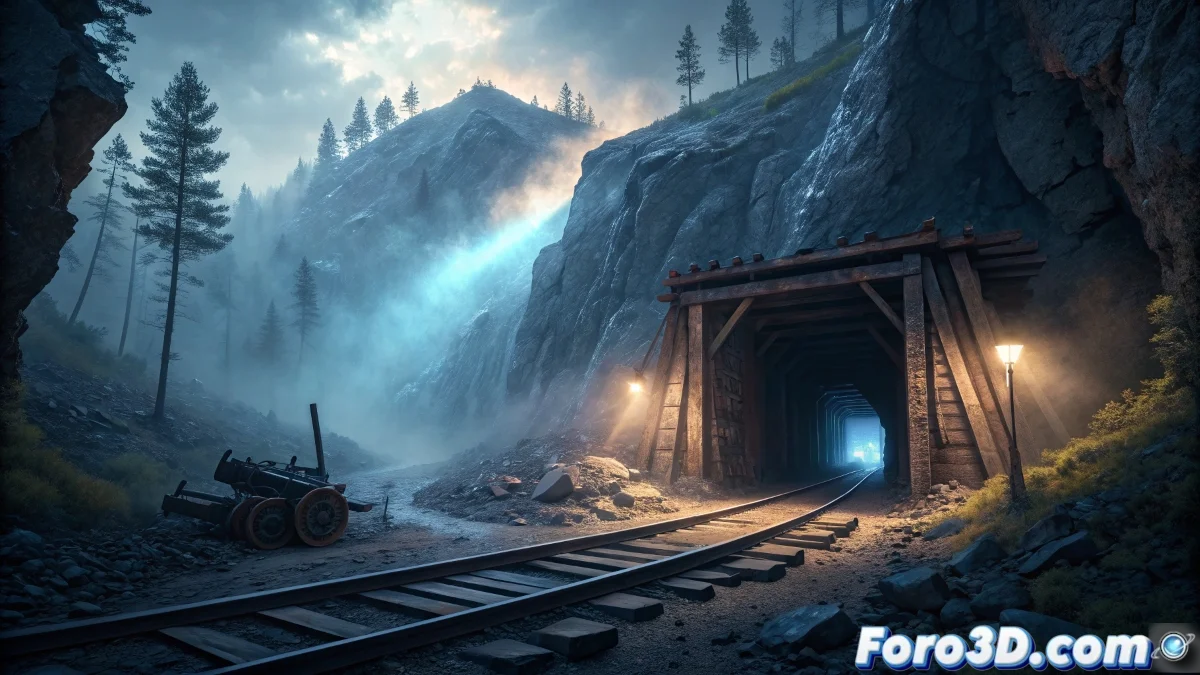
The Mystery of the Underground Whistling in the Appalachians and Its Representation in Blender
In the depths of the abandoned mines of the Southern Appalachian Mountains, a persistent hum has intrigued local communities for decades. This phenomenon, documented since the coal decline of the 1950s-70s, is perceived as ground vibrations and has inspired legends about hidden entities. 🏔️
Origins and Evolution of the Acoustic Phenomenon
Early reports described a low-frequency whistle that persisted even after mining activity ceased. Initially attributed to residual ventilation or machinery, the enigmatic nature of the sound led to more imaginative theories, such as the "breathing of the earth." Over time, it became integrated into Appalachian folklore, symbolizing industrial legacy and unresolved mysteries.
Key characteristics of the whistle:- Extremely low frequency, transmitted through the ground
- Persistence decades after mine closure
- Interpretations ranging from geological to paranormal
The real mystery is not whether the earth breathes, but why the ghosts of the mines chose to learn to whistle instead of speaking normally.
Project Setup in Blender
To capture this atmosphere, start by setting up Blender with Cycles and 4K resolution (3840x2160). Adjust color management to Filmic for a wide dynamic range and organize the scene into collections: terrain, mine, sound effects, and lighting. Use a 35mm camera with depth of field to focus on critical elements, like the mine entrance. 🎥
Essential initial setup:- Cycles engine for high-fidelity rendering
- Collection system for efficient object management
- Camera setup with realistic lenses and selective focus
Modeling and Environment Design
Create the mountainous terrain by applying the Displace modifier to a subdivided plane, using procedural noise textures to generate realistic elevations. Model the abandoned mine through digital sculpting, adding broken beams and rusted rails. Use Cell Fracture to simulate fractured rocks and, for the sound, design abstract shapes with Bezier curves that suggest waves emerging from the mine. 🪨
Critical modeling elements:- Procedural displacement for mountainous relief
- Decomposition details with controlled fractures
- Organic curves to visualize the invisible whistle
Lighting and Materials
Set up a three-point lighting with three sources: dim sunlight, warm internal spotlight, and volumes for god rays. In the Shader node editor, develop PBR materials with high roughness and low reflectivity, combining procedural noise and images for textures of eroded rock, rotten wood, and rusted metal. For the sound effect, assign an emissive material with variable intensity animation. 💡
Material and lighting aspects:- PBR-based textures for realism
- Light volumes for dense, mysterious atmosphere
- Emission animation to simulate sound vibrations
Special Effects and Post-Processing
Implement dust and fog particles with field forces for organic movement, and use Principled Volume with animated density to represent the whistle's vibrations. In the compositor, apply contrast and vignette adjustments, and shift colors toward earthy tones. Render with 500-800 samples and OptiX denoising to balance quality and time. 🌫️
Final rendering steps:- Particle system for atmospheric floating elements
- Animated volumes for visualized sound effects
- Post-processing with nodes for aesthetic enhancement
Cultural Legacy and Technical Conclusion
The underground whistle remains a symbol of the Appalachian industrial past, fusing acoustic mystery with oral tradition. In Blender, this scene not only recreates an enigmatic phenomenon but demonstrates how advanced visual effects can narrate complex stories. The combination of procedural modeling, atmospheric lighting, and detailed materials offers a powerful tool for digital artists. 🎨