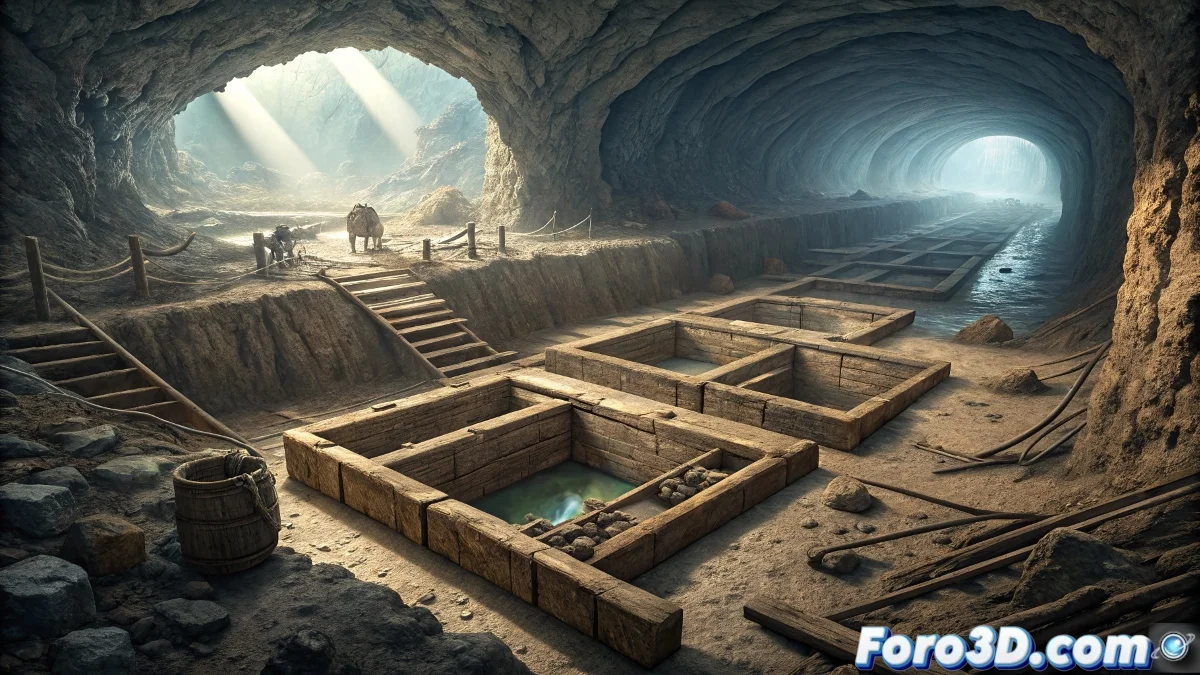
The Mystery of the Money Pit on Oak Island: 3D Recreation
For over two centuries, Oak Island in Nova Scotia has captivated treasure hunters with its enigmatic Money Pit, an underground engineering marvel that has thwarted more than 200 expeditions. What began as a simple hole discovered in 1795 revealed itself as a complex system of flooded tunnels designed to protect hidden treasures 🏴☠️.
History of a Persistent Enigma
The Money Pit is not simply a hole in the ground - it represents one of the most sophisticated engineering mysteries of the 18th century. Excavations have revealed extraordinary features suggesting deliberate construction by expert hands. The Truro Company discovered in 1849 that the pit was artificially connected to the ocean via five drainage tunnels, creating an instant flooding system that activated when excavators reached a certain depth ⚓.
Unique Architectural Features:- Oak platforms every 10 feet with mysterious masonry marks
- Drainage system with charcoal filters to purify seawater
- Trigger mechanisms that released sand and gravel to collapse tunnels
The Money Pit's design demonstrates hydraulic knowledge surpassing many modern constructions, protecting its secret through reverse engineering applied to archaeology.
Professional Recreation in Blender: Step-by-Step Guide
To recreate this icon of mysterious engineering in Blender, we will follow a professional workflow that ensures historical realism and technical precision. This tutorial assumes Blender 3.0+ and intermediate experience 🎨.
Initial Terrain Setup:- Create a 200x200 meter base plane with 64 subdivisions using the Subdivision Surface modifier
- Apply displacement with Musgrave texture scale 0.8, detail 12.0, dimension 1.8 for natural terrain
- Use the Grab brush with sphere falloff and strength 0.4 to form the central circular depression 8m in diameter
Detailed Structural Modeling
The pit modeling requires attention to documented historical details. We start with the main structure and progress to complex elements 🔧.
Step-by-Step Modeling:- Create cylinder with 32 vertices, radius 4m, depth 40m for the main pit
- Apply boolean difference with scaled cubes to create lateral tunnels at 45° angles
- Use array modifier with count 6 and offset 6m in Z for wooden platforms
- Set up bevel modifier with width 0.08m and segments 3 for realistic edges
Advanced Materials and Shaders System
Realistic texturing is crucial to convey 200 years of exposure to the elements. We will use Blender's node system to create physically accurate materials 🌊.
Materials Setup:- Earth material: Principled BSDF with base color #5C4033, roughness 0.85, with noise texture scale 50.0
- Aged wood material: Principled BSDF with base color #8B4513, roughness 0.7, wood texture normal map
- Water material: Principled BSDF with base color #1E90FF, transmission 1.0, roughness 0.05, IOR 1.33
Cinematic Lighting and Rendering
Dramatic lighting is essential to capture the pit's mystery. We will set up a three-point setup with precise intensity and color control 🎭.
Lighting Setup:- Main light: Sun light with strength 3.0, angle 1.5°, color #FFF4E6 positioned at 45° above the pit
- Fill light: Point light with strength 50W, radius 2m, color #6495ED at the pit bottom
- Ambient light: World texture with strength 0.3 using cloudy sky HDRI
Advanced Post-Production Techniques
For the final render, we will use Cycles with specific optimizations for complex scenes with multiple materials and volume effects ✨.
Render Settings:- Samples: 512-1024 depending on complexity, using denoising with OpenImageDenoise
- Volume: Principled Volume density 0.1, anisotropy 0.2 for underground fog
- Compositing: Glare filter fog glow with size 9, mix 0.4 for atmospheric effects
The Enduring Legacy of an Unsolved Mystery
The Oak Island Money Pit represents more than just treasure - it is an ancient engineering testament that continues to challenge modern technology. Through recreation in Blender, we not only preserve its visual legacy but honor the ingenuity of its anonymous creators, whose defenses have withstood the test of time better than many contemporary structures 🕰️.