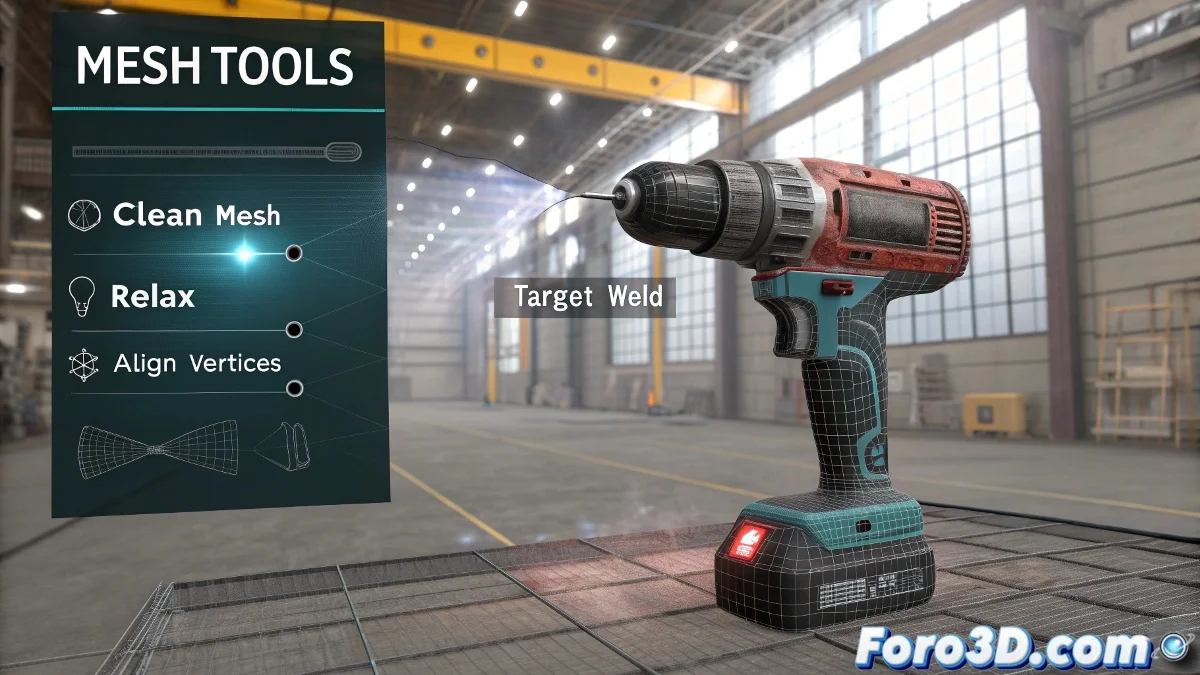
The Secret Tools of 3ds Max
In the vast ecosystem of 3ds Max modeling tools, there exists a curious disparity between the popularity of PolyTools and the almost complete oblivion of MeshTools. The situation you describe is exactly the reality: while PolyTools have abundant documentation, dedicated tutorials, and an active community sharing techniques, MeshTools seem to have become the great unknowns, mentioned only in passing in some modeling tutorials without anyone stopping to explain them in depth. It's like having two siblings where one is famous and the other lives in its shadow, despite having equally valuable talents.
Understanding the Fundamental Difference
The key to understanding why MeshTools have been relegated lies in the historical evolution of modeling in 3ds Max. MeshTools represent the original triangle-based modeling system, while PolyTools emerged later as a more intuitive and powerful evolution based on polygons. However, this does not mean that MeshTools are obsolete; in fact, they have specific applications where they shine on their own.
- MeshTools work with triangles as the basic unit
- PolyTools use n-sided polygons
- Compatibility with old software and game engines
- Mathematical precision in complex operations
Where MeshTools Really Shine
Far from being obsolete tools, MeshTools have very specific niches where they are irreplaceable. From working with 3D scans to preparing models for physical simulations, these tools offer low-level control that PolyTools have abstracted to make modeling more accessible.
Mastering MeshTools is like learning Latin: few use it daily, but it gives you a deep understanding of the language
- Optimization for realtime and game engines
- Work with 3D scans and dense meshes
- Preparation for CAD and manufacturing
- Simulations that require triangular topology
Resources to Discover This Hidden World
Although official documentation is scarce, there are scattered resources you can leverage to master these tools. The most effective strategy is usually to combine practical experimentation with specific searches for techniques that take advantage of the unique benefits of mesh-based modeling.
At the end of the day, learning MeshTools in the era of PolyTools is like studying traditional martial arts: it requires more effort and dedication, but it turns you into a more complete and versatile artist 🥋. The important thing is not to underestimate these tools due to their lack of popularity, as they can be the perfect solution for very specific modeling problems.