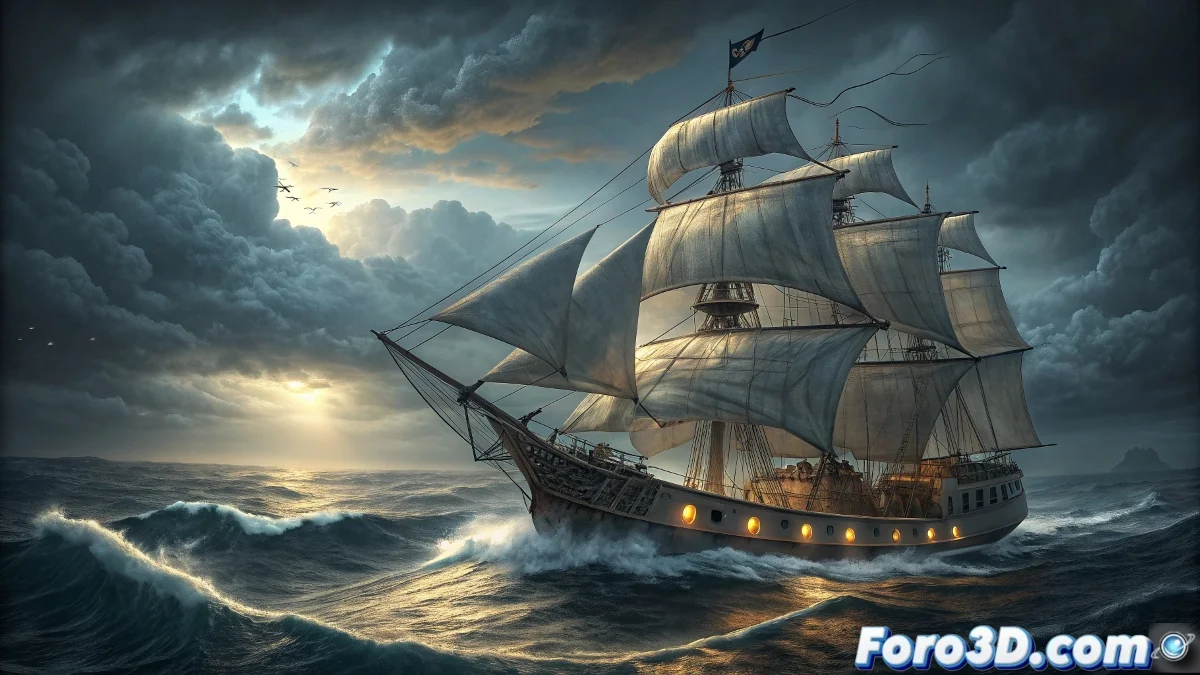
The mystery of the Mary Celeste: recreating the ghost ship in Blender
On December 4, 1872, one of the most enigmatic chapters in naval history was written when the brig Mary Celeste was discovered sailing adrift in the Atlantic, near the Azores. The 31-meter ship was found by the crew of the Dei Gratia in perfectly seaworthy condition, with sails partially deployed and a cargo of 1,700 barrels of industrial alcohol intact. However, the most disturbing thing was what was missing: the ten occupants had disappeared without a trace. 🚢
The Perfect Crime Scene at Sea
Upon boarding the Mary Celeste, the rescuers found a scene that defied all logic. The captain's table had food served and half-eaten, as if the crew had abandoned the ship in the middle of lunch. Personal belongings and valuables remained in their cabins, the navigation instruments were operational, and only the lifeboat and chronometer were missing. There were no signs of struggle, fire, or pirate boarding, suggesting a sudden but voluntary abandonment due to an invisible threat that was never identified. 🌊
Key elements of the mystery:- Ship completely seaworthy but abandoned
- Food served on the captain's table
- Personal items and cargo completely intact
The crew left the ship suddenly for an unknown reason, but terrifying enough that no one returned
Initial Project Setup in Blender
To recreate the Mary Celeste in Blender, we begin by setting up the scene with metric units and 1:1 scale. We set Color Management to Filmic with Medium High Contrast look for a cinematic render. We create a 100x100 meter base plane to represent the ocean and set up the camera with a 35mm lens for a natural perspective. The initial lighting uses an oceanic HDRI from Poly Haven for realistic lighting. ⚙️
Base setup:- Units: Metric, 1:1 scale
- Render: Cycles with 256 samples
- Color Management: Filmic Medium High Contrast
Hull and Brig Structure Modeling
The Mary Celeste was a 31-meter wooden-hulled brig. We start with a basic cube and apply Subdivision Surface with level 2. We use the Displace modifier with noise texture to create the characteristic curved hull shape. We extrude the bow and stern using Loop Cuts and proportional editing for organic shapes. The exact dimensions (31m length, 7.9m beam, 3.6m draft) are maintained using viewport measurements. 🛠️
Hull modeling:- Subdivision Surface level 2 for smoothing
- Displace with noise for natural curvature
- Loop cuts for geometry control
Sail and Rigging System with Simulations
The sail system is crucial for authenticity. We model the sails using subdivided planes with Cloth modifier to simulate wind inflation. We apply canvas textures with Normal Maps for seams and wear. The masts and yards are created with scaled cylinders and Bevel modifier for rounded edges. The rigging and ropes use Bezier curves with circular bevel object for round geometry. ⛵
Sailing elements:- Main sails: 4 square sails + jib
- Masts: Main and foremast at real scale
- Ropes: Curves with bevel for ropes
Deck and Navigation Elements Creation
The deck must show interrupted life. We model the wooden structure using planes with plank textures and Displacement Maps for relief. We add specific elements like the wheel rudder, binnacle, and cargo barrels. In the captain's mess, we place a table with half-eaten food using low-poly modeling for plates and utensils. Human scale is verified with a reference character. 🍽️
Deck elements:- Wheel rudder with carved wood details
- Industrial alcohol barrels (original cargo)
- Captain's table with interrupted meal
Materials and Aging Textures
The materials must show wear but good maintenance. We use the Shader Editor to create complex PBR materials. For the hull wood, we combine oak Diffuse Map with wear Roughness Map and grain Normal Map. The sails have translucent material with subsurface scattering to simulate canvas fabric. Metals use texture painting for rust and saltpeter. 🎨
Material setup:- Wood: Roughness 0.7, Normal strength 1.5
- Canvas: Subsurface 0.1, Roughness 0.8
- Metal: Metallic 1.0, Roughness 0.4
Atlantic Atmospheric Lighting
The lighting creates the mysterious mood. We use a Sky Texture with high turbidity (3.5) for marine atmosphere. We add a Sun Light with low angle (15°) for dramatic late afternoon light. Point lights in the interior simulate lit oil lamps. World Strength is adjusted to 0.8 for soft ambient lighting. Shadows should be long and soft to enhance the sense of solitude. 💡
Lighting setup:- Sun Light: Angle 15°, Strength 3.0
- Sky Texture: Turbidity 3.5, Ground Albedo 0.9
- Point Lights: Interior, Strength 10, Radius 0.5m
Particle System for Oceanic Environment
To create life in the scene, we implement particle systems. We use Particle System with emitter from the ocean plane to create water splashes. Seagulls are added as instanced particles flying around the ship. For ship movement, we apply an animated Empty as parent with smooth rotation simulating sea rocking. 🌊
Particle systems:- Splashes: 1000 particles, lifetime 2s
- Seagulls: 20 particles, instanced objects
- Rocking: Empty with sinusoidal rotation
Final Composition and Post-Processing
In Blender's Compositor, we add nodes for final atmosphere. We use Glare node with Fog Glow mode for glow on strong lights. Color Balance adjusts tones toward cool blues for oceanic atmosphere. We add light Vignette to direct attention to the ship. The Denoise node cleans the final render without losing details. For atmospheric depth, we use mist pass with Z-depth. 🎭
Composition nodes:- Denoise: OptiX for Cycles
- Color Balance: Saturation -0.1, Contrast 1.1
- Glare: Fog Glow, size 5, mix 0.3
Render and Optimization for Different Outputs
For the final render, we use Cycles with 512 samples and 4K resolution (3840x2160). We enable Adaptive Sampling and Denoising Data. For animations, we set 24 fps and 300 frames showing the ship sailing alone. We export in EXR format for maximum quality or MP4 H.264 for web. Social media versions render in 1080p with optimized compression. 📹
Render setup:- Sampling: 512 samples + Adaptive Sampling
- Resolution: 4K for print, 1080p for web
- Format: Multilayer EXR for post-production
Bringing a Naval Legend to Digital Life
Recreating the Mary Celeste in Blender allows visualizing one of the ocean's great unsolved mysteries. Through attention to historical detail and creation of evocative atmospheres, we can convey the essence of this century-old enigma. This project demonstrates how modern 3D tools can bring historical stories to life, allowing artists, educators, and enthusiasts to explore past events with realism and depth never before possible. ✨