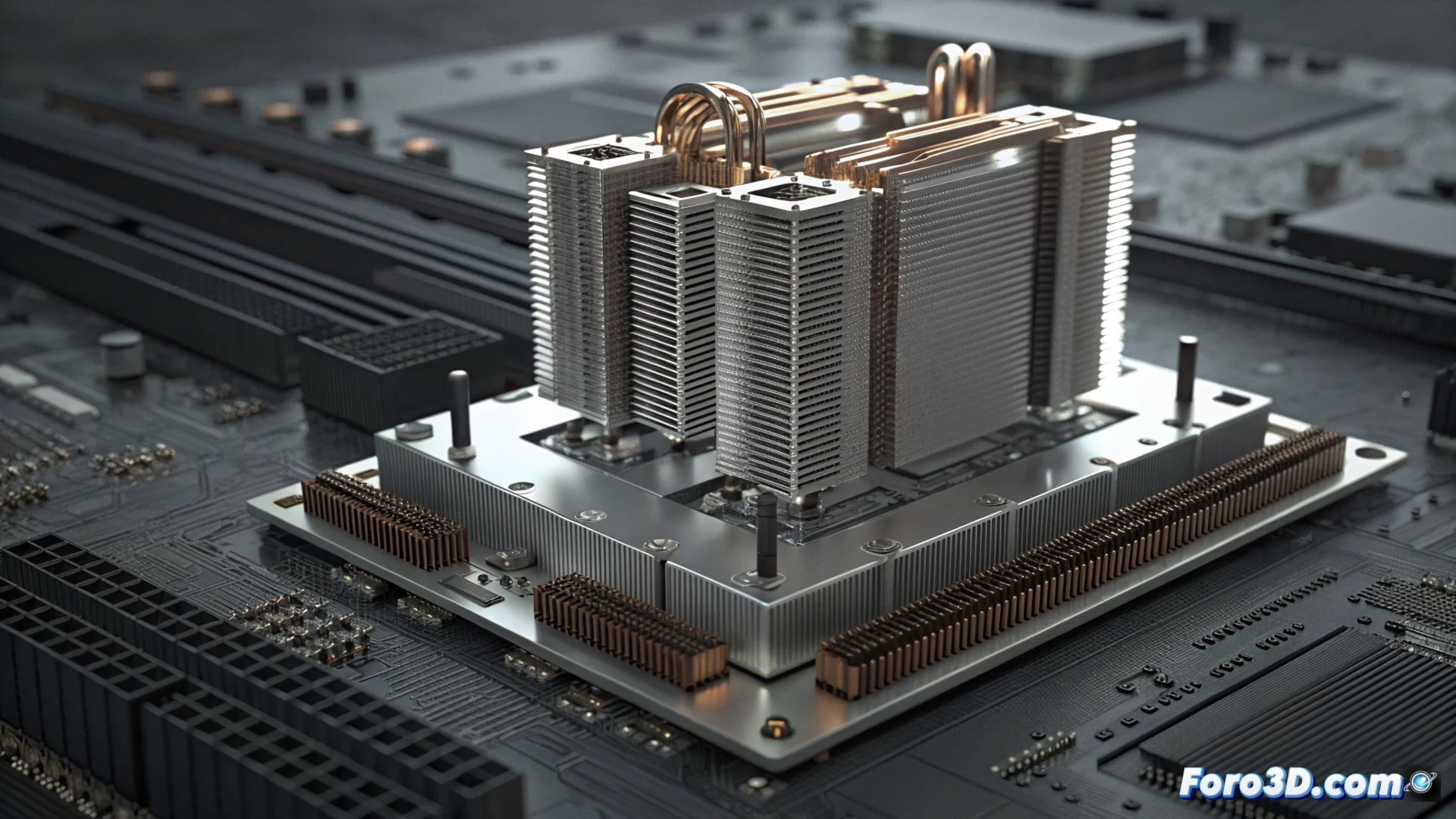
The Multiphase Voltage Regulator Module in AI Servers
At the core of any server running artificial intelligence workloads is a critical component: the multiphase voltage regulator module (VRM). Its mission is to transform the 12 volts supplied by the power source into the low voltage, often close to 1 volt, that modern processors need. This step is fundamental because CPUs and GPUs for AI can demand more than 1000 watts and their consumption changes violently in microseconds. Unstable voltage here causes errors, crashes, or reboots, putting complex and costly operations at risk. ⚡
Parallel Architecture to Handle Extreme Currents
The solution to the challenge of supplying so much power lies in the multiphase design. Instead of relying on a single conversion stage, the VRM deploys several identical phases that operate in parallel. A controller activates them sequentially and interleaved, which distributes the thermal and electrical load evenly. This method achieves several key objectives: it increases overall efficiency, reduces the heat generated by each individual phase, and allows the assembly to supply hundreds of amperes continuously and stably.
Key elements of each phase:- Digital controller: The brain that synchronizes the phases. Modern models allow real-time parameter adjustments to optimize system response.
- Power MOSFETs: Switches that must have very low on-resistance (RDS(on)) to minimize losses and the heat they generate.
- Inductor or coil: Filters the current. High-quality inductors are used, often with special alloy cores.
- Filter capacitors: Located near the processor, they absorb rapid load variations and provide instant reserve energy.
A deficient VRM in an AI server is comparable to trying to power a fusion reactor with a battery: the ambition is enormous, but the infrastructure collapses at the first real demand for energy.
Physical Design and Components for an Ultrafast Response
The quality of individual elements defines performance, but their integration on the motherboard is equally crucial. A robust physical design is essential to handle load transients, those instantaneous consumption changes that characterize AI processors.
Critical factors in VRM design:- Ground plane and power traces: A solid ground plane and wide, short power traces are implemented. This reduces impedance and parasitic inductance, which would otherwise degrade response speed.
- Capacitor selection: Solid polymer or tantalum capacitors are preferred for their low internal resistance (ESR) and ability to respond quickly.
- Thermal management: The heat generated is immense. Therefore, a massive heatsink, often passive or with forced ventilation, covers the entire VRM area to efficiently dissipate that heat and keep components within their safe operating range.
Electrical Stability as the Pillar of AI Computing
In summary, the multiphase VRM is much more than a simple voltage converter; it is the backbone of electrical integrity in a high-performance server. Ensuring clean and stable voltage under extreme dynamic loads is what allows CPUs and GPUs to execute complex artificial intelligence algorithms without failures. Investing in a robust VRM design with top-tier components is not a luxury, but an indispensable requirement for anyone seeking reliability and precision in the demanding world of AI processing. 🚀