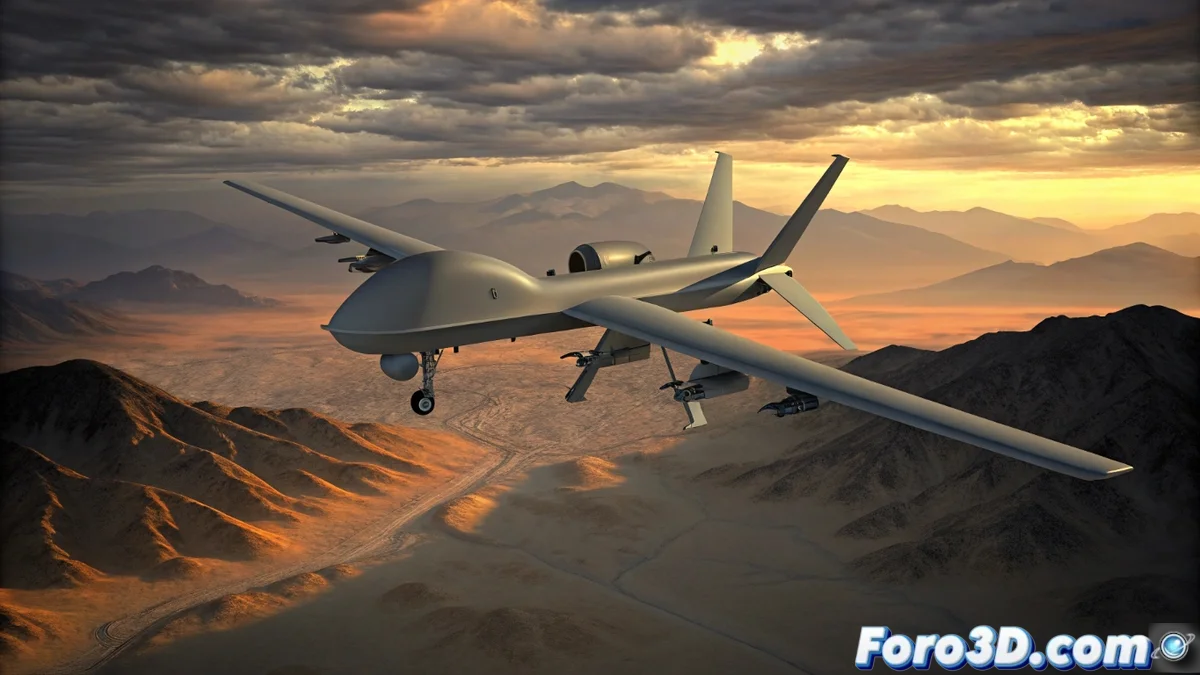
The MQ-9 Reaper: the quintessential MALE combat drone
In the landscape of modern military aviation, the MQ-9 Reaper has established itself as the most iconic unmanned combat aerial system for medium-altitude long-endurance (MALE) operations. Massively adopted by the United States and numerous allied nations, this UCAV (Unmanned Combat Aerial Vehicle) represents a qualitative leap forward from its predecessor, the MQ-1 Predator, offering vastly superior performance in power, operational range, and, crucially, lethal payload capacity. 🛩️
Advanced design and surveillance systems
The Reaper's architecture is immediately recognizable. With a wingspan exceeding 20 meters and a length of 9 meters, its profile is dominated by an inverted V-tail and a pusher propeller mounted at the rear. For optimized flight, it features a retractable tricycle landing gear. However, its most distinctive feature is the voluminous sphere on the nose, which houses the sophisticated AN/DAS-1 MTS-B sensor system. This multispectral suite, integrating electro-optical and infrared cameras, provides exceptional 24-hour observation capabilities, enabling target tracking and laser designation with great precision.
Key features of its design:- Aerodynamic configuration: Slim fuselage and straight high-aspect-ratio wings for high efficiency in long-duration flights.
- Propulsion system: Honeywell TPE331 turboprop engine that gives it a cruise speed exceeding 300 km/h and exceptional endurance.
- Ground control station: The aircraft is remotely piloted by a crew located thousands of kilometers away, operating through secure satellite links.
The Reaper redefines the concept of persistence on the battlefield, combining uninterrupted surveillance with immediate lethal response capability.
Firepower and mission flexibility
The Reaper's primary evolution lies in its formidable armament capacity. It has six hardpoints under the wings, allowing it to configure a versatile and lethal weapons load. This platform can act as a persistent sensor or transform, in minutes, into a precision attacker. Its typical arsenal is designed to counter a wide range of threats, from light vehicles to fortified infrastructure.
Main armament and roles:- AGM-114 Hellfire missiles: Up to four units for precise attacks against vehicles, structures, or personnel. They are the hallmark weapon of surgical strikes.
- Laser-guided bombs: Such as the GBU-12 Paveway II, ideal for targets requiring manual designation and maximum precision.
- GPS-guided precision bombs: Such as the GBU-38 JDAM, used against larger fixed targets with preprogrammed coordinates.
Impact and strategic considerations
The operation of the MQ-9 Reaper has profoundly transformed modern combat doctrines. Its ability to maintain persistent surveillance for more than twenty hours and execute an attack with extreme precision introduces total tactical disruption. However, this power brings complex ethical and legal dilemmas surrounding remote warfare, where the operator, after hours of meticulous observation, can decide the fate of a target with the simple push of a button from a continent away. Its legacy is that of a system encapsulating the paradox of 21st-century warfare: a tool of unprecedented intelligence and precision that also raises profound questions about the future of armed conflict. ⚖️