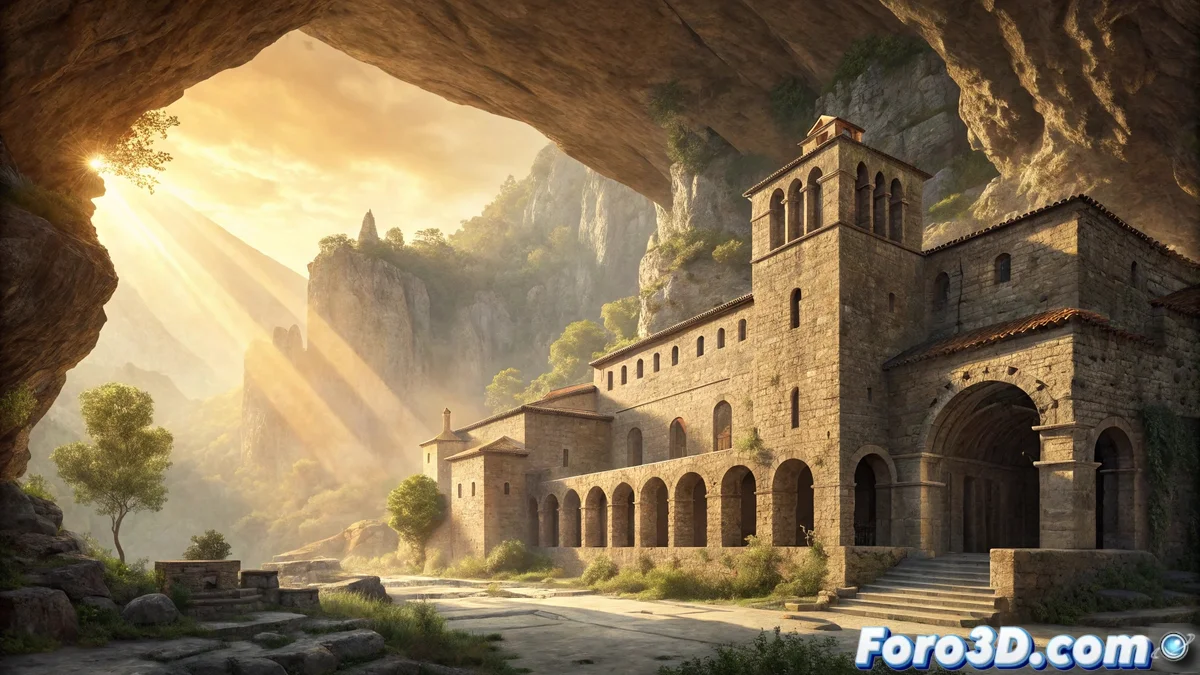
The Monastery of San Juan de la Peña and its Virtual Reconstruction in Cesium for Unreal Engine
The Monastery of San Juan de la Peña in Aragon represents one of the most emblematic monastic complexes of Spanish Romanesque, where in the mid-16th century, under the reign of Philip II, a monumental transformation towards the Renaissance style was conceived. This ambitious project sought to modernize the medieval facilities and turn them into a colossal complex that reflected the power and religious influence of the era, although it was ultimately truncated by various historical circumstances 🏰.
Historical Context of the Renaissance Project
The works on the Renaissance cloister began around 1575, directed by prominent architects of the time. The original plans included a two-story design with monumental arcades, elaborately carved capitals, and sculptural decoration that would have competed with the great European monasteries. However, after progressing only on foundations and some arcades, the project faced serious financial difficulties and was definitively abandoned around 1590, leaving a unique testimony of Aragonese Renaissance architecture and the limits of monastic power in 16th-century Spain 💔.
Key Aspects of Historical Development:- Start of works in 1575 with a two-story design and monumental arcades
- Definitive abandonment in 1590 due to economic crisis and changing priorities
- Cultural legacy as a symbol of the frustrated ambitions of the Spanish Renaissance
The visible archaeological remains today show the magnitude of what could have been one of the most imposing monastic complexes on the Iberian Peninsula.
Preparation of the Virtual Reconstruction Project
For the digital reconstruction in Cesium for Unreal Engine, it is essential to precisely configure the geographic coordinate system of the monastery. This involves importing the real terrain using LIDAR data and orthophotos of the area, ensuring topographic accuracy. The initial setup must establish the correct scale and metric unit system, along with the exact GPS coordinates of the historical site. It is recommended to create separate layers for existing and projected elements, facilitating the management of different construction states 🗺️.
Initial Technical Configuration:- Terrain import using LIDAR data and orthophotos for topographic precision
- Establishment of exact GPS coordinates and metric unit system
- Creation of separate layers for existing and projected elements
Modeling and Structure in Virtual Archaeology
The architectural modeling is approached through virtual archaeology techniques, using available historical references and archaeological studies. For the foundations and half-built structures, geometric modeling tools are used to show the incomplete state of the work. The Renaissance arcades are recreated using splines for the curves and extrusions for the pillars, maintaining the majestic proportions described in original documents. It is crucial to differentiate between documented built elements and hypothetical reconstructions based on 16th-century plans 🏗️.
Lighting, Materials, and Special Effects
The dynamic lighting of Unreal Engine recreates the lighting conditions of the natural rock environment, configured with the specific latitude and longitude. Materials for carved stones use PBR textures with normal and roughness maps that simulate erosion and the passage of time. For unfinished areas, shaders are applied that show different construction states, from rough stone to partially carved ashlars. Effects of invasive vegetation and temporal deterioration are implemented through the foliage system, distributing mosses and climbing plants in the abandoned areas 🌿.
Visual and Rendering Elements:- Dynamic lighting configured with specific geographic coordinates
- PBR materials with textures simulating erosion and construction states
- Foliage and particle effects to simulate abandonment and temporal deterioration
Final Rendering and Conclusions
The final rendering is optimized for the Cesium platform, using staggered levels of detail and streaming techniques that allow smooth visualization of the complete environment. The export includes dynamic shadow configuration and environmental reflections that reinforce the sensation of abandonment and truncated grandeur. This project demonstrates that unfinished works can teach us more about history than completed projects, especially when technology allows us to virtually complete what reality left halfway, offering a unique window into the past through digital reconstruction 🕰️.