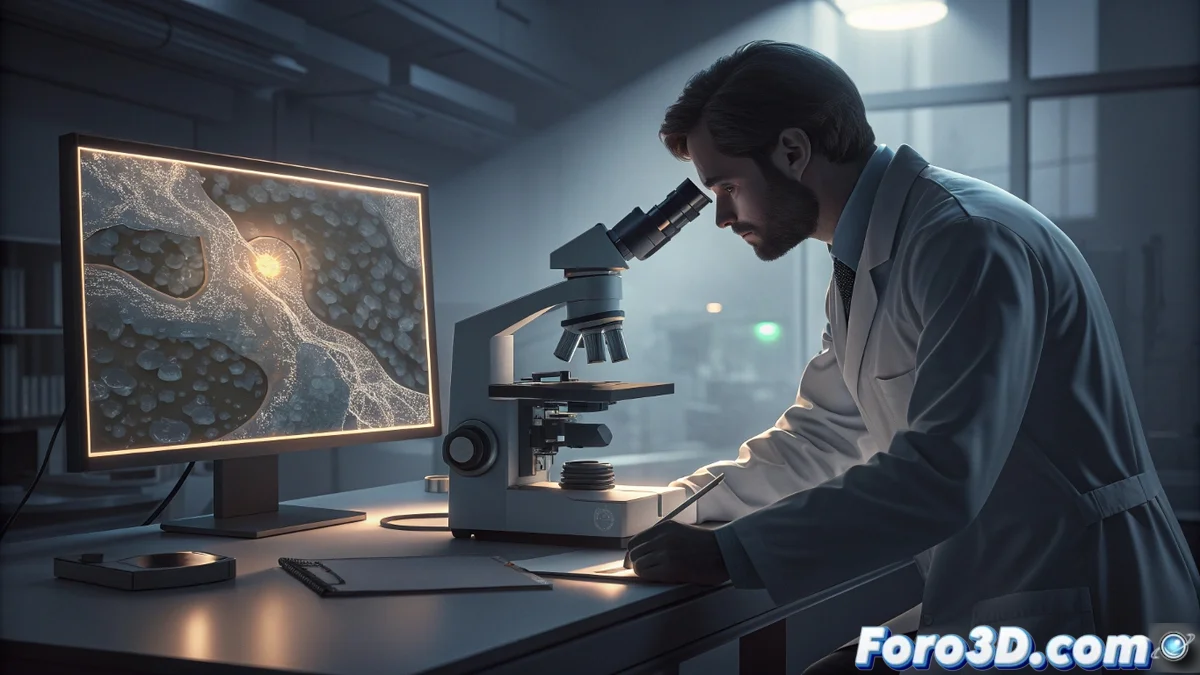
The Missing Sheet: Recovering Hidden Text with 3D Scanning
In an investigation, the missing page may contain the most valuable information. When tearing out a sheet, the pressure from writing leaves traces on the next page. These marks, invisible to the eye, hold the data that someone wanted to eliminate. Current technology allows recovering that content without damaging the physical medium, transforming seemingly lost evidence into key proof. 🔍
Capturing the Surface with Extreme Precision
The first step involves digitizing the paper's topography. For this, devices such as a 3D confocal microscope (e.g., Sensofar S neox) or a structured light scanner are used. These devices project light patterns onto the sample and, through algorithms, build a high-resolution digital three-dimensional model. This model records the slightest deformations in the fibers, accurately mapping the indentations left by the original writing. The method is completely non-invasive.
Key Advantages of the Capture Process:- Preserve Integrity: The system does not touch the physical evidence, allowing for other subsequent analyses.
- Record Micro-Deformations: Captures surface variations that are imperceptible to other methods.
- Generate a 3D Digital File: Creates an exact replica that can be studied, manipulated, and archived without limits.
The technology turns a simple blank sheet into key documentary evidence, revealing what was presumed lost.
Processing the Data to Reveal the Message
With the obtained 3D model, the next step is to process the data. Specialized programs like GOM ATOS or forensic software apply filters and adjust virtual lighting. This enhances the contrast between the indented areas and the flat surface of the paper. The algorithms are capable of isolating useful marks from the natural texture of the medium.
Main Software Functions:- Apply Filters and Enhancements: Improves the visibility of pressure marks to make them readable.
- Isolate Signal from Noise: Separates writing indentations from the paper's irregular texture.
- Generate a Clear Image: Produces a legible visual representation of the content written on the sheet above.
Limits and Practical Considerations
Although the technique is powerful, its success is not automatic. Effectiveness largely depends on the writing instrument used. If the writer used a felt-tip pen or has very soft handwriting, the pressure marks may be too faint to be recorded. Similarly, unclear writing, such as a doctor's prescription, poses an additional challenge for reconstruction algorithms. The human and material factor remains crucial. 🖊️