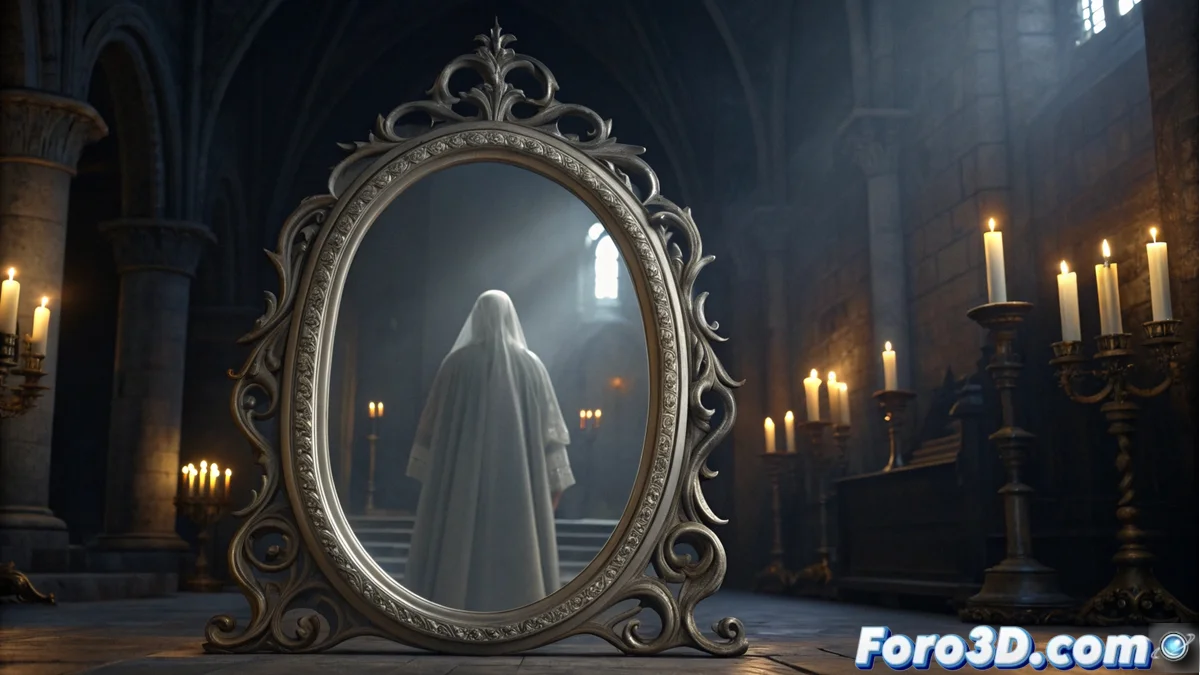
The Short Visit Mirror: History and Creation in Blender
The short visit mirror has its roots in the folkloric traditions of medieval Western Europe, where beliefs in enchanted objects were widespread. The earliest 14th-century manuscripts already mention household artifacts with supernatural properties, and this particular mirror stood out for its carved silver frame with protective symbols, created by artisans who mastered ancestral rituals. The need to keep it covered between uses suggests a safety mechanism to contain its potentially dangerous effects, adding an aura of mystery to its legend 🪞.
Historical Development and Evolution of the Mirror
During the Renaissance, references to the mirror multiplied in occult texts and inquisitorial records, enriched with details about the interdimensional entity that briefly appears behind the observer. In the 17th century, paranormal treatises documented cases of people who experienced the phenomenon, always following the pattern of a few seconds of reflection before the entity disappeared from the mirror and materialized in the real world. This evolution reflects how popular superstitions integrated into the early conceptualizations of the supernatural in Europe.
Key Features of the Mirror:- Silver frame with protective symbols carved by specialized artisans
- Condition of remaining covered between uses to control dangerous effects
- Reflection that omits the person and reveals a momentary entity behind
The short visit mirror represents a fascinating intersection between superstition and the paranormal, influencing gothic works and contemporary folklore.
Cultural Impact and Legacy of the Mirror
This artifact has left a deep mark on European culture, serving as an metaphor for the boundaries between the visible and the supernatural. Its legend inspired numerous 19th-century gothic literary works and remains a standout example of cursed objects in modern folklore. The concept of the reflection that omits the person but reveals what is behind has been analyzed as a cultural reflection on human perception and the invisible, highlighting how fear of the unknown manifests through everyday objects.
Relevant Cultural Aspects:- Influence on 19th-century gothic literature and horror stories
- Analysis as a metaphor for perception and supernatural reality
- Persistence in contemporary folklore as an emblematic cursed object
Project Setup in Blender
To recreate the mirror in Blender, start by setting up a new scene and deleting the default elements. Set the units to metric and adjust the color management to Standard for optimal realism in lighting. Create a camera with a focal length of 50mm and set the render engine to Cycles, leveraging its ray-tracing capabilities for precise reflections. Organize the scene into three main collections: mirror, environment, and entity, which will facilitate handling the elements during the creation process 🎬.
Initial Setup Steps:- Delete default elements and set metric units
- Adjust color management to Standard for realistic lighting
- Set up camera with 50mm focal length and Cycles render engine
Modeling and Structure of the Mirror
Model the mirror starting from a subdivided plane and apply the Subdivision Surface modifier to smooth the geometry. For the frame, extrude the edges of the main plane and use the Solidify modifier with a thickness of 0.1 units, adding medieval ornamental details using sculpt mode with brushes like Clay Strips and Crease. For the entity behind the character, create a basic human figure with altered proportions and apply the Displace modifier with a noise texture, giving it an ethereal and transitional appearance that reinforces its supernatural nature.
Essential Modeling Elements:- Subdivided plane with Subdivision Surface for the mirror base
- Frame created with Solidify and sculpted details with medieval brushes
- Entity modeled with Displace and noise texture for ethereal effect
Lighting and Materials for Supernatural Realism
Set up dim lighting using three strategic point lights: a main one from above with 300W intensity, and two 150W side fill lights each with warm color temperature. For the mirror material, create a shader with Principled BSDF, setting metallic to 1.0, roughness to 0.05, and specular to 0.9. Add an additional layer with a mix shader that combines the main reflection with a blue tint via color ramp, simulating antique glass. The entity requires an emission material with strength of 2.0 and gradual transparency using transparent BSDF mixed with principled volume, creating the characteristic fading effect 🌟.
Material and Light Setup:- Lighting with main point light and warm side fill lights
- Mirror material with Principled BSDF and mix shader for antique glass
- Entity material with emission and transparency for ethereal effect
Special Effects and Final Rendering
For the entity's disappearance effect, animate the object's visibility using keyframes at frame 120 (visible) and frame 130 (invisible), with ease in interpolation. Add an invisible plane behind the camera with a light path material that captures only the background reflection. In Blender's compositor, incorporate glow effects around the entity using the glare node with fog glow type. Render in 4K with 2048 samples, enabling denoising with OptiX and setting light paths to 12 transmissions for maximum quality in reflections, ensuring the final result is terrifyingly realistic and faithful to the mirror's legend.
Steps for Effects and Render:- Visibility animation with keyframes and ease in interpolation
- Use of invisible plane and glare node for glow effects
- 4K render with high samples and light paths settings
Final Reflection on the Project
This project demonstrates how the combination of folkloric history and advanced Blender techniques can bring legendary objects like the short visit mirror to life. From its medieval origins to its digital recreation, the mirror symbolizes how what we don't see reflected can be the most terrifying, a reminder to check every detail, like applying the correct materials, to avoid surprises in the final render. This guide not only teaches technical skills but also invites exploration of the intersection between art, history, and the supernatural in 3D design 🎨.