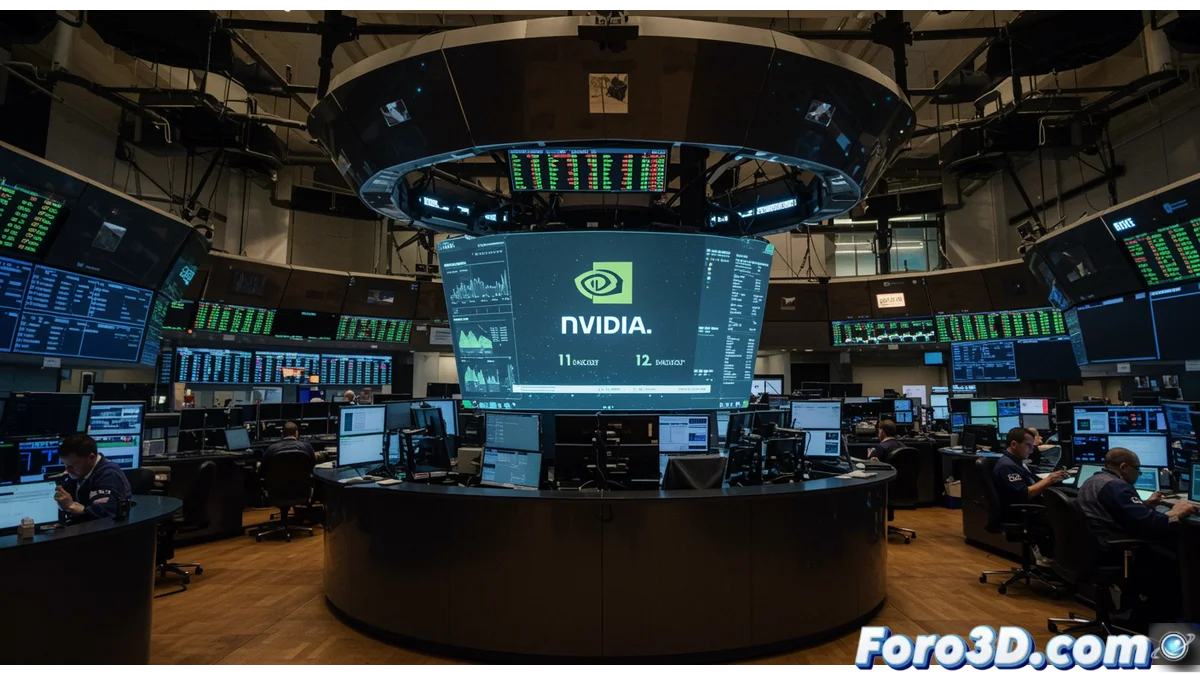
The market responds optimistically to the US lifting restrictions on Nvidia H200 in China
The decision by US authorities to lift the limitations on exporting Nvidia H200 accelerators to China has generated a wave of favorable reactions in the technology sector. This measure alleviates immediate commercial tensions in a key segment and allows companies to plan with greater certainty their medium-term strategies. 🚀
A broader commercial horizon for manufacturers
For companies that design and produce hardware, access to the Chinese market is fundamental. Being able to sell systems based on the H200 architecture without significant obstacles opens up a very substantial revenue channel. This change not only benefits Nvidia, but also its entire supply chain and the partners that integrate these components into their final solutions. The sector perceives a lower risk of further fragmentation of the global semiconductor ecosystem.
Direct impacts of the measure:- Companies can benefit from the AI boom without completely isolating a market of great magnitude.
- Logistics and development operations are simplified for specialized component manufacturers.
- Pressure on the global supply chain is reduced, allowing a more stable flow of technology.
Being able to offer platforms with the most powerful accelerators without specific and limited product lines simplifies operations and reduces costs.
Expanding opportunities for system integrators
Providers of servers and data center solutions are among the most enthusiastic. China represents a huge portion of global demand for high-performance computing and artificial intelligence infrastructure. This regulation allows them to equip platforms with the most advanced technology without having to develop limited regional variants, which could accelerate AI deployments in the Asian country. 💻
Key advantages for integrators:- Access to a massive market without the need to produce specific versions of hardware for a region.
- Significant reduction in development, inventory, and support costs.
- Ability to respond more agilely to China's growing demand for computing power to train AI models.
The technological truce and its uncertain future
While part of the sector celebrates this opening, another wonders how long this truce will last in the technological war between powers. There is doubt about whether the next generation of chips will again be under the scrutiny and restrictions of regulators. The geopolitics of semiconductors proves to be a field where rules can be rewritten with each new advance, maintaining a scenario of strategic uncertainty for companies that depend on these components. The balance between commercial collaboration and national security remains fragile. ⚖️