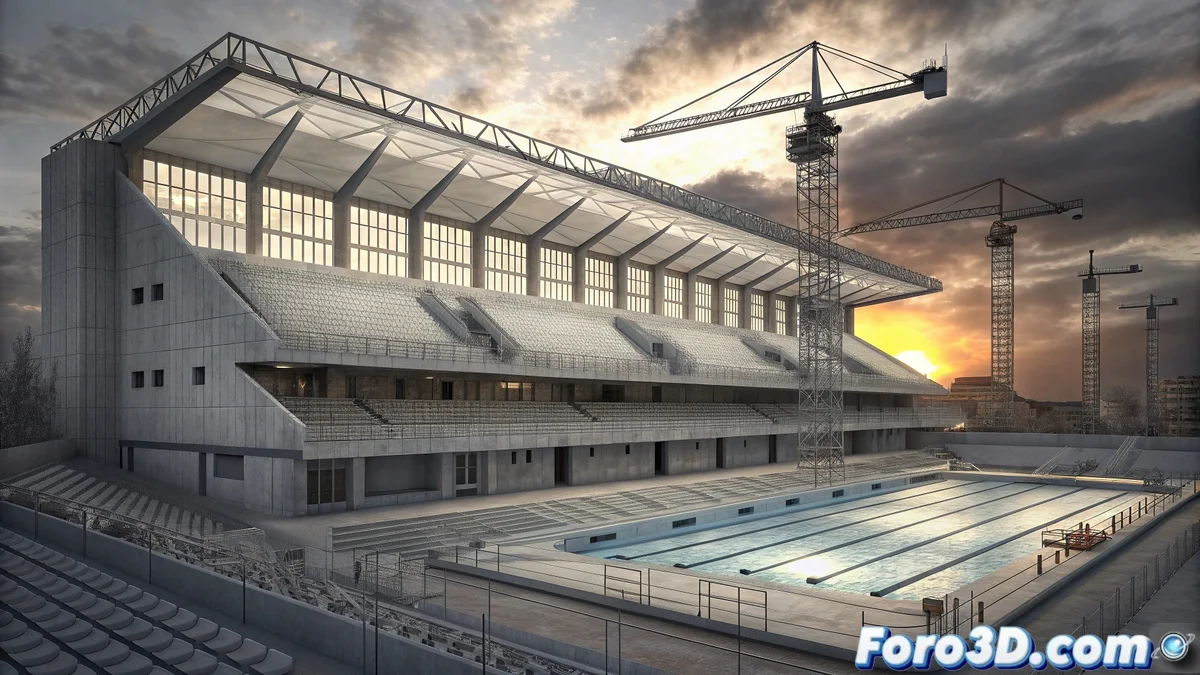
Madrid's Olympic Aquatic Center: An Architectural Giant Without Purpose
The Aquatic Center designed for Madrid's Olympic bids stands as an architectural colossus that never saw its elite destiny fulfilled. Although largely constructed, the repeated failure of the Olympic bids left this structure without the competitive use for which it was specifically conceived. Its imposing facilities and avant-garde designs remain underutilized, with incomplete exterior elements creating an atmosphere where sporting excellence blends with institutional abandonment 🏊♂️.
A Visionary Project Without an Olympic Stage
This complex was developed under the most demanding international standards, integrating cutting-edge technology in purification, climate control, and timing systems. Its pools rigorously comply with FINA regulations for high-level competitions, featuring seating for thousands of spectators and fully equipped press areas. The center's innovative architecture, characterized by undulating roofs and translucent facades, sought to represent the dynamism of an Olympic Madrid, although currently these same features highlight its status as an unfinished work.
Key Features of the Complex:- State-of-the-art filtration and climate control systems
- FINA-homologated pools for international competitions
- Stands with massive capacity and complete press zones
While other nations compete to build Olympic facilities, Madrid possesses a perfectly operational one awaiting a purpose, like an elite athlete preparing for a contest that never occurs.
The Legacy of a Missed Opportunity
Despite its state of semi-abandonment, the center has managed to implement alternative uses as a municipal facility, hosting local sporting events and community aquatic activities. However, the contrast between its Olympic potential and its everyday reality is evident, particularly in spaces like the main pool, whose architectural grandeur still seems to await the presence of elite swimmers. Maintaining the complex involves a considerable cost for public finances, sparking periodic discussions about its definitive repurposing or potential demolition.
Controversial Aspects of the Center:- Costly maintenance funded with public money
- Recurring debates about repurposing or demolition
- Current use as a municipal facility versus its original elite design
Final Reflections on an Urban Symbol
The Madrid Olympic Aquatic Center remains as a tangible reminder of unfulfilled aspirations, where architectural excellence coexists with practical underutilization. Its history illustrates the fragile balance between ambitious urban planning and political and sporting realities, raising questions about the future of large infrastructures conceived for events that never materialize 🏗️.