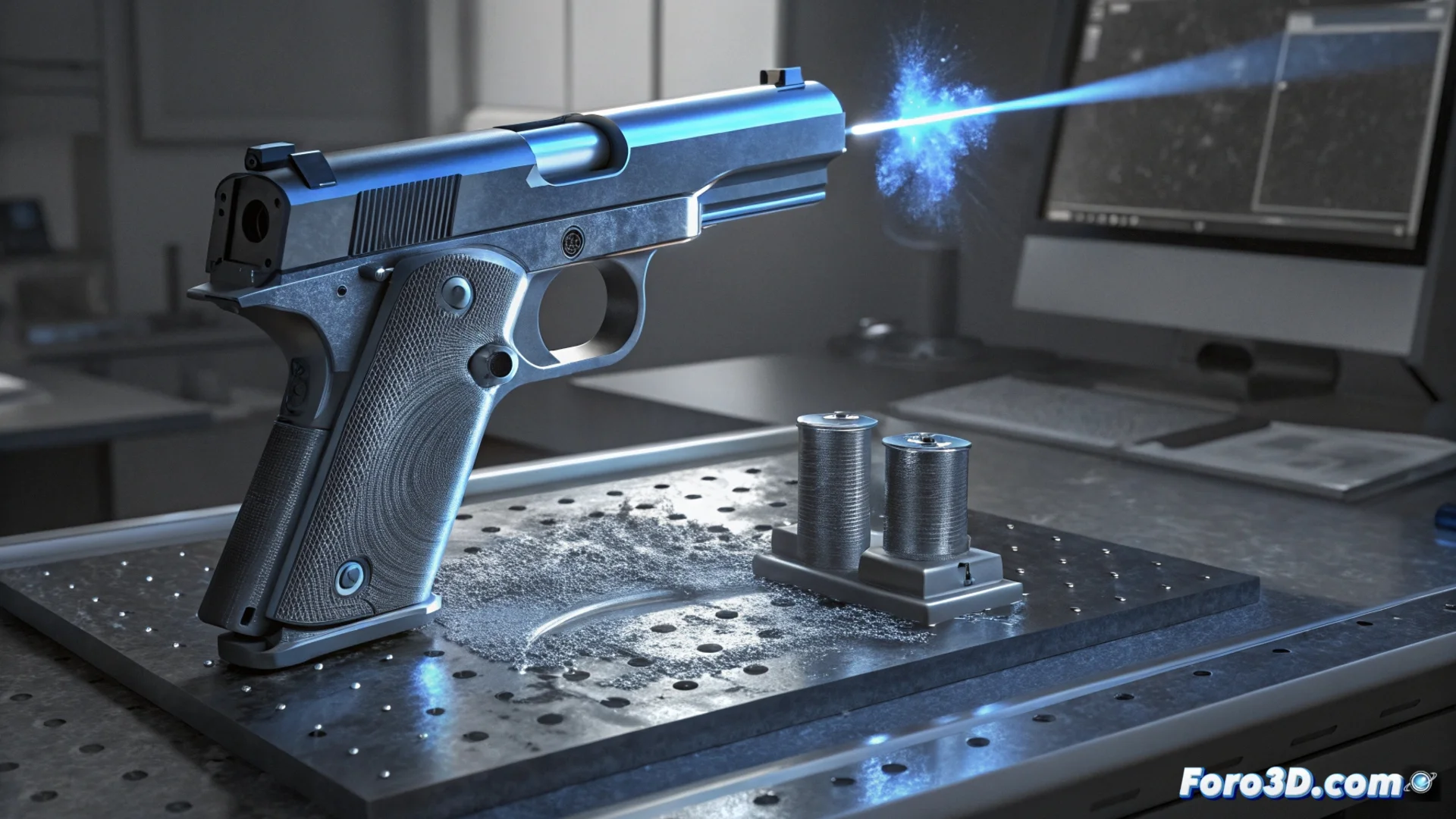
The Machining Fingerprint Identifies Ghost Guns with 3D Metrology
So-called ghost guns, manufactured without a serial number, pose a challenge for law enforcement. However, the technology that produces them also leaves an inadvertent clue. High-precision 3D metrology has become a key tool for tracing their origin, by analyzing the unique signature imprinted by each machine tool. 🔍
Capturing the Invisible Manufacturing Signature
During the process of manufacturing a gun on a CNC milling machine, the cutting tool leaves a series of striations, micro-grooves, and vibration marks on the metal. This pattern is microscopic and varies between machines and even between different tools, functioning as an intrinsic machining fingerprint for each produced piece.
Process to register the fingerprint:- The critical surface of the gun, such as the receiver block, is scanned with a high-resolution 3D scanner (e.g., GOM ATOS, Creaform MetraSCAN).
- The device projects structured light fringes and captures the geometry with micrometric precision.
- A dense point cloud is generated and converted into an exact 3D digital model, which encodes the complete surface texture.
The machine that intends to leave no trace actually signs every piece it produces.
Analyze and Compare to Link the Origin
The obtained 3D model is processed with specialized metrology software, such as GOM Inspect. Experts isolate areas of interest to measure specific machining parameters, such as the direction of the striations or their depth.
Keys to forensic analysis:- The principle of ballistic comparison is adapted, but applied to manufacturing marks instead of firing marks.
- A database is created and maintained with the fingerprints of seized guns and intervened CNC machines.
- By comparing the ghost gun's pattern with the database, a statistical link can be established with a specific illegal workshop or production batch.
The Technological Paradox That Aids Investigation
This method transforms an advantage for the clandestine manufacturer into their weak point. The same CNC technology that allows anonymous gun production is the one that leaves an inherent and impossible-to-completely-eliminate signature. 3D metrology thus provides a solid forensic line of investigation based on physical evidence, crucial for dismantling illegal production networks. The precision that manufactures also identifies. ⚖️