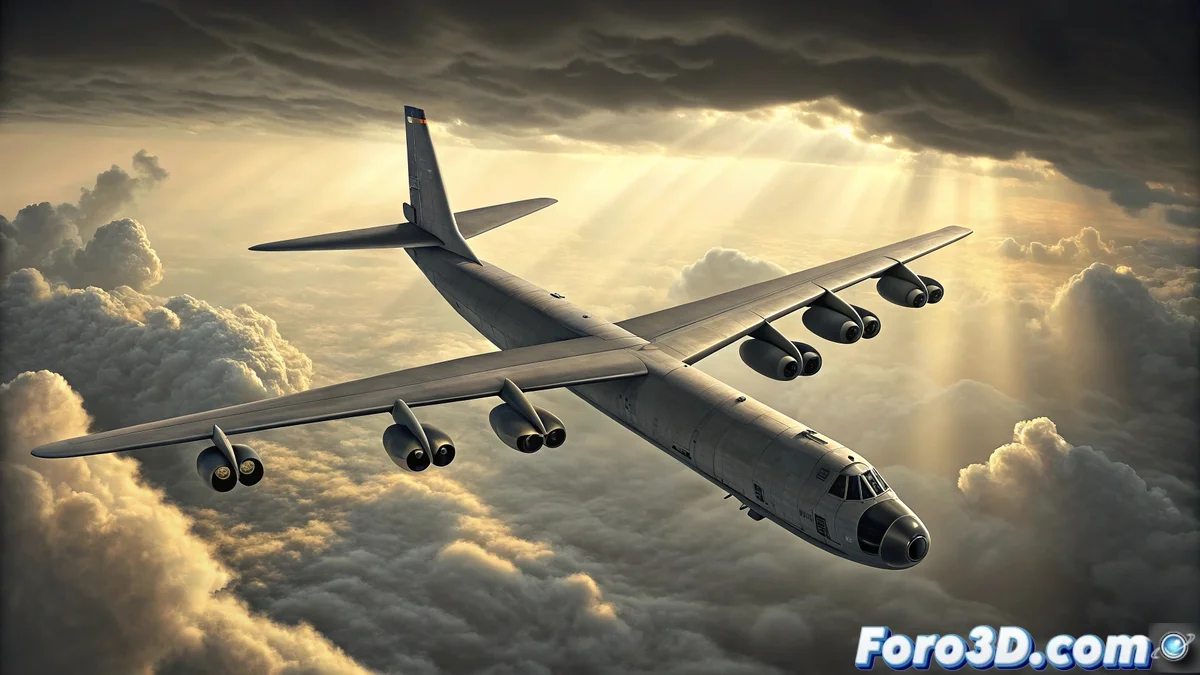
The Legendary B-52 Stratofortress: Technical Analysis and Characteristics
The B-52 Stratofortress represents one of the longest-serving strategic bombers in military history, maintaining continuous operational status since the 1950s. Its impressive technical specifications and adaptability have made it an icon of global strategic aviation ✈️.
Dimensions and Structural Capabilities
With a wingspan of 56.4 meters and a length of 48.5 meters, this aerial colossus features a configuration optimized for long-range missions. Its structure reaches 12.4 meters in height and can operate at altitudes up to 15,000 meters, allowing it to overcome adverse atmospheric conditions. The empty weight of 83,000 kg contrasts with its maximum takeoff capacity of 219,600 kg, demonstrating its structural robustness 💪.
Key Dimensional Characteristics:- Wing Span: 56.4 meters for optimized lift
- Elongated Fuselage: 48.5 meters total length
- Operational Height: 12.4 meters to the tail
- Maximum Takeoff Weight: 219,600 kilograms
A design that defies time, as if determined to keep flying until pilots need sunglasses to read the original flight manuals
Propulsion Systems and Range
The powerplant incorporates eight TF33 turbofan engines in an H configuration, providing the necessary power for transcontinental flights. Its internal fuel tank stores approximately 141,600 kg, guaranteeing exceptional strategic range without requiring refueling during extended missions 🛢️.
Propulsion Elements:- Eight TF33 turbofan engines in H variants
- Fuel Capacity: 141,600 kilograms
- Maximum Operational Ceiling: 15,000 meters altitude
- Strategic range for deep incursions
Armament Configuration and Aeronautical Design
The B-52 integrates a spacious internal bomb bay combined with multiple external hardpoints for various types of armament, including conventional and nuclear options. Its characteristic design features four double-engine nacelles under the wings, an extensive horizontal stabilizer, and a high vertical tail that ensure stability during flight 🎯.
Design and Armament Characteristics:- Spacious internal bay for diversified payload
- External pylons for long-range missiles
- Configuration of four double-engine nacelles
- High vertical tail for directional control
- Multiple access points for efficient maintenance
Operational Legacy and Versatility
This strategic bomber has demonstrated extraordinary versatility through decades of continuous service. Its capacity for rapid reconfiguration for different operational roles and adaptability to modern technologies explain why it continues to be a fundamental asset in contemporary military aviation 🛡️.