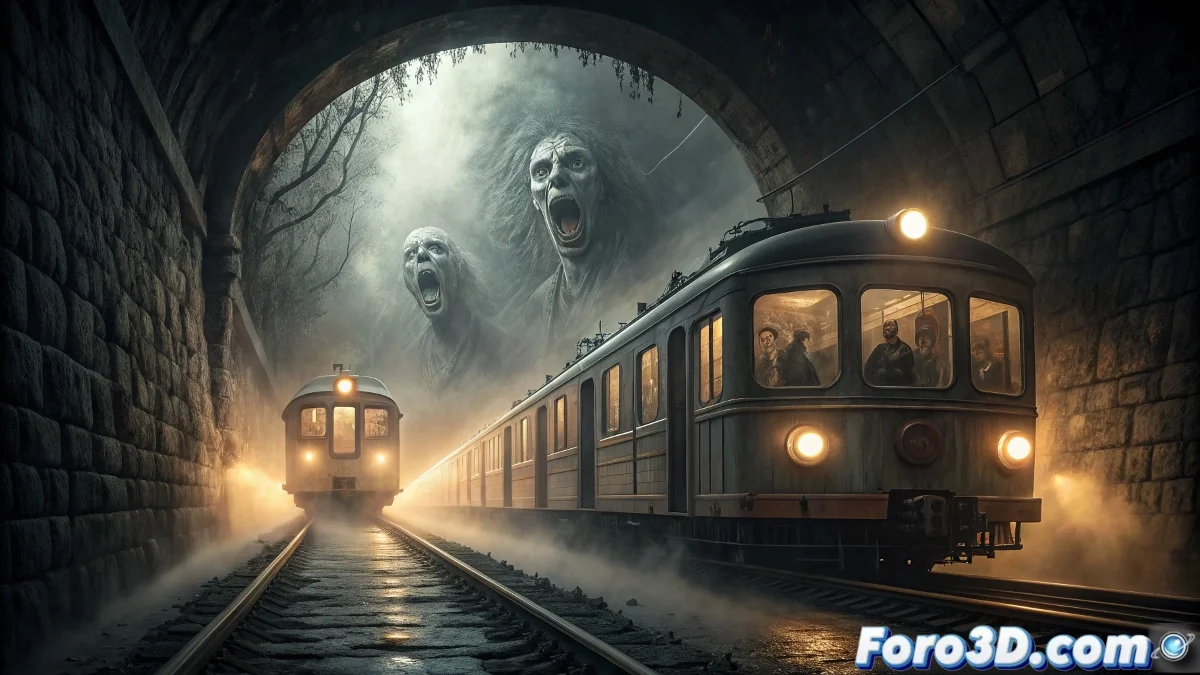
The Legend of the Train Mirror Tunnel and Its Digital Representation
The mysterious story of the mirror tunnel originated in the 1960s in Eastern Europe regions, specifically in an abandoned railway passage connecting Poland with the Czech Republic. The first testimonies came from freight train engineers traveling secondary routes at night, who reported encounters with an exact replica of their own convoy moving in the opposite direction, despite the track being one-way with no branches. Authorities initially dismissed these reports as extreme fatigue or optical illusions. 👻
Historical Evolution and Chilling Testimonies
During the 1970s, the accounts multiplied and included occasional passengers traveling in special convoys. The descriptions became more precise and consistent in a chilling detail: at the moment of crossing inside the tunnel, the lights from both trains illuminated the faces of the occupants of the mirror train, showing identical versions of themselves but with expressions of absolute panic or, in more disturbing cases, with decomposing facial features. This phenomenon, known as the doppelgänger train, became deeply rooted in local communities. 🚂
Key aspects of the legend:- Origin in secondary tracks of Eastern Europe during the 1960s
- Testimonies from drivers and passengers about encounters with exact replicas
- Consistent descriptions of terrifying faces in the reflections
The mirror tunnel symbolizes the collective fears of an era marked by the Cold War and the duality of identities.
Cultural Impact and Legacy in Folklore
This legend became a pillar of railway folklore in Eastern Europe, representing the region's deep fears during a period of geopolitical tensions. It has inspired numerous literary works, horror films, and documentaries on paranormal phenomena. For experts in popular traditions, the myth embodies fears about identity, duality, and parallel realities. The real tunnel was closed to traffic in 1992, but it remains a pilgrimage site for paranormal enthusiasts. 📚
Highlighted cultural elements:- Inspiration for literary and cinematic horror works
- Symbol of collective fears during the Cold War
- Site of interest for researchers of inexplicable phenomena
Project Preparation and Initial Setup in Adobe Illustrator
To recreate this scene, open Adobe Illustrator and create a document in 4K resolution (3840x2160 pixels). Set the workspace to advanced mode to access all illustration tools. Establish a color palette based on cool tones like deep blues, metallic grays, and intense blacks, reserving warm accents for the train lights. Organize the workflow using separate layers for the tunnel, the main train, the mirror train, and special effects. 🎨
Essential setup:- 4K document with advanced workspace mode
- Cool color palette with warm accents for the lights
- Organized layers for each composition element
Modeling and Scene Structure
Use vector shape tools to design the tunnel's geometric structure, emphasizing a perspective that narrows toward the vanishing point. Develop the train model based on mid-20th century European railway designs, incorporating distinctive details like circular headlights and rectangular windows. Meticulously duplicate this model to create the mirror train, ensuring perfect symmetry between both. Add worn rails and eroded stone textures on the tunnel walls to increase realism. 🏗️
Modeling elements:- Tunnel structure with converging perspective
- Train model inspired by historical European designs
- Detailed textures for rails and eroded walls
Lighting, Materials, and Atmospheric Effects
Apply a dramatic lighting scheme where the only light source comes from the headlights of both trains, creating intense contrast between illuminated areas and the tunnel's deep shadows. Use adjustment layers to control light intensity and direction. Develop aged metallic materials for the trains and wet stone surfaces for the tunnel interior. Experiment with opacity and blending modes to simulate smoke and mist enveloping the convoys, adding an unsettling atmosphere. 💡
Lighting and materials techniques:- Focused lighting from the trains' headlights
- Aged metallic materials and wet stone surfaces
- Smoke and mist effects using blending modes
Special Effects and Final Rendering Process
Implement motion blur effects on the image edges to convey a sense of speed. Create a special layer for the crossing moment, applying subtle distortion filters and duplicating the passenger windows to show altered expressions. Use digital painting tools to incorporate facial decomposition details in the reflections, balancing subtlety and impact. Finalize with a high-resolution render, applying cinematic color adjustments and high contrast to enhance the drama. This project demonstrates that sometimes the most terrifying journey is not to your destination, but to your own reflection in the darkness. 🌌
Final rendering steps:- Application of motion blur and distortion filters
- Inclusion of altered facial details in the reflections
- High-resolution rendering with cinematic adjustments