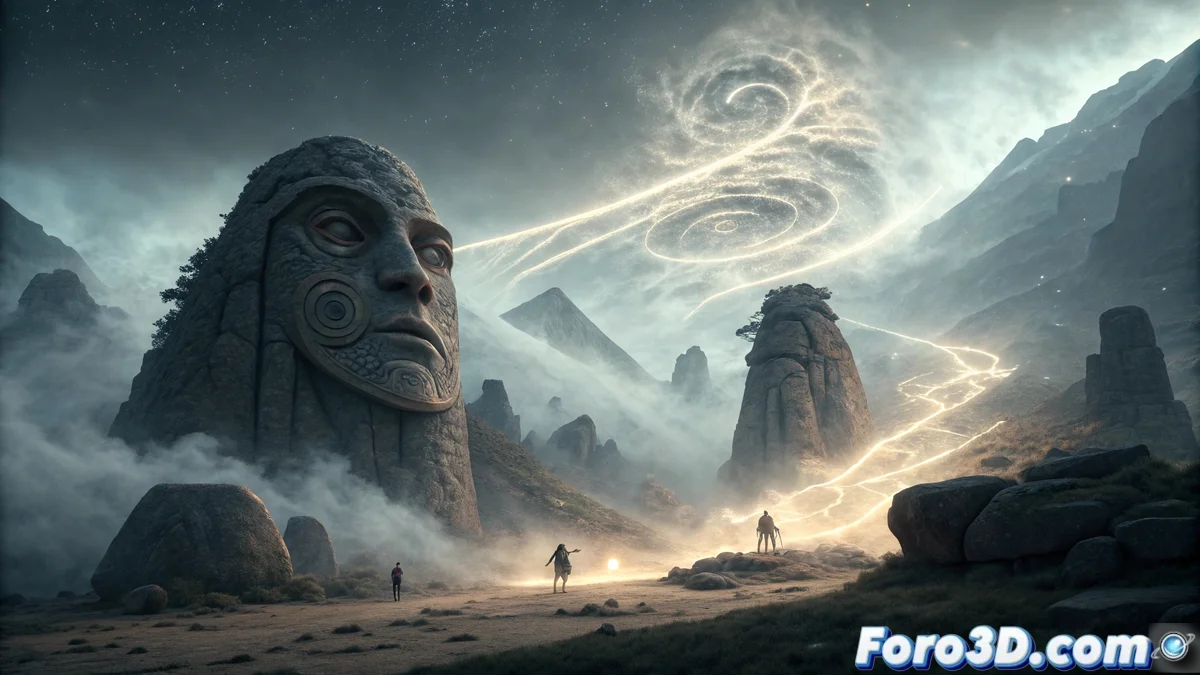
The Legend of the Speaking Wind and Its Representation in Blender
Andean ancestral traditions preserve the mystery of a unique atmospheric phenomenon: the wind that whispers hidden truths to those who traverse the highest mountain passes. This belief, first documented by Quechua and Aymara shepherds during their seasonal migrations, describes encounters with air currents that articulate almost intelligible words, functioning as messengers of the mountains considered living entities 🏔️.
Historical Evolution of the Phenomenon
The arrival of European explorers in the 19th century marked a turning point in the documentation of these experiences. Professional mountaineers during the 20th century reported similar cases in ascents to Aconcagua and Huascarán, where the wind revealed intimate information about expedition companions that was impossible to know by conventional means. During the 1970s, several mountaineering groups recorded situations where these revelations caused irreconcilable conflicts, reinforcing the belief in the price the mountain demands for sharing its secret knowledge.
Most Impactful Documented Cases:- 1972 French expedition to Aconcagua where the wind revealed infidelities among team members
- 1978 German rescue group that abandoned the mission after hearing predictions about their own fate
- 1985 anthropological research that recorded 23 coherent testimonies among separated communities
Mountains not only harbor secrets, but carefully choose those who deserve to hear them - Anonymous, Andean guide
Technical Preparation in Blender
Recreating this mystical atmosphere requires meticulous setup in Blender. We begin by establishing metric units and a cinematic 16:9 aspect ratio, with color management in Filmic mode to capture the wide dynamic range of mountain lights and shadows. The camera with a 35mm lens provides a natural perspective, while the clipping distance adjustment allows handling the extensive distances characteristic of the Andean cordilleras.
Scene Organizational Structure:- "Terrain" collection for mountainous geometry and rock formations
- "Atmosphere" collection for volumetric effects and particles
- "Narrative elements" collection for components that reinforce the legend
Development of the Mountainous Environment
The terrain modeling uses the A.N.T. Landscape add-on with alpine settings to generate realistic peaks. Applying a displace modifier with a musgrave texture adds authentic geological details to the rock walls. Sculpt mode with brushes like clay strips and crease allows creating the eroded formations characteristic of mountain passes where the speaking wind phenomena occur.
Lighting and Materials System
The cinematic lighting is based on HDRI with high mountain cloudy skies that provide diffuse and dramatic light. A main sun light with cold color temperature (6500K) simulates high-altitude lighting, complemented by low-intensity fill lights that define the rock forms without eliminating deep shadows. Materials use the principled BSDF shader with variable roughness and subtle subsurface scattering for the rocks, combining multiple noise textures with color ramps for wind-eroded surfaces.
Advanced Materials Configuration:- Blend of glossy shaders with controlled translucency for snowy areas
- Procedural textures for advanced wind erosion simulation
- Bump and displacement nodes for micro-details on rock surfaces
Special Effects of the Speaking Wind
The recreation of the legendary phenomenon uses the particle system with hair emission that simulates snow and dust particles carried by specific air currents. The animation of these particles follows curve objects that define turbulent flow patterns around strategic rock formations. Volumetrics through principled volume shader in a domain box covering the entire scene create the sensation of thin high-mountain air with very low but effective density.
Final Rendering and Reflections
The rendering process in Cycles uses 2048 samples with OptiX denoising and light paths adjusted to efficiently handle volumetric effects and particles. The irony of using a silent software like Blender to represent a speaking wind is not lost on experienced digital artists, creating a powerful metaphor about the relationship between technology and oral tradition 🎨.