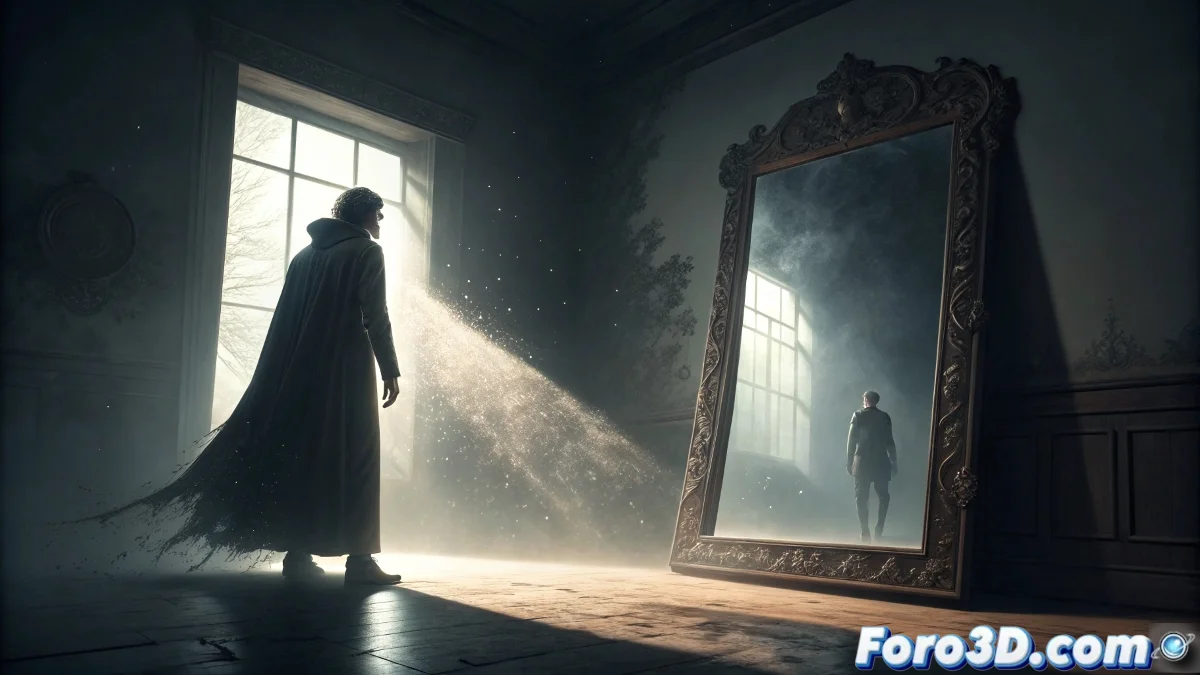
The Legend of the Shadow Leaving the Mirror: Digital Folklore and 3D Creation
This unsettling contemporary urban legend emerged in Asian forums during the 90s, describing how our reflection can come to life and detach from the mirror during states of deep distraction. The phenomenon gained global popularity through digital horror platforms, evolving from simple anecdotes to complex narratives with devastating psychological consequences 👻.
Historical Evolution and Cultural Significance
The original narrative underwent a fascinating transformation as it spread across the internet, incorporating modern anxieties about identity and technology. Initial Japanese versions simply described a silhouette leaving the reflection, but Western iterations added elements of extreme bad luck and loss of personal identity. This evolution reflects deep concerns about alienation in the digital age and the fragility of self-perception.
Key Development Points:- First reports in Japanese and Korean online communities (1995-1998)
- Expansion to Western platforms via paranormal forums and Creepypasta
- Incorporation of psychological elements about the doppelgänger and the reflected soul
Our reflection remains the most unsettling neighbor, especially when it decides to move out without notice - Anonymous, digital horror forum
Technical Implementation in 3D Environments
Recreating this legend requires advanced modeling and animation techniques. We begin by setting up the scene in centimeters for maximum precision, establishing the world coordinate system and gamma settings for linear LUT. Layer organization is crucial for handling complex elements like the animated shadow and special effects ✨.
Essential Workflow:- Unit setup in centimeters and world coordinate system
- Creation of organizational layers: mirror_frame, animated_shadow, ambient_lighting
- 16:9 reference plane for cinematic composition
Modeling and Scene Structure
The mirror frame is modeled using splines with bevel profile for ornamental details, applying shell modifier for volume. The reflective surface uses an optimized plane. For the animated shadow, we create low-poly geometry with a morpher modifier that allows transition from a flat form adhered to the mirror to an independent three-dimensional figure 🎭.
Lighting System and Materials
We implement three-point lighting with soft key light from the upper angle, dim frontal fill light, and back light for visual separation. V-Ray materials for the mirror employ near-perfect reflectivity with 0.1 bluriness for optical realism. The shadow requires an animated opacity map material that simulates its metamorphosis from reflection to autonomous entity.
Advanced Materials Setup:- Near-perfect reflectivity with slight 0.1 bluriness for the mirror
- Animated opacity map with falloff map and gradient ramp for the shadow
- Material combinations to simulate transition from reflection to entity
Special Effects and Final Rendering
For the detachment effect, we implement particle flow simulating broken mirror dust emitted from the frame edges. The volumetric light atmosphere creates luminous rays that interact with the emerging shadow. We set up separate render passes for reflection, shadows, and depth, allowing precise adjustments in post-production 🎬.
Legacy and Final Reflections
This digital legend demonstrates how modern societies reinterpret ancestral fears through new media. Its persistence in contemporary culture and influence on cinematic productions and video games confirm that the doppelgänger archetype remains deeply relevant. By recreating it in 3D, we not only explore advanced visual effects techniques but also connect with universal anxieties about identity and perception in the era of hyperconnectivity 🌐.