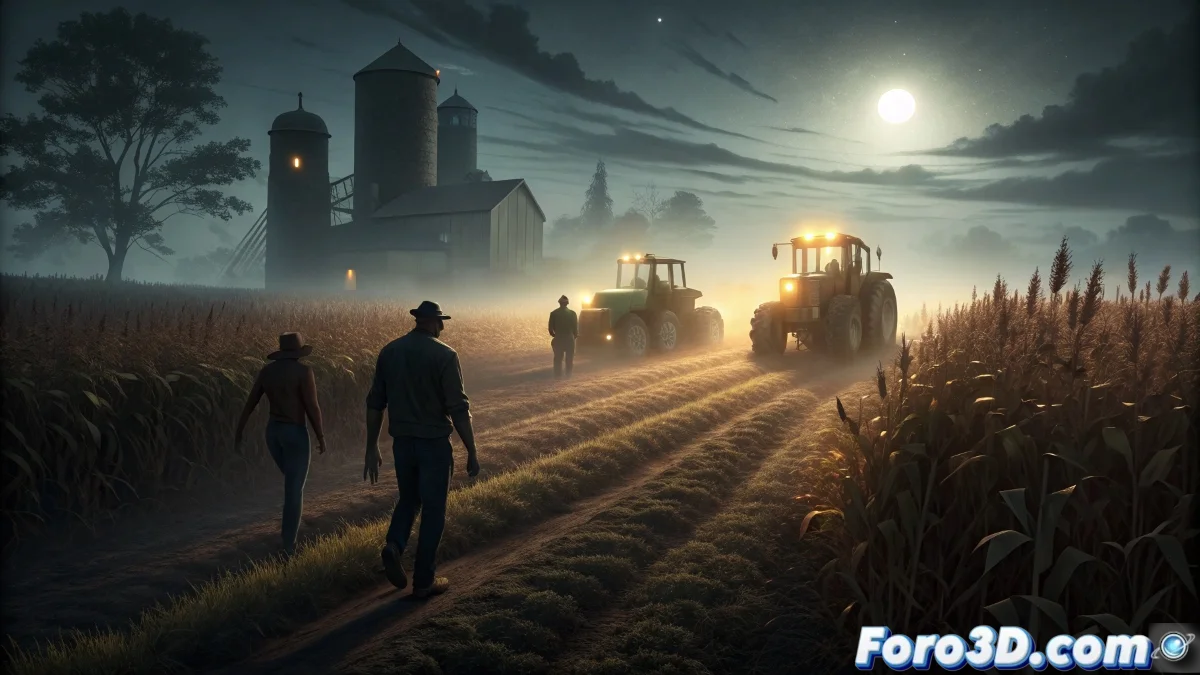
The Legend of the Shadow Harvest in Blender
The mysterious legend of the shadow harvest originated in the vast rural areas of Canada during the 1920s, when farmers reported inexplicable visual phenomena after working at night under the autumn full moon. These accounts described shadows that elongated unnaturally and acquired a density that defied all optical logic, inspiring this tutorial to recreate the atmosphere in Blender 🌙
Origins and Evolution of the Myth
As the 20th century progressed, the testimonies diversified geographically and gained in complexity. Witnesses claimed that the shadows seemed to detach from the ground and move autonomously, prowling exclusively over freshly harvested fields from dusk until dawn. The Canadian oral tradition preserves detailed accounts from peasants who swore they had witnessed this strange luminous behavior.
Main characteristics of the legend:- Shadows with anomalous length and visual density that defy optical principles
- Independent movement and preference for freshly worked crop areas
- Attributed ability to erase the dreams of those who contacted them
This visual representation demonstrates that sometimes the most terrifying shadows are not the ones we cast, but the ones that cast us.
Cultural Influence and Agricultural Practices
The most disturbing aspect of the myth—the supposed ability of these shadowy entities to erase dreams—became a warning passed down through generations of farmers. This belief directly impacted cultivation practices, leading many to completely avoid nighttime work after the main harvest. The legend represents a fascinating intersection between rural folklore and human psychology, reflecting ancestral fears about the loss of the ability to dream and the spiritual connection with the land.
Initial Project Setup in Blender
We begin by setting up Blender for a realistic nocturnal scene using the Cycles render engine. We establish 4K resolution with a cinematic 16:9 aspect ratio. We create an extensive base plane to simulate the agricultural field and adjust the ambient lighting to very low levels. We prepare separate render layers for main shadows, particle effects, and atmospheric elements that we will composite later 🎭
Essential technical preparations:- Nocturnal scene setup with minimal ambient lighting
- Preparation of render layers for later compositing
- 4K render dimensions with 16:9 cinematic ratio
Modeling and Element Arrangement
We model a tractor and grain silos using polygonal modeling techniques with sufficient geometric detail to generate complex shadows. We strategically distribute these elements in the field to create visually appealing compositions. We add basic geometry representing the traces left by the harvest and apply a displacement modifier with a noise texture to generate natural irregularities in the terrain that influence shadow projection.
Lighting System and Materials
We set up the moon as the main light source using an emission object with moderate intensity and pale blue tone. We place secondary lights strategically to accentuate the effect of elongated and dense shadows. We develop materials for the ground with minimal reflectivity but specific response to moonlight. We create shaders for metallic structures that capture the cold character of nighttime light while preserving details in shadow areas 🌌
Key lighting elements:- Emissive object simulating the moon with pale blue color
- Strategic secondary lights for elongated shadows
- Materials with low reflectivity but specific response to moonlight
Special Effects and Rendering Process
We implement particle systems to simulate shadow detachment using planes with transparent shadow materials that are animated. We use the compositor node editor to manipulate the rendered shadows, increasing their contrast and density. We apply controlled motion blur effects to the animated shadows to suggest their ethereal nature. We set up separate render passes for shadows, lighting, and ambiance, allowing precise adjustments in post-production without needing to rerender the entire scene.
Conclusion and Creative Applications
This project demonstrates how combining advanced Blender techniques with folklore elements can produce impactful visualizations. The recreation of the legend of the shadow harvest not only serves as a technical exercise but also explores the intersection between traditional narrative and digital visual expression. The methods presented can be adapted to create various mysterious atmospheres and supernatural scenes, expanding creative possibilities in cinematographic productions and visual effects projects ✨