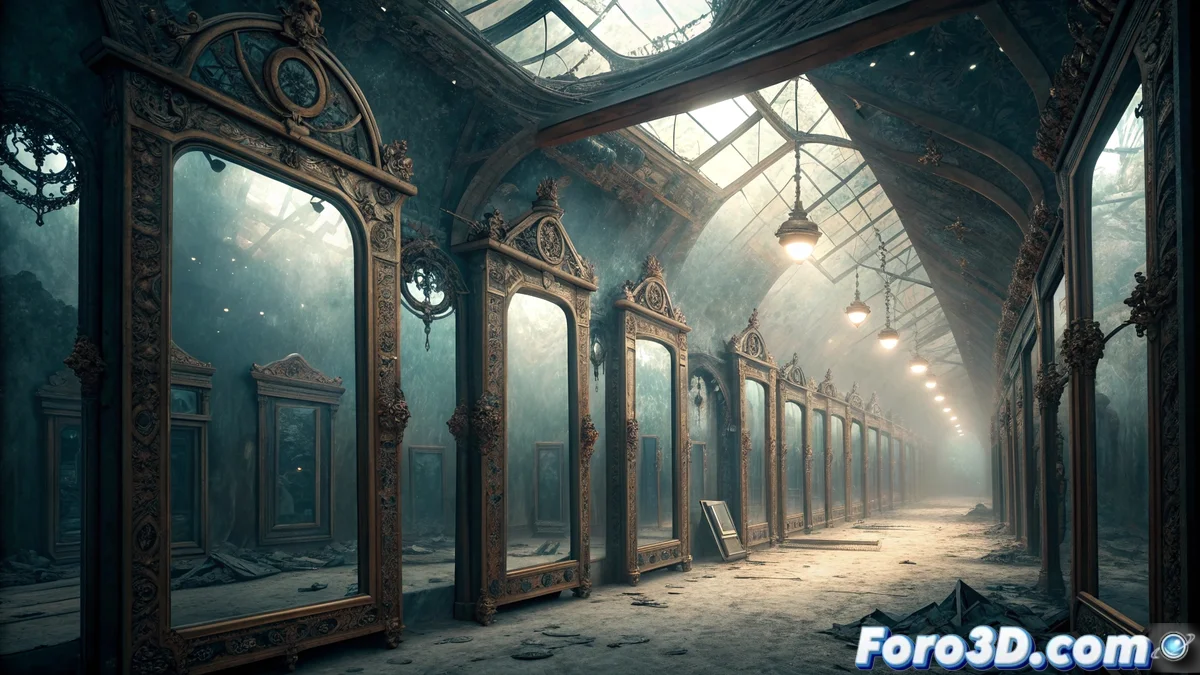
The Legend of the Empty Mirror Room and Its Recreation in Blender
The fascinating legend of the empty mirror room originated in the late 19th century, during the heyday of traveling fairs in Europe and America. These popular attractions included distorting mirror rooms that fascinated and disturbed visitors. The most intriguing version emerged at a rural fair, where stories began of people not seeing their reflection in the mirrors. Initially, the owners attributed this to defects in the silvering, but the rumors persisted even after replacing the materials, fueling the mystery 👻.
Development and Evolution of the Legend
With the decline of the fair, the pavilion was abandoned, but the stories intensified. In the 1930s, witnesses described a feeling of coldness upon entering and the complete absence of reflections, regardless of the viewing angle. The legend solidified with mysterious disappearances of visitors, and the narrative of the liberated double gained strength in oral tradition. According to this belief, whoever does not see their reflection has allowed their spiritual counterpart to escape, condemning themselves to occupy the place of the invisible reflection forever.
Key Elements of the Legend:- Origin in traveling fairs: Entertainment spaces that mixed fun and mystery.
- Testimonies of absent reflections: Consistent accounts of mirrors that did not return the image.
- Inexplicable disappearances: Cases that reinforced the supernatural terror associated with the place.
The real terror begins when you realize that the only modeling error in your scene is that you shouldn't appear reflected in it, but there you are.
Cultural Impact and Legacy
This legend has become a reference in urban folklore, symbolizing the human fear of loss of identity and the doppelgänger. It has influenced numerous works of psychological horror and supernatural literature, where the theme of the malevolent double explores human duality. The room represents how liminal spaces can act as thresholds between dimensions, questioning the nature of reality and visual perception as a guarantee of existence.
Highlighted Cultural Aspects:- Influence on psychological horror: Literary and cinematic works that explore duality.
- Symbolism of abandoned spaces: Places that challenge perception and reality.
- Reflection on identity: Anxiety about the possible loss of the self.
Project Preparation in Blender
To recreate this legend in Blender, start by setting up the scene in metric units and color management to Standard. Set the render engine to Cycles for realistic lighting and precise reflections. Prepare a scene with a low-angle camera that captures the visitor's perspective, using a focal length between 24mm and 35mm for subtle distortion. Configure the built-in denoiser and adaptive sampling with 256 to 512 samples to balance quality and render time 🎥.
Modeling and Main Structure
Create the main space using a reference plane of old mirror rooms with ornate wooden frames. Model multiple mirror panels using the array modifier for repetitive distribution, but introduce subtle variations in rotation and position to simulate abandonment. Add deterioration elements like broken frames, cracked surfaces, and rusted supports using displacement maps and boolean geometry. Incorporate objects typical of abandoned fairs, such as faded posters, hanging cables, and remnants of vintage decoration.
Essential Modeling Steps:- Use of array modifier: To create repetitive mirror patterns with variations.
- Incorporation of deterioration: Application of displacement maps and boolean operations for cracks and rust.
- Environmental elements: Addition of vintage objects that reinforce the atmosphere of abandonment.
Lighting and Materials
Implement dim lighting with volume scatter to create a dusty atmosphere, using few directional light sources that simulate external light leaks. Develop shaders for the empty mirrors by combining glass BSDF with a mix shader controlled by fresnel factor, but adjust the IOR to anomalous values that eliminate visible reflections. For aged surfaces, use principled BSDF with high roughness, adding noise texture as bump map to simulate deterioration. The wooden frames require material with clearcoat and scratches using striped image textures 🖌️.
Special Effects and Final Rendering
For the absent reflection effect, set up separate render layers and use compositing with light paths node to control reflection rays. Add volumetric fog with low density that creates a sense of emptiness and mystery. In post-processing, adjust curves and color balance toward cold bluish tones, keeping saturation low except in strategic points of warm light. Render in 4K with denoising data and apply light lens distortion and vignette effects to increase immersion. This approach ensures the scene conveys the unease inherent in the legend 🎭.
Special Effects Techniques:- Render layers and light paths: Precise control of reflections to achieve the empty effect.
- Volumetric fog: Creation of an ethereal and mysterious atmosphere.
- Strategic post-processing: Color adjustments and optical effects for realism and immersion.
Conclusion
The legend of the empty mirror room not only endures in folklore but also offers a rich foundation for visual creation in Blender. By combining modeling, lighting, and special effects techniques, it is possible to recreate this enigmatic space, capturing the essence of psychological terror and human duality. This project demonstrates how 3D software can bring ancestral narratives to life, challenging our perception of reality and identity ✨.