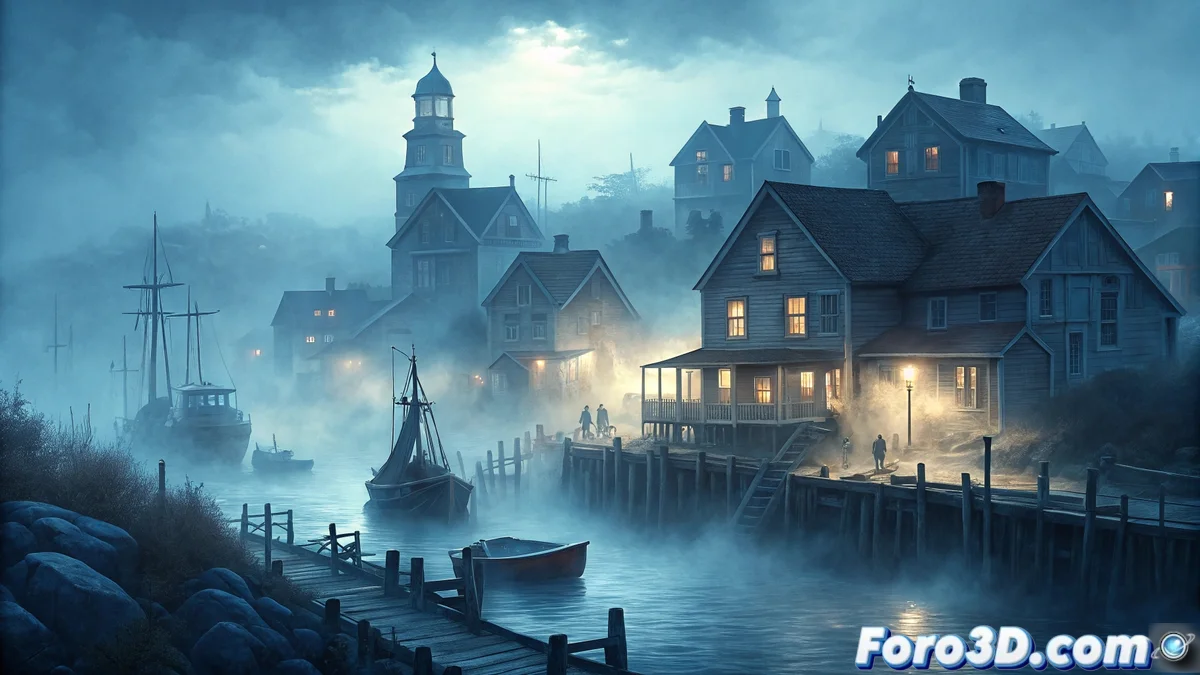
The Legend of the Recognition Fog and Its Implementation in Unity
The mysterious recognition fog constitutes one of the most intriguing paranormal phenomena in North American folklore, with documented roots in the coastal communities of New England during the 19th century. Sailors and fishermen recounted encounters with this sea mist that appeared unpredictably, even under completely clear weather conditions. The most disturbing were the testimonies of people who, after passing through this fog, returned to discover that their family and friends could no longer recognize them 🫥.
Historical Origins and Cultural Expansion
The initial records appear in navigation logs and oral accounts from fishermen in Massachusetts and Maine, describing a fog that temporarily disconnected the social identity of those who crossed it. Throughout the 20th century, the phenomenon transcended small fishing communities to become part of the regional collective imagination. Researchers documented numerous cases where victims retained intact memories and knowledge, but specifically disappeared from the collective memory of their immediate social environment.
Documented characteristics of the phenomenon:- Variable duration of the effect from several hours to three full days
- Progressive disappearance without need for external intervention
- Complete preservation of the affected person's personal memory
- Selective affliction on social recognition exclusively
"The fog doesn't erase who you are, but the place you occupy in others' memory" - Anonymous, Cape Cod fisherman, 1893
Development Environment Setup
To recreate this immersive experience in Unity 3D, we begin by setting up a new project using the Universal Render Pipeline to ensure optimal performance with complex visual effects. The base scene incorporates a coastal terrain characteristic of New England, using the integrated terrain sculpting system with sand, eroded rock, and coastal vegetation textures. It is crucial to import the post-processing package and activate the global volume to apply atmospheric effects consistently 🌊.
Essential initial setup:- Selection of URP pipeline for advanced visual effects
- Implementation of terrain system with authentic coastal textures
- Activation of global volume for post-processing effects
- Import of assets for characteristic New England architecture
Environment Modeling and Interactive Elements
The coastline design requires special attention to capture the essence of New England, with eroded cliffs, rocky beaches, and rugged coves. We incorporate distinctive architectural elements such as traditional lighthouses, salt-worn wooden docks, and Cape Cod-style houses. Unity's particle system generates the dynamic fog, configured to emit from the ocean and advance toward land with organic movement. Strategically placed trigger colliders detect when the player enters foggy areas 🎯.
Lighting System and Material Development
Atmospheric lighting plays a fundamental role in recreating the mysterious ambiance. We implement a day-night cycle where the fog appears at specific moments, with directional light using bluish and grayish tones to simulate light diffusion through the aqueous vapor. We develop custom shaders for water and fog, incorporating light scattering properties that generate the characteristic ethereal effect. Smooth-moving normal maps simulate the calm swell typical of foggy days on the Atlantic coast 💡.
Key visual elements:- Dynamic day-night cycle with scheduled fog appearance
- Custom shaders for light scattering effects
- Water materials with animated normal maps
- Aged textures for architectural elements
Special Effects Implementation and Optimization
The heart of the project lies in the recognition management system, which modifies NPC behavior when the player passes through the fog. We use Shader Graph to create the fog with density variations and natural movement. Post-processing effects include depth of field, color grading with a cold tone palette, and controlled bloom increase in high fog density areas. To maintain smooth performance, we implement scalable levels of detail for particle effects and occlusion culling techniques for areas with the highest concentration of visual effects ⚡.
Critical optimization techniques:- Levels of detail (LOD) for complex particle systems
- Occlusion culling in high-effects density areas
- Dynamic batching setup for moving elements
- Shader optimization for different hardware capabilities
Cultural Legacy and Final Reflection
This phenomenon has become a cornerstone of New England folklore, inspiring numerous literary works, oral traditions, and even preventive community rituals. Coastal communities developed practices such as placing bells on docks that had to ring upon the fog's appearance. Conceptually, it represents the universal fear of social oblivion and philosophically questions the nature of personal identity as a collective construction. The next time your loved ones don't recognize you, you might consider if you recently walked along the New England coast on a day with that peculiar sea fog that alters the most fundamental perceptions of social existence 🏖️.