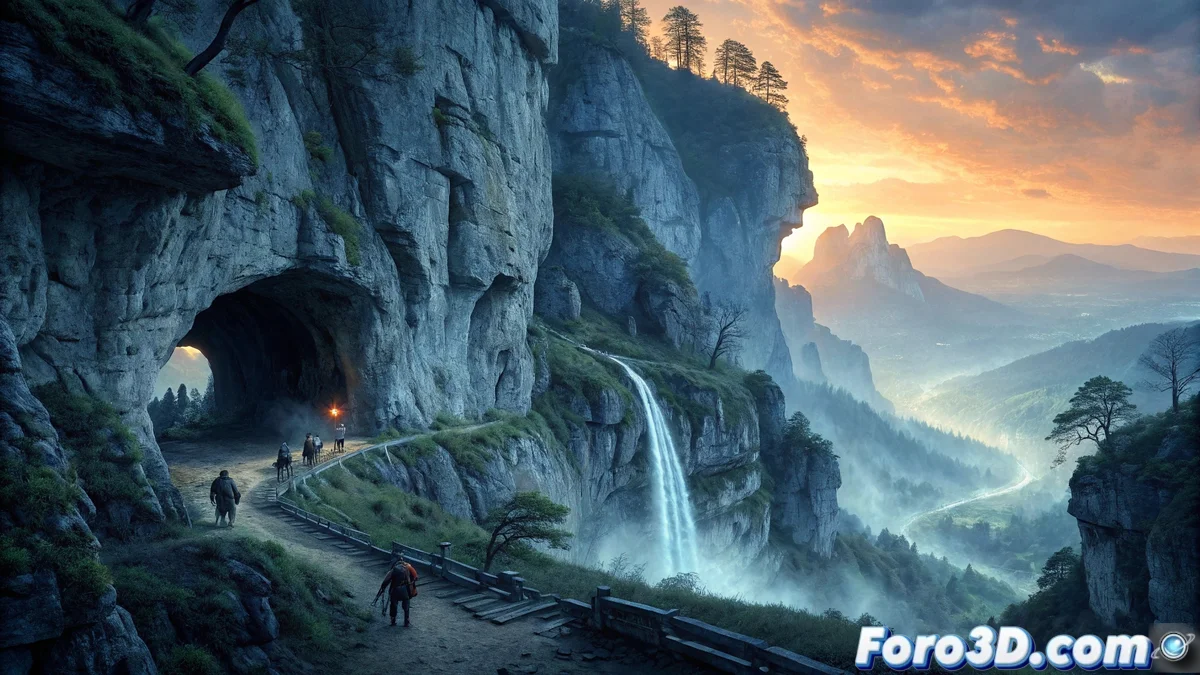
The Legend of the Mountain that Sings Opera and Its Creation in ArmorPaint
In the depths of the North American Appalachians, a fascinating legend emerged in the 19th century, where settlers and native communities recounted gutural operatic sounds coming from a specific rocky formation during storms and windy nights. What began as a phenomenon attributed to natural causes evolved into supernatural beliefs, suggesting that the voices belonged to lost souls trapped in the rock 🗻.
Historical Development and Folklore Consolidation
Throughout the 20th century, the legend took root in the regional collective imagination, with numerous testimonies from hikers and residents who claimed to hear fragments of what they called the mountain's opera. Geological investigations confirmed the presence of limestone formations with tunnels and caverns that acted as natural wind instruments, although the similarity to human voices in low registers remained without a complete scientific explanation. Popular belief warns that hearing the full opera leads to the listener's loss of voice, a detail that adds mystery to this narrative.
Key Elements of the Legend:- Origins in the 19th century with reports of sounds during storms and windy nights
- Evolution toward the supernatural, with descriptions of gutural and tragic operatic singing
- Partial geological confirmation of resonant formations, but no explanation for the resemblance to human voices
The mountain represents the boundary between the natural and the supernatural, a powerful metaphor for how communities interpret geological phenomena through their spiritual beliefs.
Project Preparation in ArmorPaint
To recreate this legendary mountain, start a new document in ArmorPaint with dimensions of 4096x4096 pixels, ensuring optimal resolution for complex geological details. Set up the workspace in PBR metallic/roughness mode, ideal for achieving realism in rock representations, and establish color management in ACES for an extended dynamic range that captures subtle lighting variations. Import or generate a base plane that will serve as the canvas for the mountain's main structure 🌄.
Essential Initial Configuration:- High-resolution document (4096x4096 pixels) for precise details
- PBR metallic/roughness workflow oriented toward geological realism
- ACES color space to enhance dynamic range and ambient lighting
Modeling, Lighting, and Special Effects
Employ ArmorPaint's sculpting tools to sculpt the basic shape of the mountain, focusing on geological features that would explain the operatic sounds, such as internal tunnels and caverns. Use the dragon brush to carve openings and passages, and the crease brush to define rocky strata that would direct the wind. Maintain a non-destructive approach using multiple sculpting layers.
For lighting, simulate twilight in the Appalachians with deep blues and soft oranges, and develop materials starting with a base of limestone material, applying layers of weathering effects using curvature masks. Add mosses and lichens in wind-protected areas, and create a special material for tunnel inner surfaces with higher reflectivity to mimic crystallized minerals.
Implement subtle particle effects for mist, using ArmorPaint's particle system with low density and slow movement, and apply depth of field to direct attention to the sound-producing formations. In the final rendering, enable ray tracing and multiple sampling settings to eliminate noise, exporting in EXR format to preserve complete lighting and depth information. As a fun fact, during rendering, your computer might emit unusual sounds, perhaps trying to imitate Pavarotti 🎭.
Key Creative Steps:- Sculpting with specialized tools to form resonant tunnels and strata
- Realistic ambient lighting that replicates twilight conditions in the Appalachians
- Application of materials and effects such as weathering, mosses, and mist particles
Cultural Impact and Enduring Legacy
This legend has integrated into the cultural identity of the Appalachians, inspiring works of art, literature, and music that reflect the connection between the natural world and the supernatural. The mountain serves as a metaphor for how communities interpret geological phenomena through spiritual beliefs, attracting adventure tourists and paranormal investigators today. However, local authorities recommend avoiding approach during weather conditions that activate the most intense sounds, thus preserving the mystery and safety. By recreating this mountain in ArmorPaint, we not only capture its visual essence but also honor a rich narrative that continues to fascinate generations 🌟.