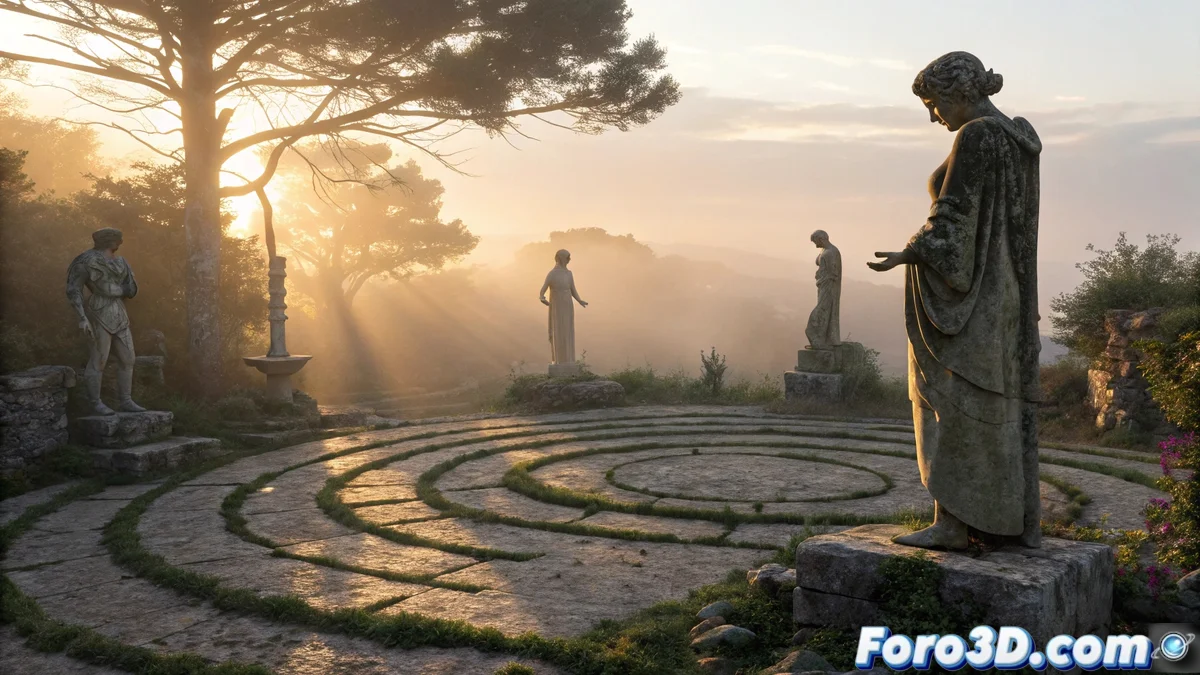
The Legend of the Living Stone Garden and Its Recreation in Blender
In the most isolated islands of Greece, traditions tell of an enchanted garden where classical statues exhibit subtle movements during the day. This myth, documented since the Byzantine era, has inspired digital artists to recreate it in Blender, blending folklore and technology 🏛️.
Origins and Evolution of the Myth
The legend arose among sailors and elders from coastal villages, describing an island invisible on maps with statues that change position. During the Ottoman period, explorers recorded in diaries how the stone figures seemed to watch them with unsettling intensity. In the 19th century, the disappearance of a British archaeologist added the key element: the statues reorganize into circles at dusk.
Key Cultural Elements:- Statues as symbols of souls trapped between life and death
- Literary metaphor about challenging the natural limits of existence
- Influence on theatrical works, poetry, and modern Mediterranean tales
The stones of this garden not only tell stories, but seem to live them with every sunset.
Initial Setup in Blender
To recreate the garden, start with a new scene in metric units, optimized for extensive environments. Color management is set to log film, and resolution to 4K for maximum quality. A base plane with a displacement modifier and procedural noise textures simulates the island's uneven terrain, including hills and typical Mediterranean rocks 🌊.
Preparation Steps:- Scale and basic lighting setup for exteriors
- Terrain generation with realistic procedural displacements
- Render parameter adjustments to preserve details at long distances
Modeling and Texturing of Statues
The statues are modeled from basic primitives, using sculpting for classical humanoid forms with temporal erosion. Modifiers like subdivision surface and multiresolution refine details, while brushes like clay strips add fractures. The distribution in apparently random groups suggests potential movement, creating dynamic visual compositions 🗿.
Advanced Modeling Techniques:- Manual sculpting for damage and eroded textures
- Use of vertex painting for moss and lichen areas
- Spatial organization implying nocturnal reorganization
Realistic Lighting and Materials
An HDRI system simulates the golden light of Greek sunset, complemented by directional lights for dramatic shadows. Materials use the shader editor with principled BSDF nodes, blending roughness and normal maps to mimic porous limestone. Procedural textures and vertex painting integrate moss in shaded areas, adding realism to the ancient environment 🌅.
Material Configurations:- Combination of roughness values for eroded surfaces
- Inclusion of normal maps for microscopic details
- Color adaptation according to sunset lighting
Special Effects and Final Render
Particle systems are implemented for low mist with soft turbulence force fields, mimicking sea breeze. The statues are animated with keyframes showing their reorganization around a central point, using easing curves for natural movements. The Cycles render uses 1500 samples, OptiX denoising, and adjusted light paths to manage complex light interactions at sunset ✨.
Render Optimizations:- High sampling to reduce noise in scenes with dim lighting
- Force fields for realistic mist dynamics
- Animation curves emphasizing the day-night transition
Legacy and Final Reflections
This project demonstrates how cultural legends can inspire immersive digital creations. The garden, more than a simple 3D model, encapsulates the symbolism of transcendence and human limits, reminding us that sometimes stones have a more active social life than many during happy hour. The combination of narrative and advanced techniques in Blender enriches both digital art and the preservation of ancestral myths 🤖.