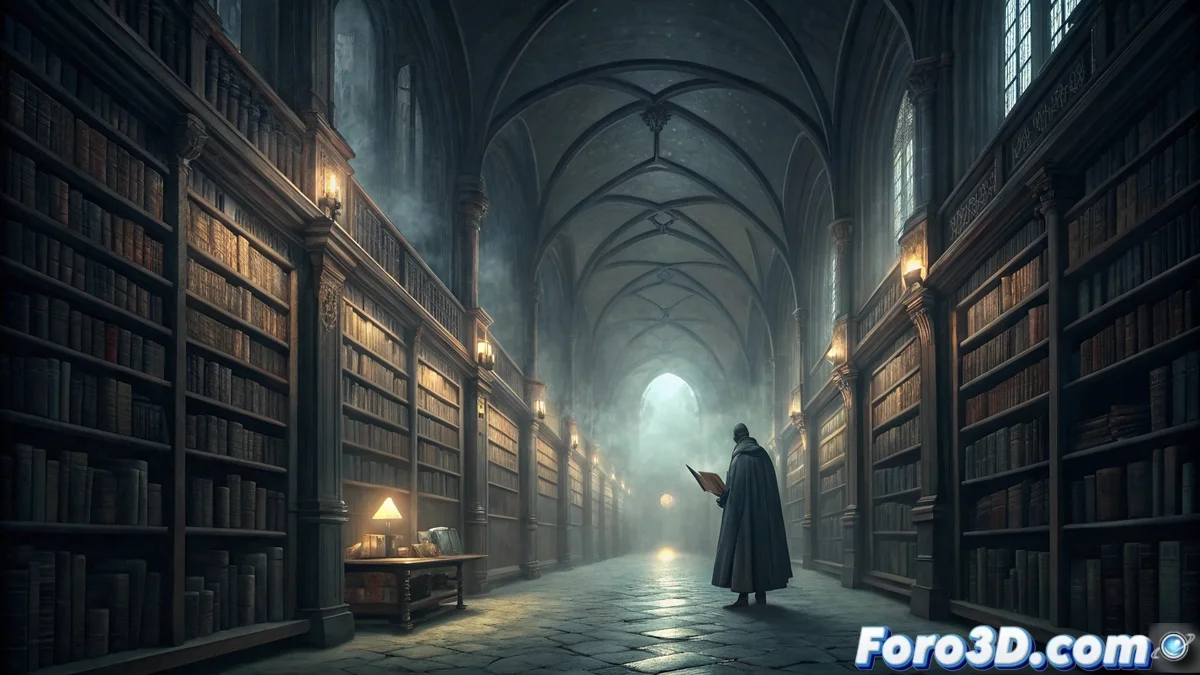
The Legend of the Library of Unrealized Intentions
The fascinating legend of the hidden library dates back to the 18th century, linked to European universities with hermetic and esoteric traditions. Unlike conventional libraries, this mystical space does not store complete physical works, but the unmaterialized creative intentions of all the scholars who have passed through its halls. Historical records indicate that access to this underground section is only possible at the precise moment of the change of day, when time seems to suspend between what was and what could have been. 📜
Development and Historical Evolution of the Concept
Throughout the centuries, this esoteric library has accumulated a growing volume of these unrealized intentions, forming what some scholars call the collective academic unconscious. Each generation of students and professors adds new layers of unconcretized potential, from abandoned scientific treatises to literary works that never saw the light of day. The nature of these records has evolved from simple manuscripts to containers of psychic energy that capture not only the ideas, but the emotional charge of their abandonment. 🔮
Key Characteristics of the Evolution:- Transformation from physical manuscripts to records of psychic energy
- Progressive accumulation of unrealized creative potential
- Evolution from simple documents to complex emotional containers
This library represents the shadow of human knowledge, the archive of everything that could have been but never was
Cultural and Psychological Impact
The main impact of this library lies in its ability to affect the human psyche through what esotericists call existential contamination. Those who interact with these intentions experience a transfer of alternative lives that never happened, leading them to progressively neglect their own reality. This space represents the shadow of human knowledge, serving as a warning about the danger of living through potentialities instead of concrete realities. 💫
Project Preparation in Godot 4.0
To recreate this mystical library in a digital environment, start by creating a new 3D project in Godot 4.0 or higher. Configure the environment with a compatible backward renderer for advanced effects and set the import configuration for textures to repeat mode with trilinear filter. Create a main node structure with Spatial as the root, adding a WorldEnvironment for global illumination and a DirectionalLight as the main source. 🎮
Essential Initial Configuration:- Backward renderer for compatible advanced effects
- Texture import configuration in repeat mode
- Node structure with Spatial, WorldEnvironment, and DirectionalLight
Modeling and Architectural Structure
Design the underground library using CSG combinations for the main walls and shelves. Create multiple shelf levels using MeshInstance with ArrayMesh for optimization. Implement a book system using MeshLibrary instances with random variations in orientation and size. Add architectural details like gothic arches and columns by extruding Bezier curves, creating a mysterious and ancient atmosphere. 🏛️
Advanced Lighting and Materials System
Set up volumetric lighting using VolumetricFog with gradual density that increases towards the corners. Apply custom shader materials to the books with a vertex displacement effect that simulates subtle movement. Use a wall material with an eroded stone normal map and faint emission on the inscriptions. Implement a particle system for archival dust suspended in the air, adding atmospheric realism. ✨</