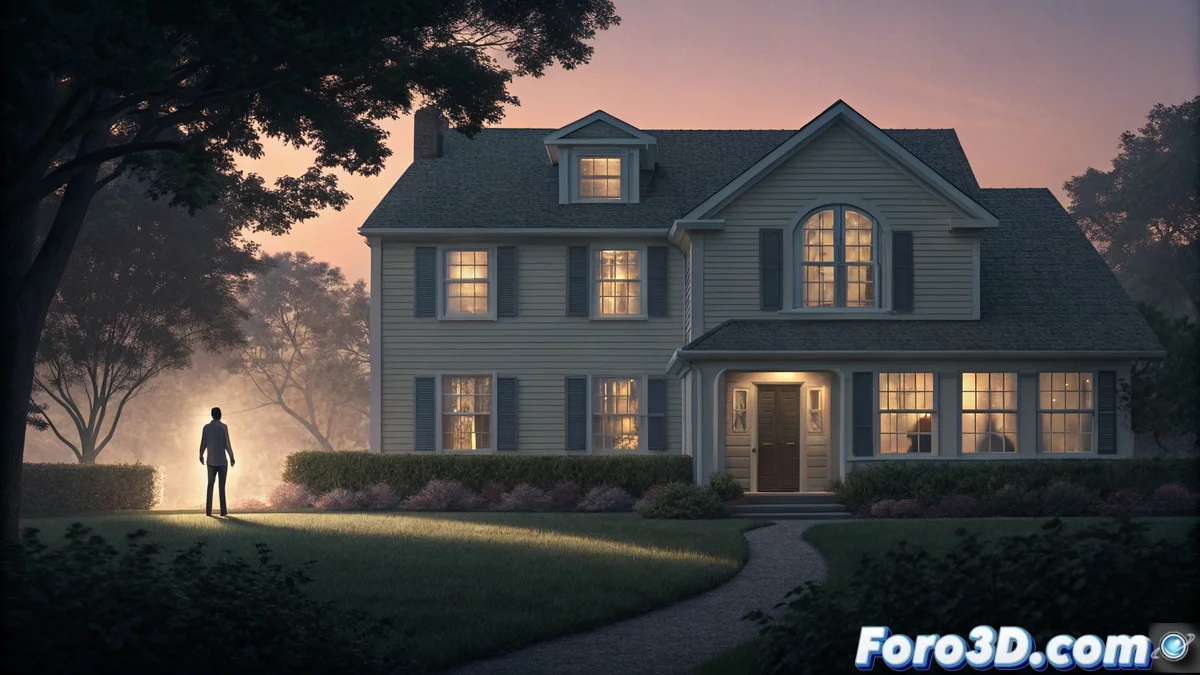
The Legend of the Silent Replacement House and Its Representation in Vector Design
The unsettling urban legend of the silent replacement house originated in the 1970s within American folklore, coinciding with the massive expansion of suburbs. This narrative serves as a veiled critique of the superficial perfection of suburban life, where impeccable facades hide unresolved family conflicts. The first records appeared in publications on paranormal phenomena, always describing a house identical to the others in conventional residential neighborhoods 👻.
Historical Evolution and Disturbing Characteristics
Over time, the legend acquired specific details that intensified its psychological impact. It was established that the entity began by replacing the most vulnerable or least loved family member, progressing gradually each year until replacing the entire family unit. What is particularly unsettling about the process is that the replaced retain memories, habits, and knowledge, being virtually indistinguishable except for their inability to experience genuine emotions. This element reinforces the underlying theme of alienation and loss of authenticity in seemingly perfect environments.
Key Elements of the Narrative:- Progressive substitution starting with the most vulnerable family member
- Complete retention of memories and knowledge in the replaced
- Inability to experience genuine joy as the only detectable difference
The silent replacement house represents the fear of losing our essence in the pursuit of perfect normalcy
Cultural Legacy and Artistic Influence
This suburban legend has deeply permeated popular culture as a powerful metaphor for social conformity and the erosion of individual identities. It symbolizes the fears associated with the homogenization of modern life and the constant pressure to maintain appearances. The narrative has influenced numerous works of psychological horror, television productions, and literary tales, where the house becomes a symbol of the threat that artificial normalcy poses to authentic human connections.
Manifestations in Popular Culture:- Influence on psychological horror television series
- Inspiration for short stories on suburbanization
- Recurrent metaphor in contemporary sociological analyses
Project Preparation in InkScape
Start InkScape and set up a document with dimensions of 1920x1080 pixels in landscape orientation. Enable a visible grid via the View/Grid menu to maintain the characteristic architectural symmetry of suburbs. Create separate layers for background, main structure, plant elements, and human figures, facilitating organization during the creative process. Select a sober color palette with muted pastel tones that convey the ambiguity between normalcy and unease 🎨.
Modeling the Architectural Structure
Draw the basic house structure using the rectangle tool, applying the standard proportions of American suburban architecture. Add symmetrical windows and a centered main door using basic geometric shapes. Create the perfectly trimmed grass with a light green rectangle and add geometric hedges using the Bézier tool. Incorporate details like a perfectly aligned white fence and a symmetrical driveway to reinforce the artificially perfect suburban aesthetic.
Essential Architectural Elements:- Rectangular structure with standardized proportions
- Symmetrical windows and centered door
- Perfect grass, geometric hedges, and aligned fence
Lighting and Materials Techniques
Apply subtle gradients to surfaces to simulate sunset lighting, creating contrasts between illuminated areas and elongated shadows. Use the gradient editor to apply warm tones to the facades while maintaining deep shadow areas around windows and doors. For materials, use minimal textures that suggest perfectly maintained surfaces, avoiding any imperfection that breaks the illusion of normalcy. The windows should show reflections that prevent a clear view of the interior, increasing the visual mystery.
Special Effects and Rendering Process
Create a stylized human figure in the window using simplified silhouettes with the freehand drawing tool. Apply a light blur filter to this figure to suggest movement or incorporeality. Adjust layer opacity to generate a sense of atmospheric depth. For the final rendering, export in high-resolution PNG format, ensuring the colors maintain that eerily perfect quality that defines the scene. Make sure the overall composition conveys both normalcy and an underlying sinister anomaly 💻.
Final Post-Production Steps:- Application of selective blur to human figures
- Opacity adjustment for atmospheric depth
- High-resolution export maintaining disturbing colors
Final Reflection on the Power of Vector Design
This visual representation demonstrates that sometimes the most terrifying tool in vector design is not a specialized filter, but the ability to create such unsettling perfection that it seems to be waiting to fail. The legend of the silent replacement house and its recreation in InkScape remind us that true disturbance often resides in the familiar turned strange, in the normalcy that hides subtle but deeply unsettling anomalies.