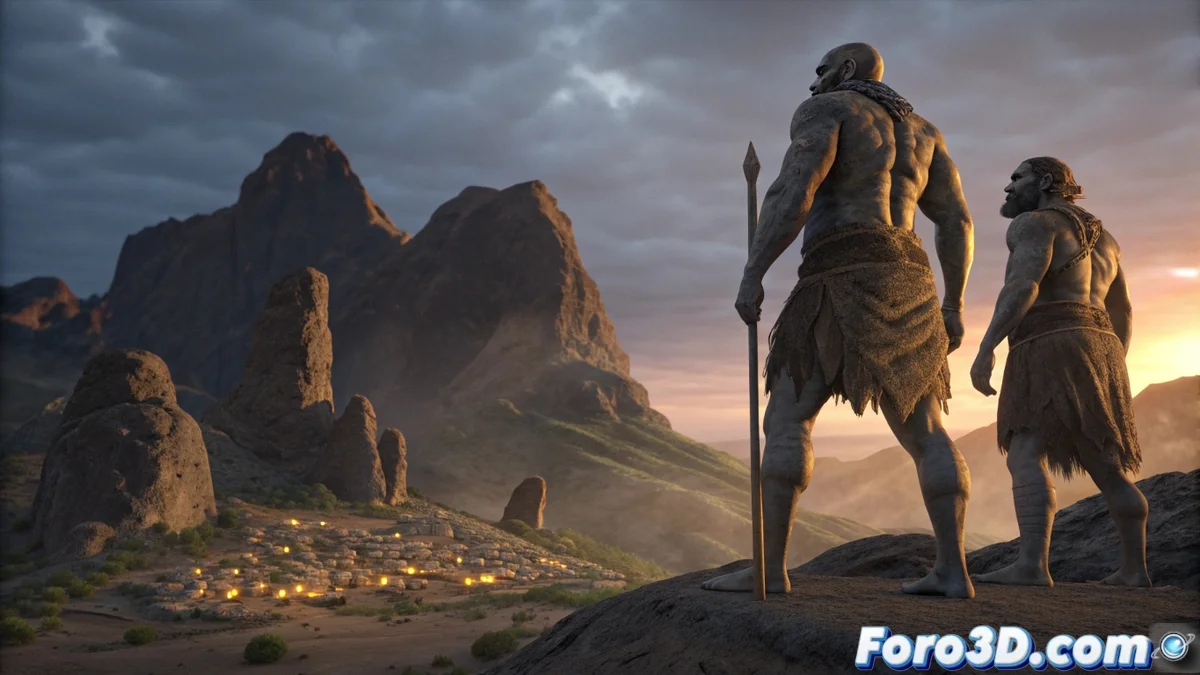
The Legend of the Giant Guanches: Between Myth and Anthropology
In the Canary archipelago, the boundary between documented history and popular narrative blurs, giving rise to a fascinating tale. The figure of the Guanche, the ancient inhabitant of the islands, has been elevated in oral tradition to the category of titanic giant, a being of superhuman strength capable of sculpting the landscape. This transformation goes beyond mere exaggeration, constituting a cultural phenomenon where the real substrate intertwines with the need to explain the monumental. 🏔️
The Titan Architects of the Volcanic Territory
Legendary chronicles attribute to these colossi the authorship of the Canary cyclopean landscape. According to these versions, their physical power allowed them to manipulate huge basalt blocks with their hands, erecting the enigmatic tagorores (stone circles) and walls that seem to defy the laws of physics. Significant archaeological sites, such as the Cueva de los Guanches in Tenerife or the imposing formations of Los Roques in Gran Canaria, cease to be seen as mere settlements or geological accidents. In the collective imagination, they become the intentional and testamentary work of a race of superior beings who dominated the primordial elements of earth and fire.
Legendary Evidence of Their Power:- Tagorores and Stone Structures: The stone circles are interpreted not as meeting places, but as deliberate constructions by giants.
- Singular Rock Formations: Large isolated or peculiarly stacked rocks are considered "toys" or tools abandoned by these beings.
- Cyclopean Walls: Some remains of large masonry are explained as fortifications or delimitations made by superhuman hands.
Is it a whim of geology or the forgotten toy of a Guanche who needed something heavy to train with?
From Colonial Impression to Enduring Myth
The origin of this magnification probably lies in a clash of perspectives. The first European chroniclers who arrived on the islands, often of slighter build, were deeply impressed by the stature and physique of the aboriginal warriors. Historical accounts describe them as tall, robust individuals, occasionally blond with light eyes, which increased their aura of singularity. This initial astonishment, transmitted orally and subjected to generational hyperbole, crystallized over time into the archetypal figure of the giant. The tangible remnants left by this culture played a crucial role in fueling the legend.
Elements That Fueled the Giant Narrative:- Bone Remains and Mummies: The discovery of skeletons of individuals of great stature for the time was taken as "physical proof" of their colossal nature.
- Large-Format Tools: Stone tools of considerable size were interpreted as instruments for titan hands.
- Pre-Scientific Mentality: A worldview that sought extraordinary and epic explanations for phenomena it did not fully understand.
Conclusion: A Legacy in Two Voices
The legend of the giant Guanches is, in essence, a dialogue between two realities. On one hand, the anthropological reality that speaks to us of a people of shepherds and farmers, robust in build and notably adapted to a hostile environment. On the other, the mythopoetic reality of a community that, through exaggeration, transformed respect, fear, and incomprehension toward a conquered culture into an epic and enduring tale. Thus, every peculiar rock formation in the Canaries carries this duality: it is a geological fact and, simultaneously, a symbol of a history that prefers to speak with the voice of giants. 🤔