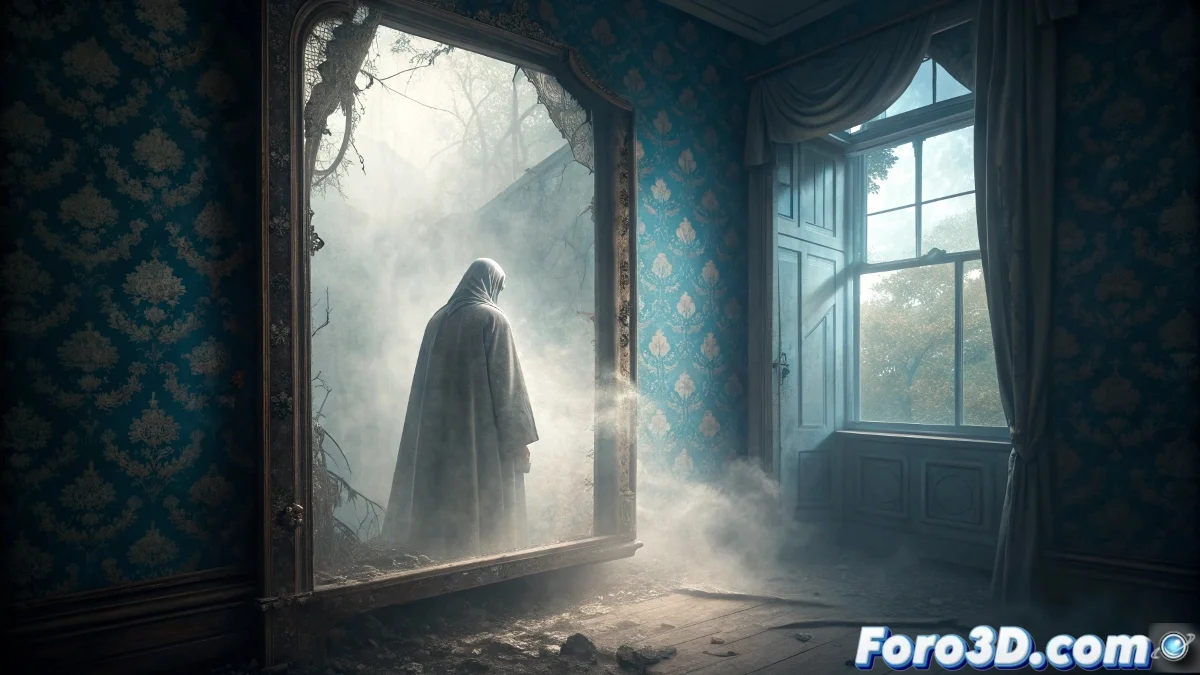
The Legend of the Dimensional Mirror in the Abandoned Mansion
Narratives about spectral apparitions in mirrors of uninhabited residences constitute a globally documented phenomenon since the 19th century, blending supernatural elements with deep cultural anxieties 🕵️♂️.
Origins and Transcultural Expansion
The earliest records come from Eastern Europe and North America, where witnesses reported silhouettes moving behind fogged glass. The layer of mist on the mirror functions as an interdimensional threshold in all variants of the legend. During the 20th century, the story incorporated indigenous elements: in Japan it was linked to the yuurei, while in Latin America it adapted to ghosts of colonial haciendas 🌍.
Universal Characteristics of the Legend:- Manorial architectural settings abandoned after family tragedies
- Reflective surfaces covered by atmospheric residue or accumulated dirt
- Liminal figures manifesting intent to cross into the earthly plane
Victorian spiritualism found in these mirrors an instrument for interdimensional communication, further popularizing these narratives.
Influence on Contemporary Media
This legend has inspired numerous cinematic, literary, and interactive productions, exploiting the combination of decadent spaces, reflective portals, and entities between existential planes. Its effectiveness lies in how it materializes universal fears toward the imperceptible and the inexplicable 🎬.
Key Elements of Cultural Impact:- Psychological exploration of fear of the unknown
- Collective fascination with alternate realities
- Representation of social anxieties through supernatural metaphors
Technical Recreation in Art of Illusion
To materialize this legend in 3D environments, start by setting up a project with a 16:9 aspect ratio and 1920x1080 resolution. Establish a dark ambient background and organize the work into three layers: architecture, lighting, and mirror special effects 💻.
Modeling the Abandoned Scene
Use polygonal modeling tools to develop the main room starting from a base cube. Apply subdivisions to smooth geometries and create a thin plane as the mirror. Position a stylized anthropomorphic figure behind the glass, in a pose extended toward the viewer. Add realism through sculpting of cracks and eroded moldings 🏚️.
Modeling Workflow:- Creation of the main volume with a base cube and subdivision modifiers
- Development of the mirror using a rectangular plane with minimal thickness
- Incorporation of the spectral figure with optimized topology
Lighting and Materials System
Set up a strategic lighting triad: bluish ambient light, directional lunar spotlight, and point light close to the mirror. For the glass material, use a glass shader with high IOR and a roughness map simulating dust accumulation. The spectral entity requires a translucent material with controlled emission 👻.
Key Materials Configuration:- Mirror: glass shader with variable roughness and blurry reflections
- Spectral figure: semi-transparent material with subtle emission properties
- Environment: PBR shaders with displacement maps for eroded surfaces
Special Effects and Post-Production
Generate the dimensional mist using slow-moving volumetric particle systems over the mirror surface. Adjust density to allow partial visions of the underlying figure. In the node editor, combine the glass transparency with the nebulous veil using material mixers. For the final render, enable ray tracing with high anti-aliasing sampling and apply post-processing with vignetting and chromatic correction toward cold tones 🌫️.
Final Reflection on the Phenomenon
This legend demonstrates how the deepest fears reside in the semi-visible, in those perceptual artifacts that question our understanding of reality. The technical recreation not only allows visualizing the myth but also analyzing its underlying psychological mechanisms 🔍.