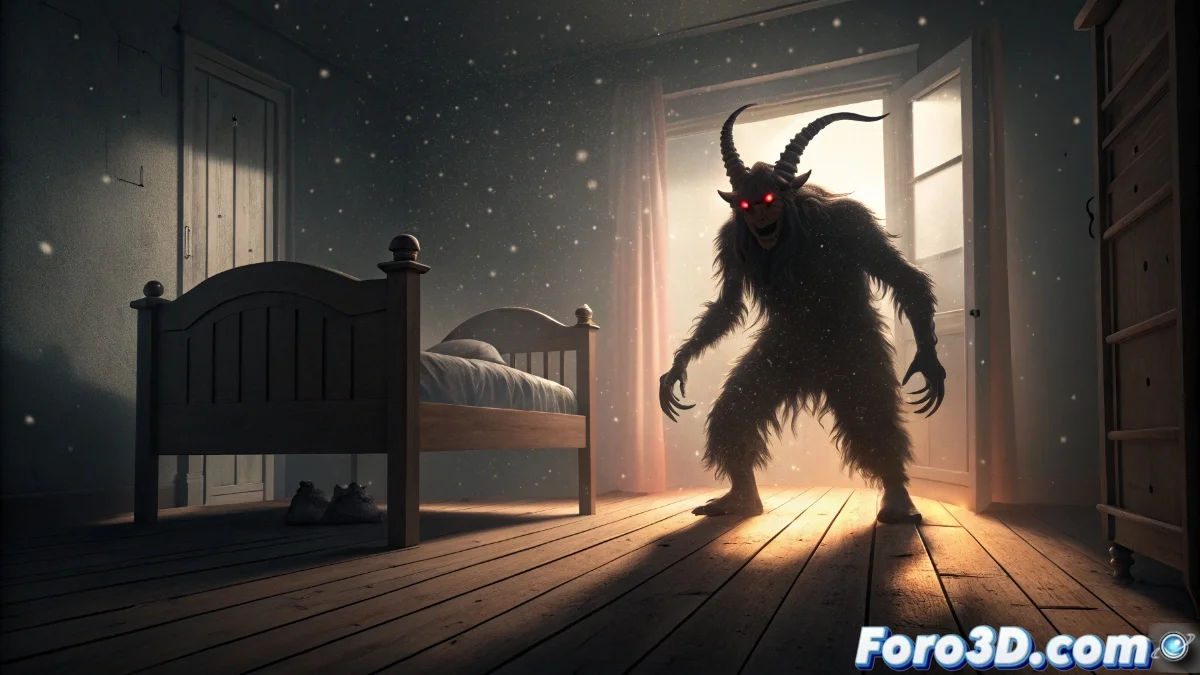
The Legend of the Butoni: the terror that lurks in the Valencian night
In the absolute darkness of Valencia, when the world sleeps and silence takes over the streets, an ancestral entity emerges from the deepest corners of reality. Known as the Butoni, this being requires no invocations as its existence permeates every empty space, stalking the little ones who defy nocturnal rest. Its icy breath slithers among forgotten toys and its viscous whispers echo behind every piece of furniture, confirming that it is not a mere fable but a tangible threat that all children instinctively recognize when the light goes out. 👹
Morphology of a living nightmare
Testimonies about its appearance are fragmentary and terrifying, describing a hybrid figure between animal and specter whose anatomy defies the laws of physics. Its dark fur blends with the shadows while its limbs twist with a bone-cracking sound that makes the skin crawl. The curved horns scrape the ceilings with a metallic sound and its eyes emit a crimson glow that hypnotizes its victims. Its movement resembles the sliding of a heavy fluid, expanding progressively until saturating the environment with an oppressive presence.
Physical characteristics of the Butoni:- Hairy and deformed body structure that adapts to any space
- Elongated claws that leave deep grooves on wooden surfaces
- Glowing eyes visible only in complete darkness
The Butoni does not punish, it simply collects children's souls as trophies in its parallel dimension.
Mechanics of nocturnal horror
Its method of action follows an escalated ritual that begins with subtle sensations and culminates in an inescapable physical contact. First it manifests as a weight on the edge of the bed, then as a hairy brush against the limbs, and finally as total paralysis before its invisible jaws. It feeds on the energy of fear, with rebellious children being its favorite delicacy since their resistance generates more intense and lasting terror. Every tear shed and every stifled moan represent a sensory feast for this entity.
Phases of its appearance:- Environmental presence through temperature drops and putrid odors
- Progressive contact starting from the distal areas of the body
- Complete immobilization through its icy breath
Paradox of childish behavior
Contrary to expectations, disobedient children have a higher probability of survival because the Butoni values the quality of fear over the ease of capture. The little ones who fight against sleep generate a more complex and sustained emotional response, turning their terror into a delicious delicacy for the creature. This irony turns parental rules into a double-edged sword where rebellion becomes a survival mechanism and obedience an unwitting risk before the claws of darkness.