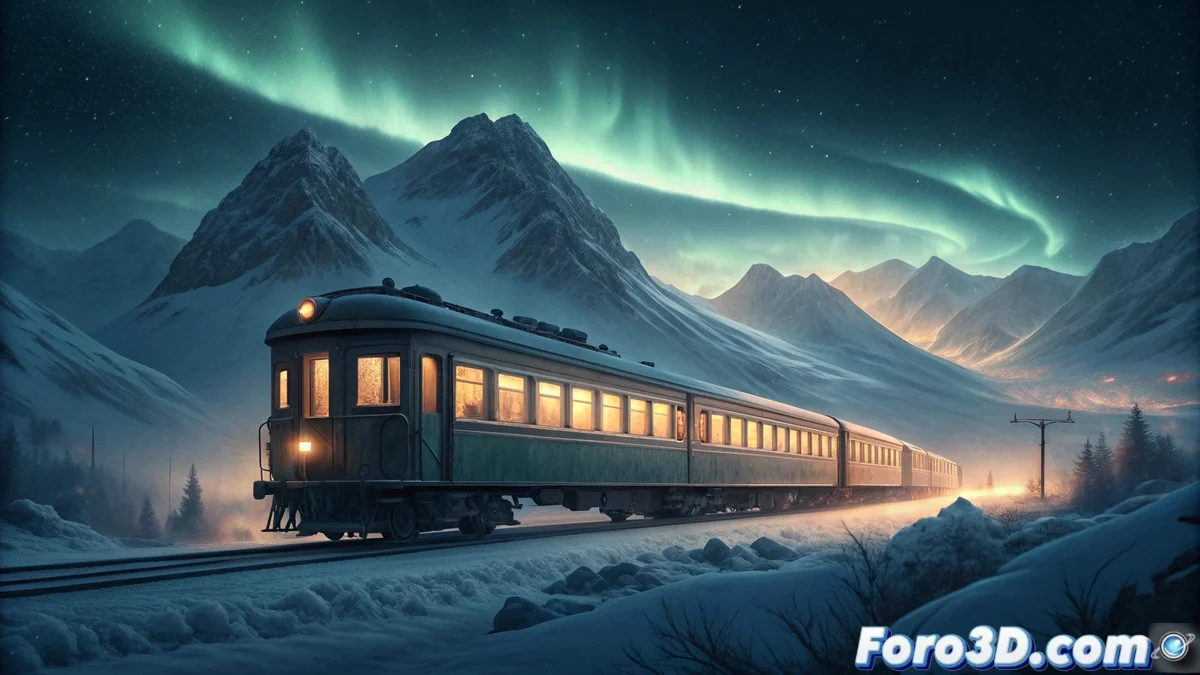
The Legend of the Arctic Train That Doesn't Allow Descent
This folk narrative emerges from the oral traditions of indigenous peoples and settlers in Canada's northern regions, consolidating as a collective warning about the dangers of traveling alone through the desolate Arctic territories during harsh winters. 📜
Origins and Cultural Significance
The first documented records appear in explorers' diaries that collected stories passed down by Inuit guides, describing a spectral railway that traversed impossible routes through perpetually snow-covered landscapes. This legend functioned as a moral allegory about communal sacrifice and simultaneously as a practical alert to the real risks of hypothermia in the Canadian Arctic.
Fundamental Narrative Elements:- Ghostly transportation operating in extreme weather conditions
- Passengers facing irrevocable decisions during the journey
- Metaphor about survival in hostile environments and isolation
"The train doesn't stop of its own accord; it requires the conscious sacrifice of a traveler to maintain the system's balance" - Adaptation of Inuit oral tradition
Historical Evolution and Adaptations
Throughout the 20th century, the story significantly enriched with each generation that passed it down, incorporating elements of railway construction in extreme climates. The contemporary version features cordial but eerily silent passengers, generating an atmosphere of progressive tension. The narrative climax occurs when it is revealed that the only way to stop the perpetual motion requires someone to voluntarily remain on board indefinitely.
Characteristics of the Modern Narrative:- Setting in desolate Arctic landscapes and extreme winter conditions
- Supernatural elements interacting with real natural phenomena
- Psychological exploration of decision-making under pressure
Visual Representation in 3D Environments
Project preparation in Blender begins with setting up scenes in appropriate metric scale for large exteriors, adjusting color management to Filmic to handle extreme contrasts between polar darkness and artificially lit areas. 🎬
Technical Setup and Modeling
A camera is established with lenses between 24-35mm to capture the vastness of the landscape while maintaining proximity to the train. The locomotive and carriage modeling is based on historical references of Canadian railways, incorporating realistic details like fogged windows and ice accumulations on structural edges.
Asset Creation Process:- Development of Arctic landscapes using displacement maps applied to subdivided planes
- Creation of track systems that appear to emerge and disappear in the snow
- Design of interiors with seat arrangements suggesting limited social interaction
Lighting System and Materials
The ambient lighting replicates Arctic moonlight using a weak sun with a bluish color temperature around 6500K. In contrast, the train interior uses warm point light sources that create visual islands of comfort against the icy exterior. For materials, snow shaders are developed with controlled subsurface scattering and reduced specular reflections.
Specific Material Details:- Aged wood textures and worn fabrics for interior seats
- Glass with condensation effects and peripheral frost formation
- Metal surfaces with progressive ice and snow accumulation
Special Effects and Post-Production
The implementation of particle systems simulates constant snowfalls and accumulation on horizontal surfaces. Subtle volumetrics are used to convey a penetrating cold sensation both inside and outside. The freezing effect is animated through materials that progressively desaturate colors and add ice crystals using procedural textures.
Final Rendering and Conclusions
The rendering setup with Cycles ensures maximum quality, activating denoising and adjusting samples according to the complexity of scenes with volumetric effects. This project demonstrates that the most unsettling journeys do not necessarily lead to destinations, but can represent the impossibility of reaching them, fusing advanced digital techniques with deeply rooted traditional narrative. ❄️