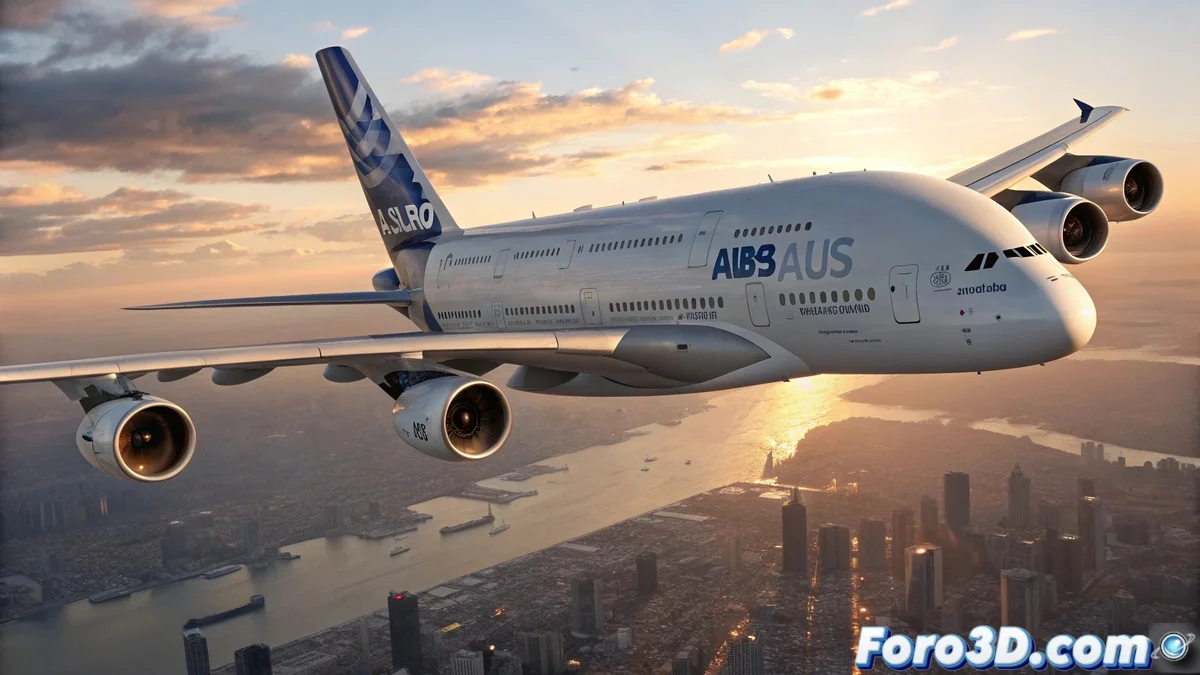
The Legacy of the Airbus A380 and Its Challenge in 3D Modeling
For over a decade, the Airbus A380 reigned as the undisputed giant of the skies, a colossus of engineering that defied all conventions with its capacity for over 800 passengers and unprecedented luxury ✈️. Although the pandemic and the shift toward more efficient aircraft ended its production, its legacy endures not only in aviation but also in the world of 3D modeling. Recreating this giant in software like Blender, 3ds Max, or Cinema 4D has become the Holy Grail for many digital artists, a project that combines technical complexity and aeronautical beauty in equal measure.
Modeling an A380 is like taming a digital giant: it requires patience, precision, and a lot of coffee.
Project Preparation and Setup
The first step to embark on this modeling adventure is to obtain detailed technical blueprints of the A380. These references are crucial for maintaining the exact proportions of the aircraft. In Blender, they are imported as background images in the main orthographic, side, and top views. Setting up metric units from the start ensures that every component, from the fuselage to the wings, maintains the real scale of this 72-meter-long colossus. 📐
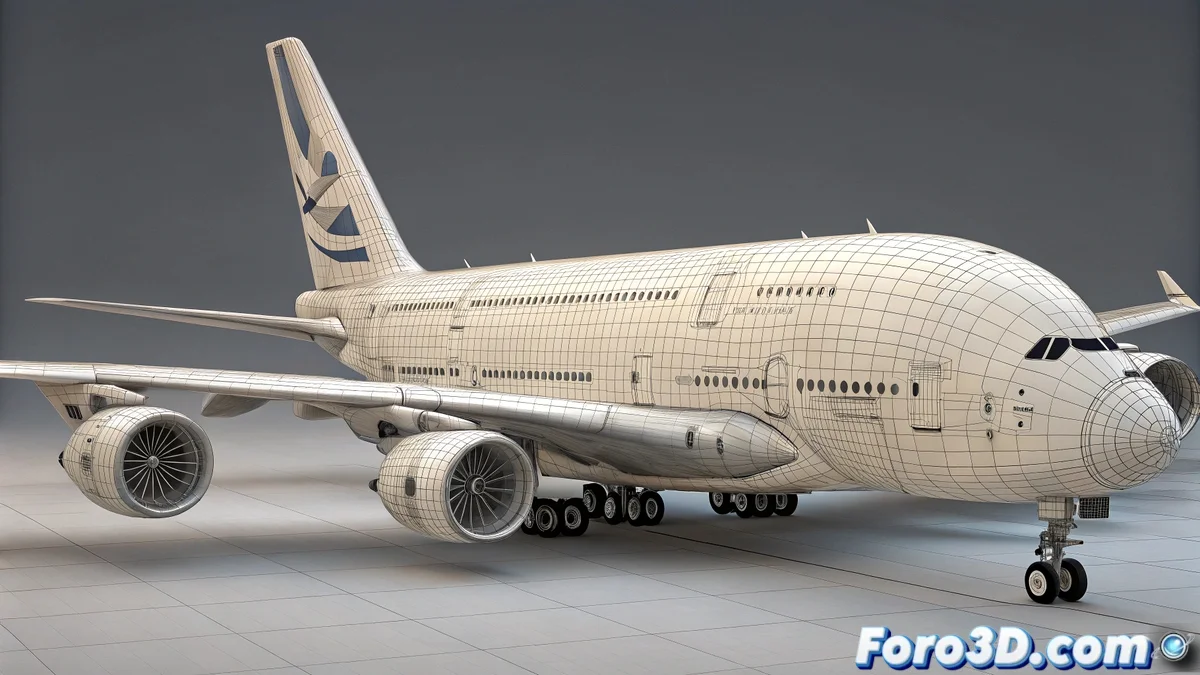
Building the Giant Piece by Piece
The process begins with blocking out the basic shapes: a cube for the main fuselage that is extruded and adjusted according to the side profile, and cylinders for the wings that are shaped according to their characteristic aerodynamic curvature. The Mirror modifier is fundamental here, allowing work on only one half of the aircraft while the other is generated automatically. Little by little, the recognizable shape of the A380 emerges from the polygonal mesh, with its distinctive nose and imposing tail. 🛠️
Detailing and Final Refinement
The magic really happens when adding the details that bring the model to life: the windows perfectly distributed with Array modifier, the complex Rolls-Royce Trent 900 engines, and the intricate landing gear that must virtually support the aircraft's 560 tons. Texturing adds another layer of realism, with materials that replicate aluminum, composites, and the glazed surfaces of the cockpit. HDRI lighting and rendering in Cycles culminate the process, transforming a collection of polygons into a digital masterpiece. 🌟
A Digital Tribute to an Aviation Icon
Although we no longer see as many A380s soaring through the skies, its spirit endures in countless 3D models created by enthusiasts and professionals. This project not only teaches advanced modeling techniques but also pays homage to a wonder of modern engineering. It demonstrates that even when giants fall, they can be reborn in the digital world, challenging a new generation of 3D artists to capture their greatness… because some aircraft are too grand to disappear, even when their time has passed. 😉