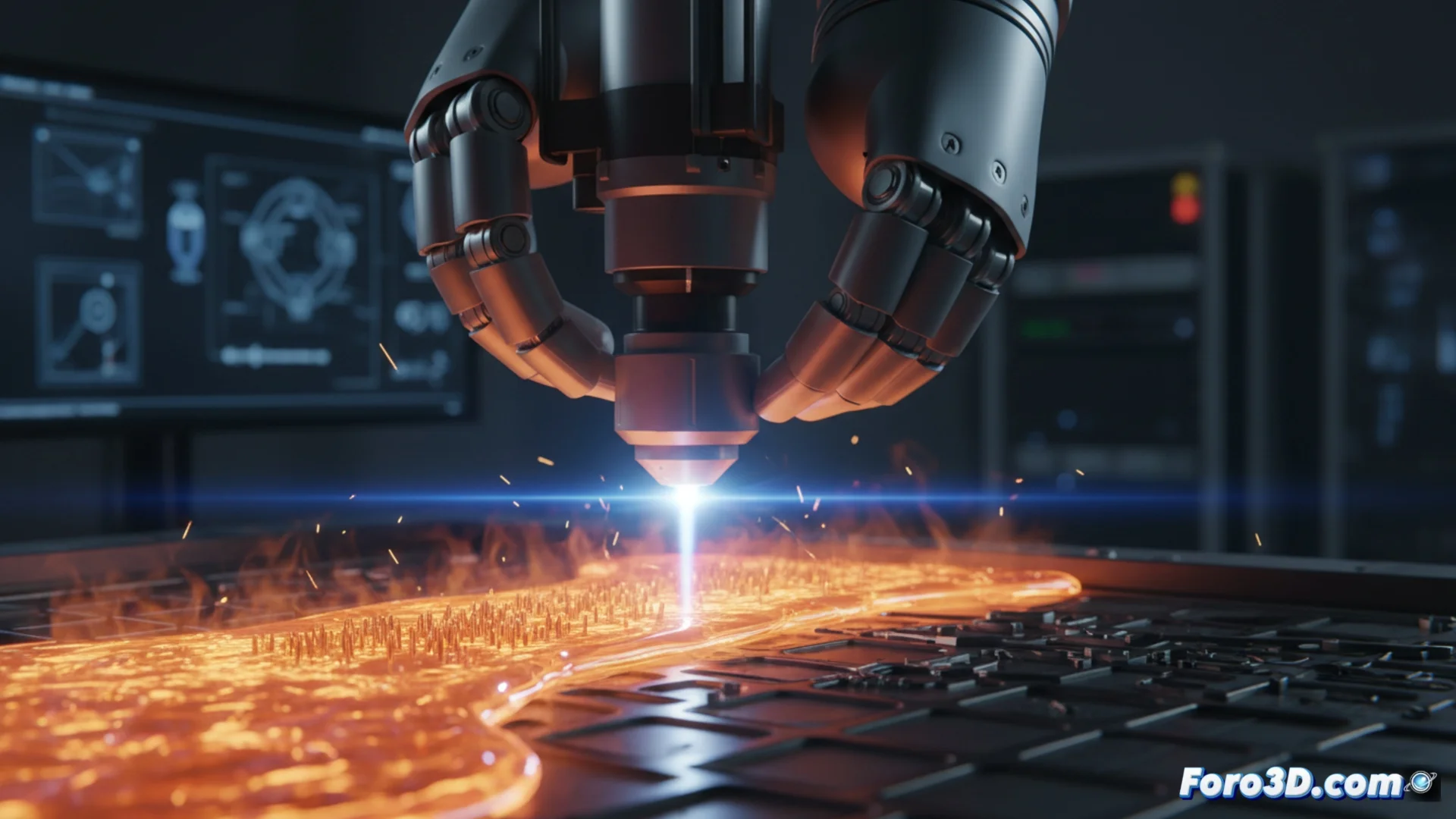
The laser modulates the microstructure of complex alloys in 3D printing
A team from the Lawrence Livermore National Laboratory explores how the speed parameter in a metal fusion laser directly influences the characteristics of high-entropy alloys. Their research demonstrates that manipulating this factor allows managing how the molten material solidifies. This control over the solidification dynamics enables adjusting the crystalline architecture and the phases that form within the component during manufacturing. 🔬
The beam speed defines the mechanical behavior
Altering the speed at which the laser moves allows researchers to produce parts with different profiles of strength and ductility. This technique enables designing materials with tailored attributes directly in the manufacturing stage. Modifying only this process parameter serves to optimize the part for its final use, without requiring complex post-heat treatments. The control is so precise that it becomes an intrinsic design tool.
Key effects of varying the speed:- Fast cooling: Generates finer crystalline structures with greater hardness.
- Slow cooling: Facilitates the development of internal phases that grant greater ductility to the assembly.
- Integrated optimization: Eliminates the need to process the part after printing to achieve the desired properties.
Simply by changing one process parameter, the component can be optimized for its final application without the need for complex subsequent treatments.
Managing solidification to obtain specific phases
The study focuses on analyzing how thermal energy dissipates and the metal transitions from liquid to solid at different rates. Accelerated solidification tends to form more compact and resistant crystalline networks, while a slower process can lead to phases with greater deformation capacity. Being able to direct the microstructure from the core of the printing process represents significant progress for manufacturing complex and customized metal components. ⚙️
Fundamental aspects of directed cooling:- Heat dissipation: The energy transfer is studied to understand phase formation.
- Phase development: The speed determines which atomic structures have time to grow and stabilize.
- Tailored manufacturing: This capability allows creating parts with specific properties in precise areas.
Implications for the future of additive manufacturing
This research underscores that the performance of a metal-printed part does not depend solely on its geometry, but on invisible process parameters. The next time a component fails, it might not be due to a design error, but to an inadequate laser speed. Precision, it seems, is the main virtue in high-speed metallurgy that defines metal 3D printing. Mastering these parameters brings additive manufacturing closer to producing ready-to-use components, with integrated engineering properties from their creation. 🚀