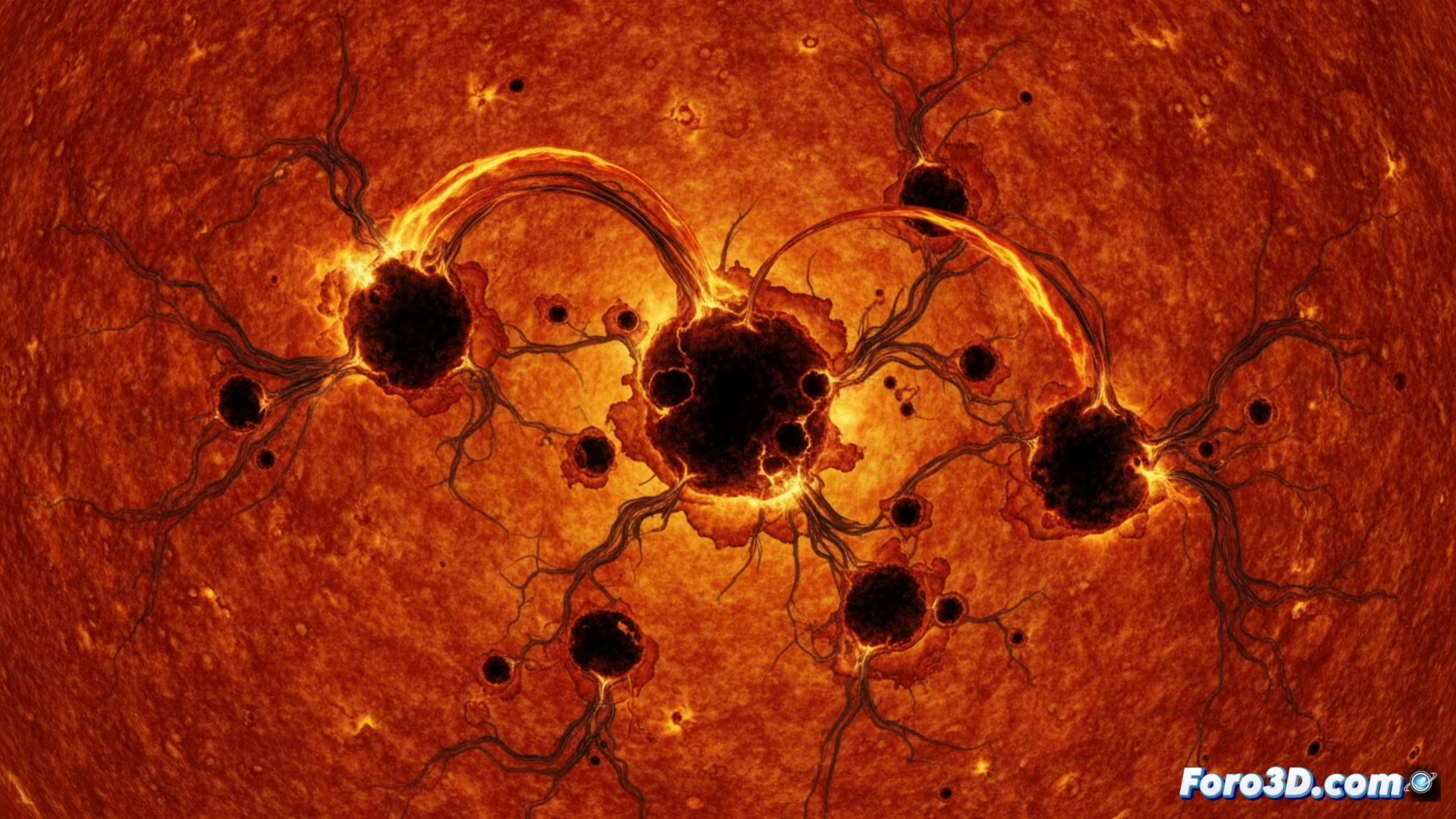
The Largest Sunspot Group of the Past Year Fades Away
The surface of the Sun has lost the largest sunspot group that formed in the last twelve months. This structure, notable for its atypical dimensions, remained without significant activity and did not cause alterations in the space environment. The data comes from the press of the Solar Astronomy Laboratory, an entity jointly managed by the Space Research Institute and the Solar-Terrestrial Physics Institute of the Russian Academy of Sciences. 🔭
The Solar Conglomerate Showed Calm Behavior
Although its size was exceptional, this area did not exhibit the eruptive activity that we normally associate with formations of such magnitude. Experts monitoring our star confirmed that the group, classified as a complex region, did not produce powerful solar flares or significant coronal plasma ejections while crossing the face of the Sun visible from our planet. 🌞
Key Observation Features:- The group was the largest in extent recorded in the previous year.
- Its transit across the solar disk was not accompanied by significant energetic events.
- Russian observatories were primarily responsible for tracking its evolution.
Tracking the behavior of sunspots helps understand the internal dynamics of the star and predict how it may affect Earth's space environment.
Sunspots Signal the Star's Magnetic Cycle
These dark areas are cooler regions in the solar photosphere, originated by an intense concentration of magnetic fields. Their emergence, change, and disappearance are part of the Sun's magnetic activity cycle, which spans about eleven years. Analyzing their behavior allows scientists to better understand the star's internal processes and anticipate possible effects in the space near Earth. 📈
What Sunspots Represent:- Areas with lower temperature than the surrounding photosphere.
- Visible indicators of the intense underlying magnetic activity.
- A fundamental component for tracking the approximately 11-year solar cycle.
A Discreet Farewell to the Most Prominent Feature
Perhaps the Sun chose to discreetly withdraw its most conspicuous mark so as not to overshadow the northern lights, which tend to be more spectacular in photographs and less prone to causing failures in communication satellites. This episode underscores the variable and unpredictable nature of our star's activity. 🌌