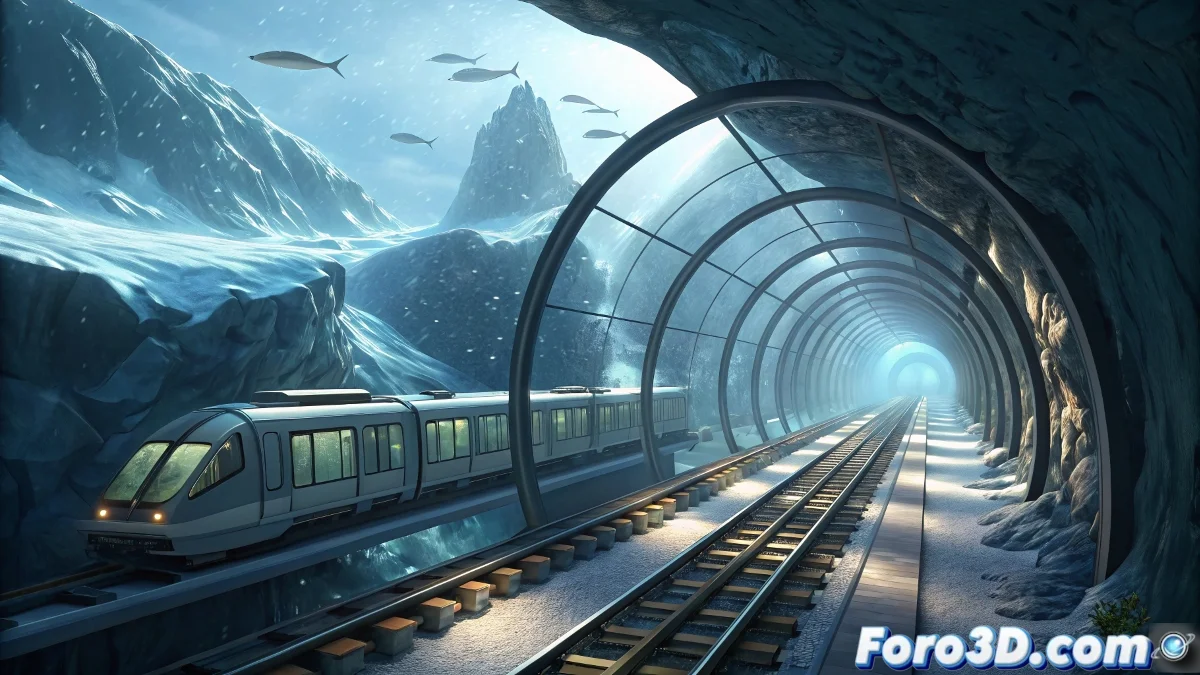
The Land Connection Between Asia and America Through the Bering Strait
The land connection between Asia and America through the Bering Strait has deep roots in geological and human history. During the last glaciation, sea levels dropped so much that the Beringia land bridge formed, allowing the passage of animals and the first settlers of America. This natural corridor disappeared approximately 11,000 years ago when the ice melted and sea levels rose, permanently separating the two continents. The Diomede Islands, located exactly in the middle of the strait, remained as silent witnesses to this ancient connection, with Big Diomede belonging to Russia and Little Diomede to the United States 🌍
Development and Historical Evolution
The modern idea of connecting Russia and Alaska resurfaces periodically since the 19th century. In 1864, the Western Union Telegraph Company proposed laying a telegraph cable across the strait. In the early 20th century, Tsar Nicholas II seriously considered a railway tunnel. During the Cold War, the project was shelved due to political tensions, but the natural phenomenon of winter ice continued creating a seasonal bridge between the Diomede Islands. Today, with Arctic thawing and new trade routes, the project has regained relevance as part of global infrastructure and international cooperation initiatives.
Impact and Cultural Legacy:- It represents much more than an engineering feat, symbolizing the possibility of reconnecting two continents separated by geography and politics
- For local indigenous communities, it would revive ancient cultural and trade routes
- Economically, it would create the first direct land link between America and Eurasia, drastically reducing intercontinental transport times
- Geopolitically, it could become a symbol of cooperation between powers, although it also presents significant challenges in terms of border security and national sovereignty
The most ambitious engineering simply consists of rebuilding what nature had already created
Project Preparation and Initial Setup
Start GstarCAD and create a new drawing with metric units. Set up the necessary layers: terrain, tunnel, support_structures, lighting, and annotations. Establish the drawing limits considering the real scale of the project - approximately 80 kilometers in length. Use the UTM coordinate system to maintain geographic precision. Create dynamic blocks for repetitive elements like support beams and ventilation systems that you can reuse throughout the tunnel.
Modeling and Main Structure:- Begin by drawing the tunnel's centerline using polylines that follow the seabed topography
- Use the EXTRUDE command to create the tunnel's cross-section, considering an internal diameter of approximately 12 meters for double railway track
- Use boolean operations to join tunnel segments
- Model intermediate stations on the Diomede Islands using solid primitives and cutting operations
- Include emergency chambers and ventilation systems every 500 meters using rectangular arrays
Lighting and Materials
Apply specific materials to each component: reinforced_concrete for the main structure, stainless_steel for reinforcements, and asphalt for the interior pavement. Set up directional lights that simulate the tunnel's artificial lighting, spaced regularly along the entire route. Use GstarCAD's rendering system to adjust light intensity and color, creating a realistic environment. Add transparent materials to observation chambers and reflective materials to metallic surfaces.
Special Effects and Final Rendering:- Set up multiple viewports showing cross-sections, elevations, and internal perspectives of the tunnel
- Use the mental ray rendering engine included in GstarCAD to generate photorealistic images
- Adjust anti-aliasing settings to high quality to smooth edges
- Create walkthrough animations using the model walk-through tool, showing the complete route from Alaska to Russia
- Export views in high resolution for technical documentation
Conclusion
This project demonstrates that sometimes the most ambitious engineering simply consists of rebuilding what nature had already created, but now with air conditioning and wifi 🚇