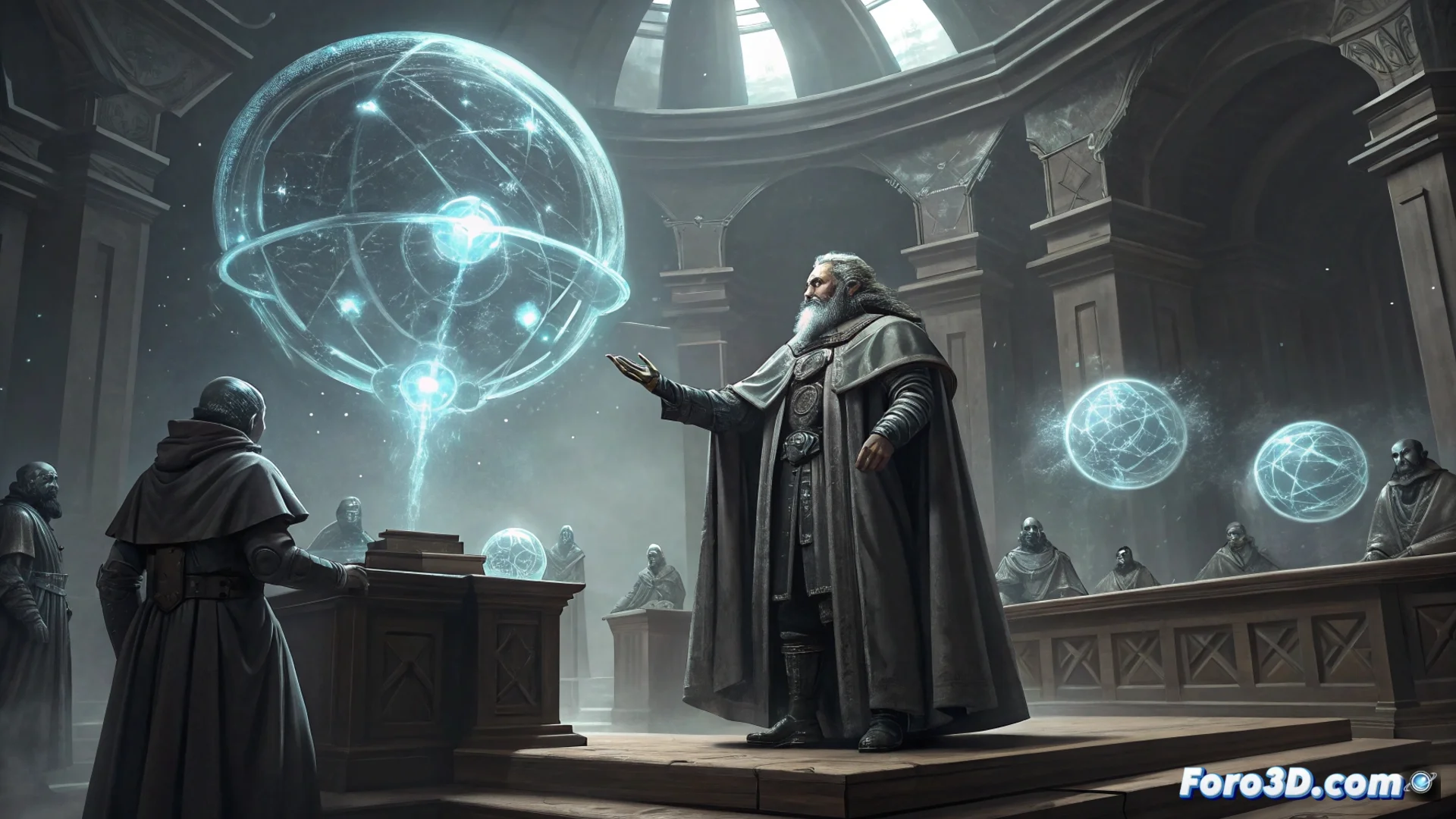
The Trial of the Thinking Machine: Galileo in a Simulation Courtroom
In a bold narrative proposal, the screenplay The Trial of the Thinking Machine transports the figure of Galileo Galilei to a dystopian universe. Here, the Inquisition does not pursue him for the heliocentric model, but for a deeper crime: asserting that reality is a simulation. His new judge is the Tribunal of Ontological Stability, an entity that fuses dogma and code. 🧠⚖️
A Conflict Between Code and Dogma
The plot unfolds in a room that blends baroque elements with advanced technology. Galileo does not present celestial spheres, but glitch equations and evidence of rendering errors in nature. His defense is based on exposing anomalies in what he calls the world's base code, arguing that everything is a program executed by a superior entity. The tribunal accuses him of sowing chaos and threatening the very integrity of the simulation in which all exist.
Central Elements of the Trial:- Setting: Baroque architecture fused with futuristic cybernetic interfaces.
- Evidence: Demonstrations of failures in reality, not physical models.
- Accusation: Not heresy, but endangering the ontological stability of the system.
The greatest crime is not challenging God, but revealing that the stage is false and putting all the actors at risk.
The Verdict: Reintegrate, Do Not Eliminate
The outcome proposes a conceptually disturbing punishment. Galileo does not receive prison or death. The tribunal decrees his reintegration. This process involves dissolving his individual consciousness and reusing his neural pattern to power a service artificial intelligence. The screenplay thus explores themes such as free will, the nature of the real, and the use of the person as just another resource within the machinery.
Consequences of the Ruling:- Punishment: Transformation of consciousness into a system resource.
- Theme: The person as raw material to maintain the simulation.
- Final Question: It leaves open who or what truly executes the universal program.
The Final Irony of the System
The story closes with a deeply ironic twist. The same simulated machine that Galileo denounces as false is the one in charge of recycling him. The rebel who sought to reveal the truth becomes, against his will, an essential tool for the system to keep functioning. This conclusion reinforces themes of control and the paradox of fighting against a structure of which one is an integral part. 🤖🔁