The James Webb Telescope Deciphers Star Formation Bursts in Young Galaxies
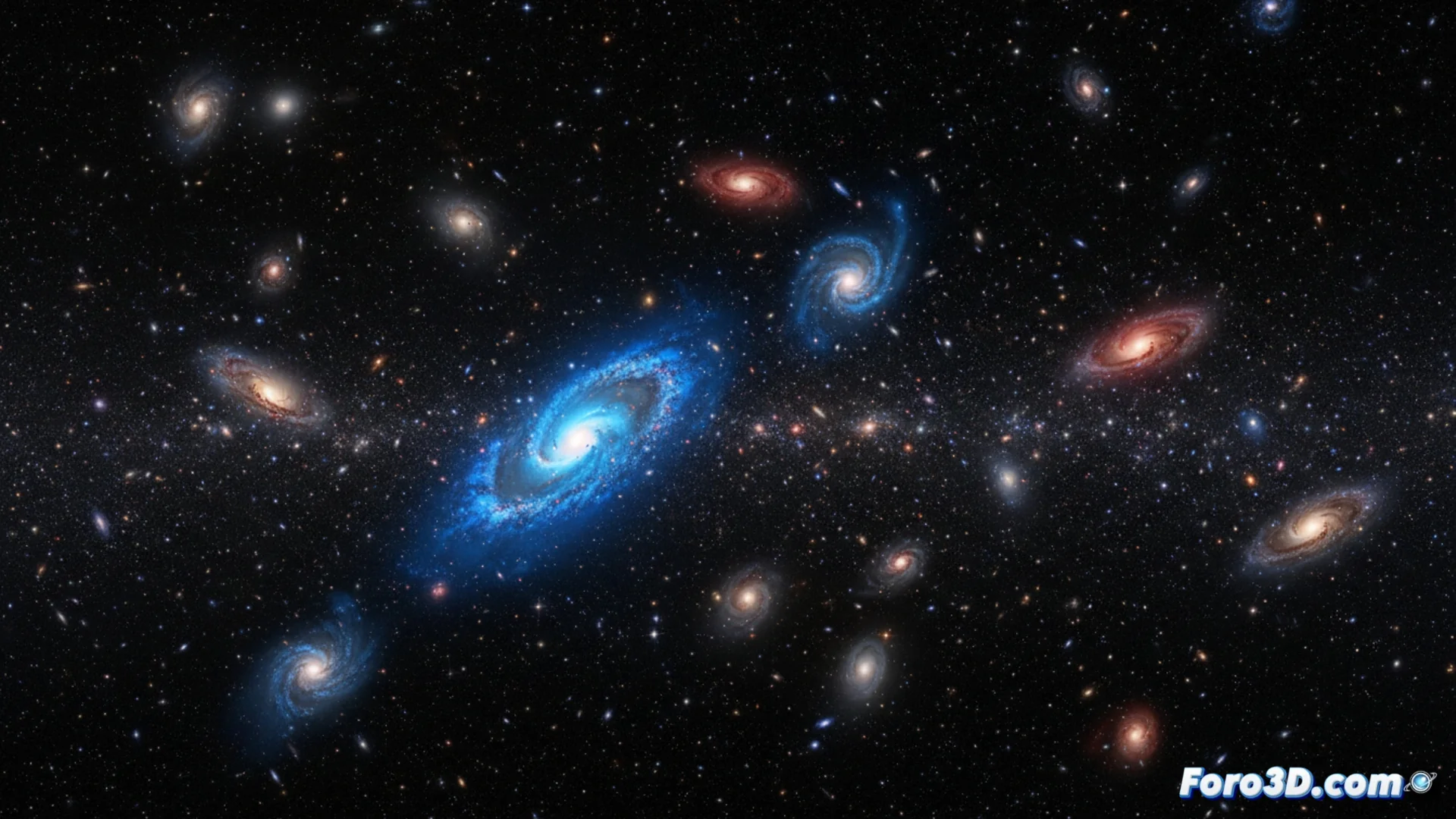
The James Webb space telescope is directing its gaze toward galaxies that existed when the cosmos was young, characterized by a redshift greater than 4. These galaxies exhibit a surprising variety in their luminosity and colors. Astronomers propose that this diversity arises because these galaxies form stars in short but extremely powerful bursts, with abrupt changes in their rate. However, precisely determining how long these episodes last and how strong they are in each galaxy is a huge challenge, due to technical barriers and the fact that different theoretical models can generate very similar observational data. 🔭
An Innovative Approach to Modeling Galaxy Populations
To overcome these obstacles, scientists have devised an inference method that operates at the scale of entire populations. This framework does not analyze galaxies one by one, but directly models complete sets and their spectral properties, from ultraviolet to optical light, which are highly sensitive to the star formation history. It employs a stochastic model based on power spectral density, capable of covering time scales from just one million years up to ten billion.
Key Features of the Method:- Analyzes galaxy populations simultaneously, not in isolation.
- Uses spectral signatures from UV to optical to infer the star formation history.
- Its stochastic model covers an immense temporal range, from very short to long scales.
With simulated samples of 500 galaxies at redshift 4 and the precision anticipated from the JWST's NIRSpec instrument, the technique proves viable and powerful.
Distinguishing Between Competing Theories of Galaxy Evolution
The findings reveal that this statistical framework can measure the power of fluctuations in star formation with the precision needed to differentiate, with more than 99% confidence, between the results of different cosmological simulations, such as FIRE-2 and Illustris, on time scales shorter than 100 million years. It is essential to model both random fluctuations and the recent overall trend in the star formation history simultaneously. The reason is that a secular trend alone could mimic the signal of an intense burst in commonly used diagnostics, leading to erroneous conclusions.
Model Achievements and Considerations:- Can discriminate between galaxy formation models with high statistical confidence.
- It is crucial to include both stochastic variability and the secular trend to avoid false positives.
- The power of fluctuations is measured on cosmically short time scales.
Unraveling the Puzzle of the Teenage Universe
It seems that the young universe went to great lengths to hide its secrets, concealing its explosive star formation episodes behind a veil of model degeneracies and instrument sensitivity limits. This cosmic puzzle, which has long perplexed astronomers, is now beginning to be deciphered thanks to the unprecedented observational power of the James Webb combined with innovative analytical approaches that look at the forest rather than individual trees. The diary of the cosmos's adolescence is finally starting to be read. 🌌