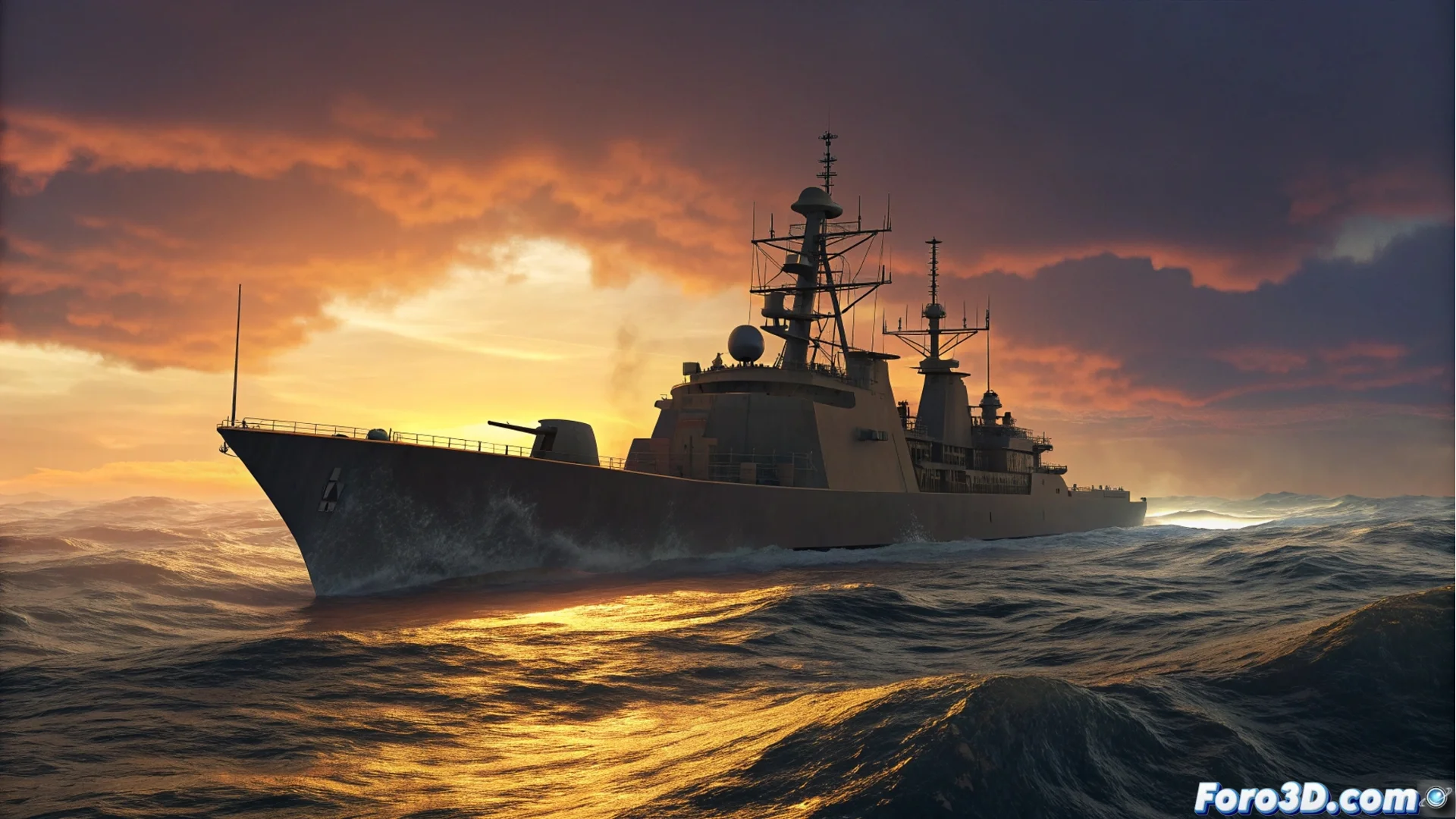
The Israeli Navy's Sa'ar 6 Class Corvette
The Israeli Navy operates the Sa'ar 6 Class, a corvette that redefines the concept of naval power in a compact format. With a length of 90 meters, this ship demonstrates how to integrate frigate capabilities into a smaller and more agile hull ⚓.
Dimensions and Design Philosophy
It measures 13.2 meters in beam and 4 meters in draft. Its design prioritizes operational capabilities over size, packing a very powerful suite of sensors and armament. This makes it a versatile naval platform with solid defenses.
Key features for 3D modeling:- Integrated mast with a state-of-the-art AESA radar, similar to that used on larger frigates.
- Dome over the hangar that houses a secondary radar for the embarked helicopter.
- Hull with multiple vertical launchers for various missile systems.
Recreating this ship involves packing an unusual amount of weapon systems into a relatively small hull, a challenge that reflects the Israeli naval doctrine.
Weapons Systems and Defense
Its firepower is considerable for its class. The armament is designed to face multiple threats, from air attacks to surface and submarine targets 🎯.
Main and secondary armament:- 76 mm OTO Melara automatic gun mounted forward.
- Two Typhoon remote weapon stations for close-in defense.
- 16 Gabriel V anti-ship missiles and 16 long-range Barak-8 air defense missiles.
- 40 cells for the C-Dome system (naval version of Iron Dome) for short-range defense.
- Torpedo tubes for anti-submarine warfare (ASW).
Challenge for the 3D Modeler
For the modeler, the challenge lies in capturing the high density of systems. Every centimeter of the hull and superstructure houses sensors, radars, or launchers. Accurately representing this complexity in a 3D model requires carefully studying the layout and scale of each component, an exercise that goes beyond aesthetics to understand modern military naval engineering 🛠️.