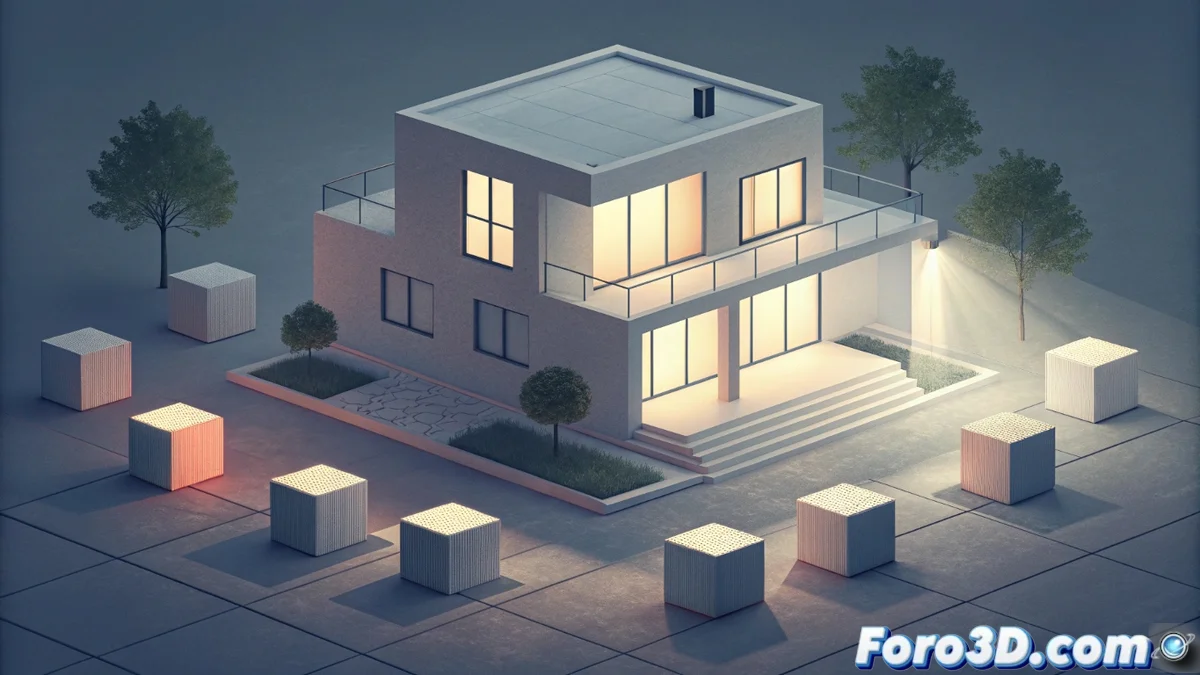
Isometric Perspective with Realistic Shadows Generates Spatial Dissonance
Representing 3D objects on a plane without vanishing points, keeping the axes parallel, defines isometric perspective. This method prioritizes technical clarity and visual stability. However, when integrating a lighting system that projects dynamic and realistic shadows, a fascinating contradiction arises for our visual system. 🧠
A Conflict for the Brain
Our brain is programmed to associate shadows with volume and conical perspective, where lines converge toward vanishing points. Isometry, lacking this convergence, presents a flat and stable geometry. When the shadow suggests depth and a single light source, the depth cues come into conflict. The result is not a processing error, but a tension or spatial dissonance that the viewer perceives as strange or intriguing.
Clashing Depth Cues:- Parallel Perspective: The object's axes in isometry do not diminish, maintaining a constant size.
- Realistic Shadows: Indicate light position, relationships between objects, and volume, cues typical of conical three-dimensional space.
- Oclusion: Although some objects may cover others, the lack of convergence weakens the sense of a single viewpoint.
The viewer may rub their eyes, wondering why a well-defined structure seems both solid and about to slip away.
Exploiting Visual Tension Creatively
Artists and developers do not see this effect as a problem, but as an expressive tool. By using this contrast deliberately, atmospheres can be built that feel familiar yet unsettling, ideal for dreamlike genres or visual puzzles. In video game design and illustration, it allows displaying complex mechanics or structures with total clarity, while the lighting adds drama and a tactile realism that engages the user.
Practical Applications:- Puzzle and Adventure Video Games: Create scenes where spatial perception is part of the challenge.
- User Interfaces and Infographics: Offer clear information with a touch of visual dynamism.
- Digital Art and Concept Illustration: Generate environments that break realistic expectations to evoke specific emotions.
The Technical Challenge Behind the Effect
Implementing this combination poses an interesting technical challenge for graphics engines. The calculation must project shadows onto a plane that, essentially, has no vanishing point. It requires defining a coherent light direction and processing how shadows interact with isometric geometry, something modern engines can resolve but demands careful configuration. The final result is a powerful hybridization between diagrammatic clarity and the sensory richness of light. 🎮