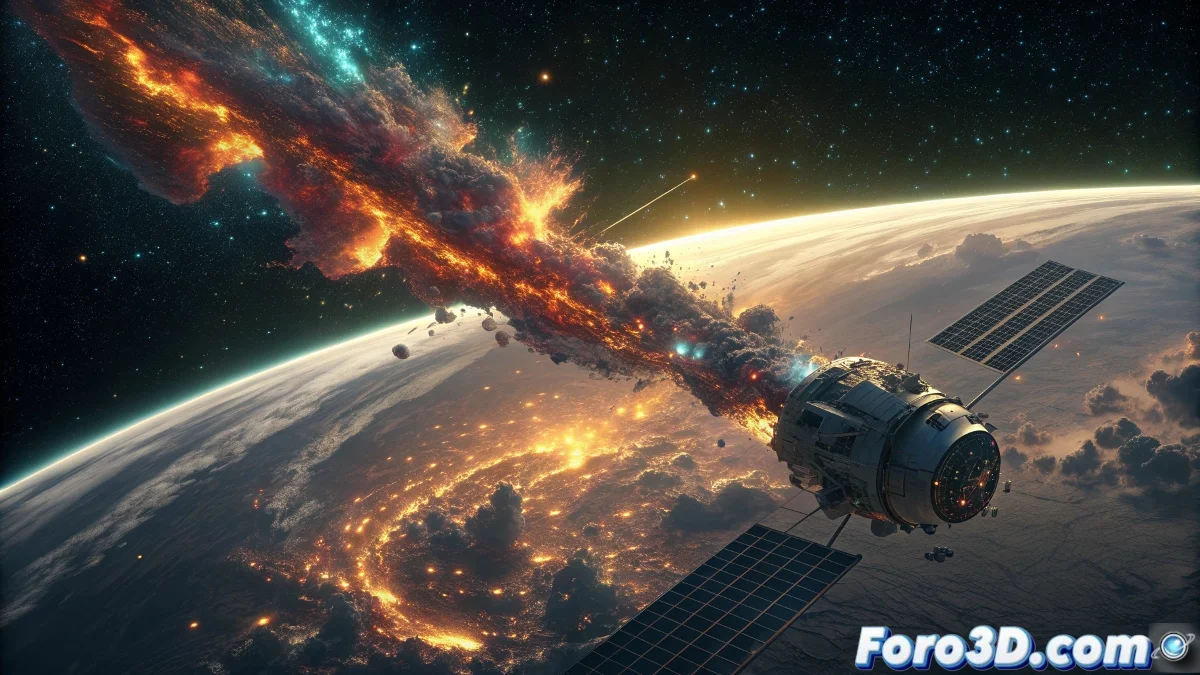
The Invisible Threat: Toxic Chemicals from Satellites During Atmospheric Disintegration
The space race that began in the 1950s left us a hidden legacy: thousands of obsolete satellites containing hazardous materials that eventually return to Earth. What was initially considered a minor problem has evolved into a silent environmental crisis affecting our atmosphere and ecosystems. 🛰️
Evolution of Orbital Chemical Risk
The first satellites used nickel-cadmium batteries and ammonia cooling systems, but increasing technological complexity raised the potential danger. The Kosmos 954 tragedy in 1978, which scattered plutonium-238 over Canada, marked a turning point in awareness of this issue. Currently, communication and Earth observation satellites contain structural beryllium, hydrazine tanks, and halogenated compounds in their electronic components.
Hazardous Materials Identified in Satellites:- Beryllium in solar panel structures and supports
- Hydrazine as propellant in propulsion systems
- Brominated and chlorinated compounds in circuit boards
- Cadmium alloys in electrical systems
- Pulverized aluminum during atmospheric disintegration
- Mercury in stabilization and control systems
"Every satellite reentry represents an uncontrolled chemical experiment in our upper atmosphere" - Dr. Elena Vargas, Atmospheric Chemistry Researcher
Creating a Visualization in Blender: Satellite Disintegration
To visually understand this phenomenon, we can recreate in Blender the process of a satellite's atmospheric disintegration with the release of toxic chemicals. This representation helps to visualize the impact and communicate the risk to both technical and non-technical audiences. 🔥
Initial Project Setup:- Open Blender and delete the default cube (X → Delete)
- Go to Properties → Scene and set Units Scale to 1.0 and Unit System to Metric
- In Color Management, change View Transform to Filmic and Look to Medium High Contrast
- Create three collections: "Intact_Satellite", "Incandescent_Fragments", "Chemical_Clouds"
- Configure World Properties with a dark background Color (Hex: #0A0A2A)
Detailed Satellite and Component Modeling
Realistic modeling requires attention to structural details and the specific materials of satellites. We will start with the main structure and progressively add the critical components that contain hazardous substances.
Step-by-Step Modeling Process:- Add → Mesh → Cylinder (Radius: 1.5m, Depth: 3m, Vertices: 32) for the main body
- Apply Subdivision Surface modifier with Level Viewport: 2 and Render: 3
- Add Modifier → Displace with Strength: 0.3 and Texture type Clouds (Size: 0.8)
- Create solar panels with Plane (Scale X: 4, Y: 0.1, Z: 2) and apply Array modifier
- For fuel tanks: Add → Mesh → UV Sphere (Radius: 0.4, Segments: 24)
- Use Cell Fracture (Shift+W) with Source: Recursive, Recursive Level: 3 for fragmentation
Materials and Shaders for Toxic Components
The visual representation of toxicity requires careful material design that communicates danger without losing technical realism. We will use the Principled BSDF shader combined