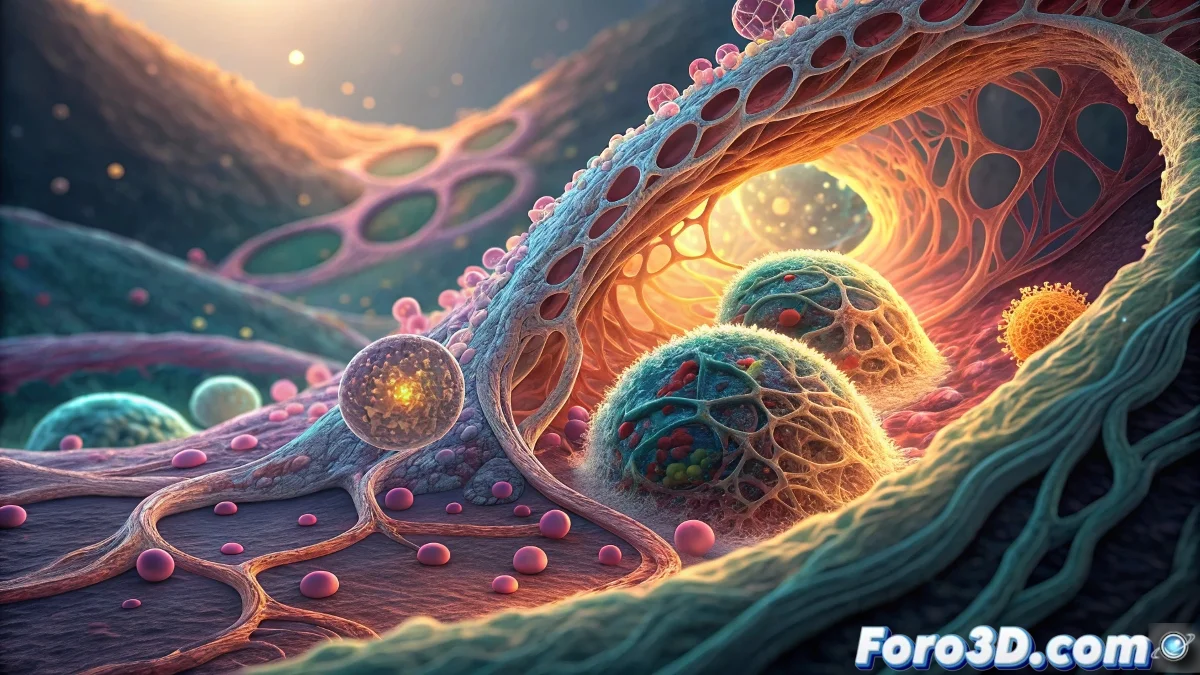
The Interstitium: That Old Acquaintance That Wanted to Be a Star
It spreads like wildfire on the internet that in 2025 a new organ was discovered in the human body. The reality, as usual, is much more complex and less cinematic. The interstitium —that network of fluid-filled spaces that permeates our tissues— has been studied all its life, but it was in 2018 when a team from New York University formally proposed it as an independent organ. Something like when you rediscover that forgotten shirt in the closet and decide it's your favorite. 👔
It's Not New, It's Renewed
What really happened was a technological reinterpretation of something anatomists have known for centuries. Traditional microscopy techniques crushed these delicate fluid spaces, making them appear as simple dense connective tissue. With new endomicroscopy technologies, researchers were able to see it live and direct: a complex network of fluid-filled channels that extends throughout the body.
Characteristics that make it special:- possibly one of the largest organs by volume
- acts as a shock absorber for tissues and organs
- interconnects different bodily systems
- involved in the spread of cancer metastases
Why So Much Controversy?
The scientific community maintains an active debate on whether the interstitium truly deserves the title of organ. Critics argue that it is simply part of the connective tissue system, while its defenders highlight its unique structure and specific functions. The original 2018 study suggested that this system could explain why some cancers spread so rapidly between apparently unconnected organs.
The interstitium is not a discovery, it's an anatomical category promotion
Functions Beyond Simple Filler
Far from being a simple empty space, the interstitium functions as a fluid highway that transports lymph, nutrients, and even immune cells. Its study could revolutionize how we understand inflammation, edema, and even the aging process. Researchers compare its network of channels to an organic piping system that keeps everything hydrated and connected.
Areas where its study is relevant:- oncological research and metastasis
- regenerative medicine and tissue engineering
- understanding inflammatory diseases
- development of new drug delivery systems
So the next time someone talks to you about the new organ discovered, you can explain that it was rather given a promotion in the body organigram. After all, in the world of anatomy, sometimes the best place to hide something is in plain sight for everyone. 🔍