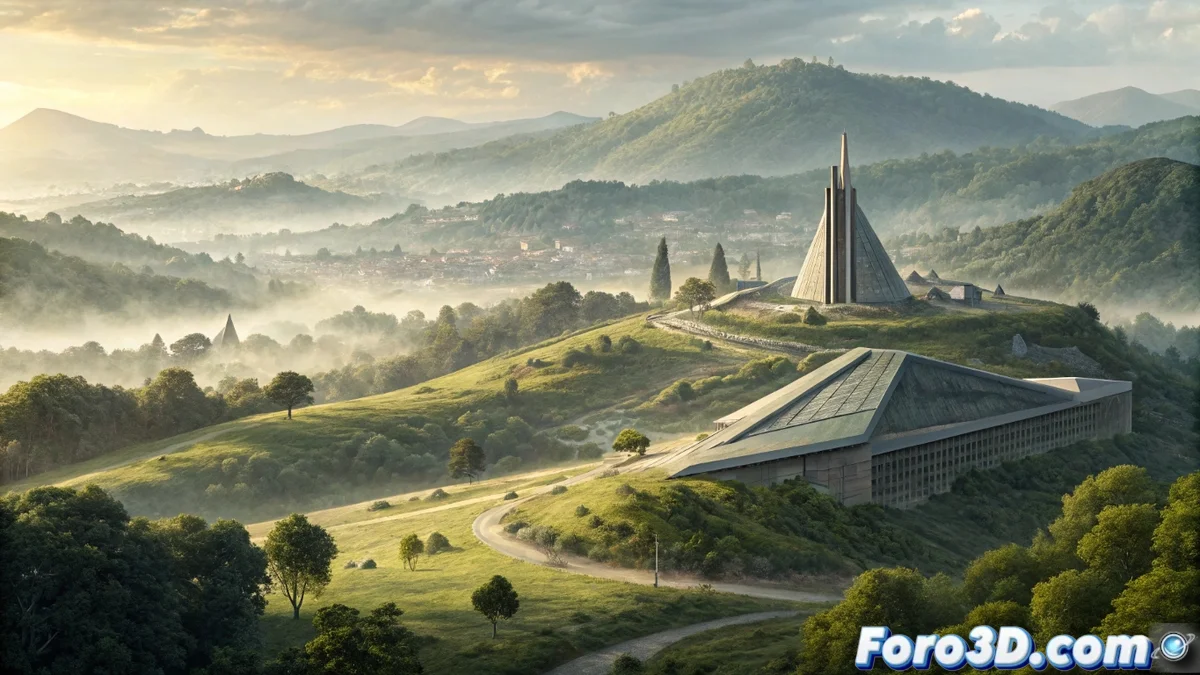
The Incomplete Stone Forest in Santiago de Compostela
Imagine a vast labyrinth of angular forms emerging from the Galician landscape, an architectural dream that promised to revolutionize culture in Santiago de Compostela, but which now lies as a modern enigma. This ambitious complex, the work of visionary Peter Eisenman, began in 2001 with the idea of fusing history and avant-garde, but endless delays and financial problems have turned it into a symbol of the unfinished, attracting both curious visitors and critics. 😮
Roots and Evolution of the Design
This project draws from the unique topography of Santiago de Compostela, blending ancestral Galician elements with a bold contemporary style, where irregular geometric forms evoke an urban landscape in perpetual transformation. City of Culture was the original plan: a set of interconnected buildings that would include libraries, museums, and exhibition halls, but budget cuts and government changes have reduced its scope to just a few operational areas. Despite these obstacles, the design remains a testament to innovation, though now somewhat truncated and melancholic.
Key elements of the design:- The angular structures that imitate the local terrain, creating a dynamic and organic effect that fuses the historical with the modern, although many parts remain unfinished due to insufficient funds.
- The integration of planned cultural spaces, such as libraries and museums, that sought to promote Galician heritage, but which today only function partially due to accumulated delays since 2001.
- The use of materials like stone and concrete to evoke a "stone forest," a poetic concept that, however, has generated debates about its economic and environmental viability in the region.
This Incomplete Stone Forest could be seen as a monument to administrative indecision, where what was supposed to be a cultural beacon has become an improvised theme park of modern ruins.
Effects on the Local Society
Today, this site has transformed into a magnet for intrepid visitors who wander through its partial sections, taking photos and reflecting on its state of semi-abandonment. However, not everything is negative: some completed areas host vibrant cultural events, offering a fascinating mix of modernity and decay that highlights the Galician spirit. 😕 On the other hand, criticism does not cease, as it is perceived as a waste of public resources that fails to achieve its original goal of boosting regional culture.
Highlighted aspects of the impact:- The tourist attraction it generates, with curious explorers who enjoy its modern ruins for ironic selfies, but who also question whether this ambitious project will ever be completed.
- The cultural events held in the finished parts, providing unique experiences that combine the innovative with the unfinished, although they do not compensate for the perceived waste.
- The ongoing debates about its sustainability, where the cost to the Galician community and the possible legacy of this "monument to indecision" in the cultural landscape are discussed.
Final Reflection on This Architectural Enigma
In the end, the Incomplete Stone Forest represents a lesson on the challenges of great cultural dreams, where Peter Eisenman's vision clashes with budgetary and political realities. Projects like this invite us to ponder the balance between ambition and practicality, and although its incomplete structures continue to attract interest, the question arises: will it become an eternal icon or a bitter reminder of what could have been? 😌 This place, with its mix of history and truncated modernity, invites personal reflection on the future of culture in Galicia.