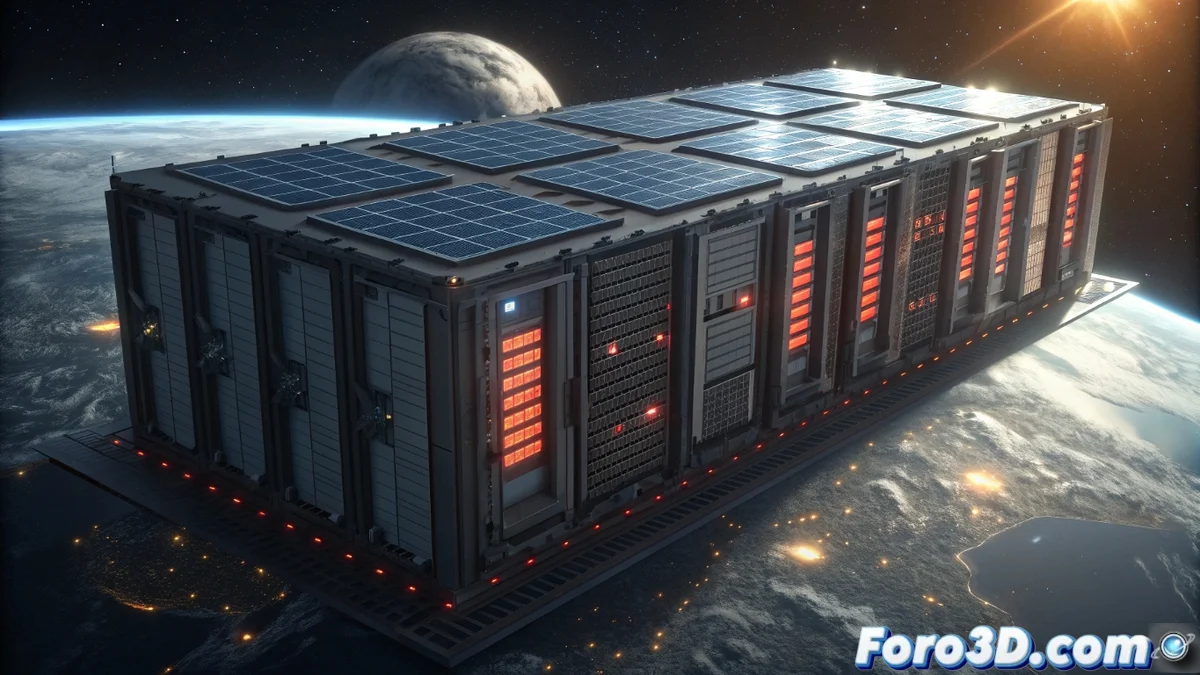
The idea of taking data centers and AI to space is more complex than it seems
The vision of migrating servers and artificial intelligence systems to Earth's orbit sounds like promising science fiction. It is promoted as the panacea for the colossal energy consumption and environmental impact of terrestrial computing. However, upon closer inspection, the proposal crashes into a wall of physical and economic realities that industry experts, including NASA veterans, bluntly describe as impractical and enormously problematic 🚀.
A logistical and engineering nightmare
Beyond the astronomical cost of each launch, operating a functional data center in the vacuum of space requires reinventing solutions that are trivial on Earth. The main hurdle is heat management: in the absence of air, dissipating the thermal energy from thousands of servers requires liquid or radiative cooling systems of extreme complexity and robustness. Any hardware failure demands an extremely expensive repair mission with astronauts or robots, and cosmic radiation irreversibly degrades electronic components, compromising long-term reliability.
Critical obstacles for space computing:- Heat dissipation in vacuum: The lack of convection forces the development of radically new cooling technologies with zero tolerance for failures.
- Impossible maintenance: A simple RAM upgrade or faulty hard drive becomes a high-risk operation with a multi-million dollar budget.
- Radiation degradation: High-energy particles in space drastically shorten the lifespan of processors and memory, generating errors and requiring massive shielding.
"It's a terrible idea, a logistical nightmare. Sending a technician with a wrench to geostationary orbit is not a viable option now or in the foreseeable future." - Former NASA engineer.
The myth of sustainability and the space debris problem
The star argument—access to clean and unlimited solar energy—loses strength when considering the initial energy debt. The energy required to manufacture specialized materials, launch the enormous mass into space, and perform orbital maneuvers is colossal. Solar panels must operate for years just to offset that initial carbon footprint. Additionally, at the end of their useful life, these data center satellites would become orbital debris, contributing to the already critical space debris problem and creating a new front of planetary-scale contamination 🌍.
Ecological and energy disadvantages:- Launch energy debt: The rocket consumes an enormous amount of fuel, negating the benefits of solar energy captured in orbit for years.
- Polluting lifecycle: The manufacturing, launch, and eventual disposal of the infrastructure generate pollution on Earth and in space.
- Limited scalability: The complexity and cost make it unfeasible to replicate the massive scalability of terrestrial data centers.
Conclusion: feet on the ground (for now)
No matter how much it captures the imagination, the proposal for orbital computing faces barriers that make it impractical and inefficient with current technology. Efforts in energy efficiency, advanced cooling, and renewable energies on Earth offer a more realistic and sustainable path. The "cloud," for the moment, will remain firmly anchored to our planet, while the idea of servers floating above us remains in the realm of theoretical speculation and enormous engineering challenges 👨💻.