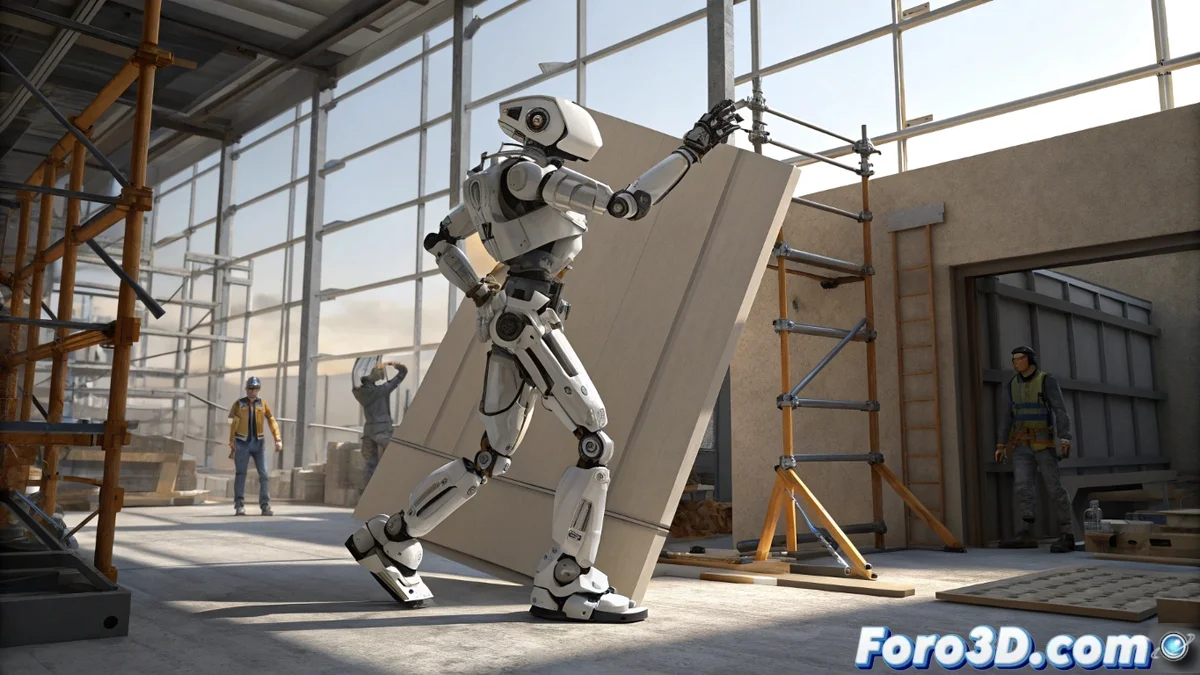
The Humanoid Robot HRP-5P Revolutionizes Construction
In response to the growing labor shortage, Japan's National Institute of Advanced Industrial Science and Technology (AIST) has introduced the HRP-5P, a cutting-edge humanoid robot specifically designed for construction environments. This automaton not only performs physically demanding tasks but does so with a high degree of autonomy, marking a before and after in the automation of the sector 🏗️.
Technical and Operational Capabilities
Equipped with a sophisticated network of 3D sensors and computer vision algorithms, the HRP-5P can perceive its environment with great detail. This allows it to identify objects, calculate trajectories, and manipulate tools or heavy materials, such as gypsum boards or beams, dynamically adapting to the unpredictable conditions of an active construction site.
Key Features:- Autonomous Navigation: Moves through complex terrains and cluttered spaces, independently avoiding obstacles.
- Load Manipulation: Its robotic arms have the strength and precision needed to lift and place large and heavy materials.
- Adaptability: Reconfigures its movements in real time in response to changes in the environment or assigned task.
The integration of humanoids like the HRP-5P represents a qualitative leap, moving robotics from closed assembly lines to the controlled chaos of construction.
Transformation of the Sector and Considerations
The adoption of this technology promises a profound transformation of the industry. By taking on the most repetitive and dangerous tasks, a dual objective is achieved: dramatically increasing productivity and, more crucially, reducing workplace accidents. This frees human workers to focus on supervision, planning, and tasks that require creativity and judgment.
Key Impacts on the Industry:- Risk Mitigation: Reduces human exposure to work at heights, handling heavy loads, and unhealthy environments.
- Continuous Efficiency: Operates without fatigue, allowing uninterrupted work shifts and optimizing project timelines.
- New Job Roles: Creates demand for specialized profiles in robotics, maintenance, and supervision of autonomous systems.
Reflections on the Automated Future
As the HRP-5P works tirelessly, an inevitable debate arises about the future of employment in construction. Although today it is an ally that fills staffing gaps, its evolution raises questions about redefining the necessary skills. The image of the traditional worker joking about a rival that never asks for a break encapsulates this transition: the challenge will not be to compete with machines, but to learn to direct them and collaborate with them to build a safer and more efficient environment 🤖.