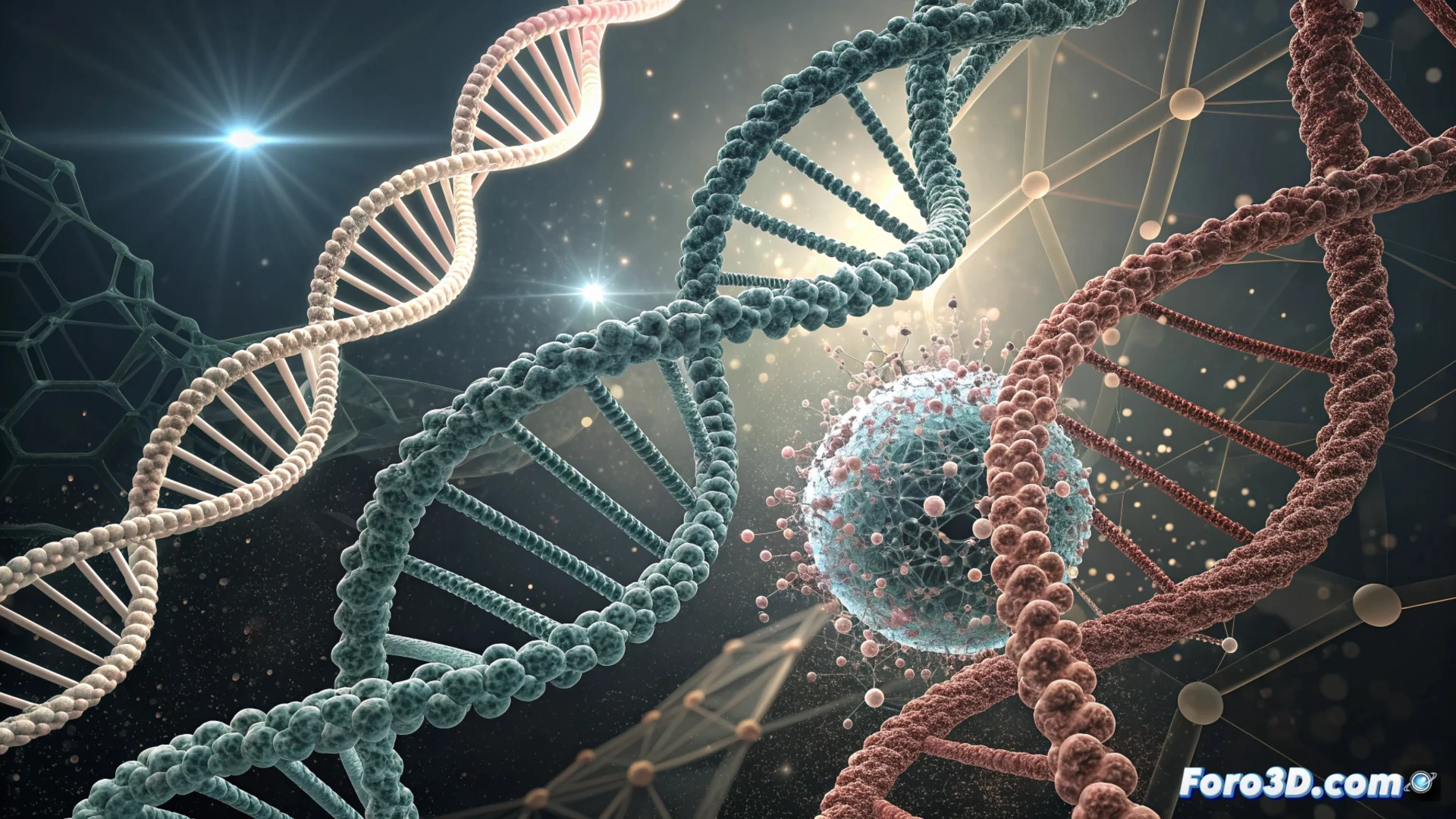
The human genome folds in 4D to regulate genes
Genomic science takes a conceptual leap by ceasing to view DNA as a simple linear sequence. Now, researchers explore how it organizes in the three-dimensional space of the nucleus and, crucially, how this architecture changes over time. This fourth dimension is the key to understanding how life is controlled at the molecular level 🧬.
The fourth dimension: time and space in the nucleus
The genetic code is not a stretched strand. It compacts intricately, generating loops, topological domains, and compartments. The radical novelty is observing how these folds are not fixed, but continuously reorganize. This movement allows genomic regions separated by long distances in the linear sequence to come into physical contact to activate or silence genes.
Key mechanisms of 4D folding:- Promoter-enhancer contacts: Folding brings distant regulatory elements closer, turning on specific genes.
- Temporal dynamics: The 3D structure changes so that a cell can respond to signals and define its function.
- Silencing by distance: Turning off a gene often involves physically moving its regulators away.
The blueprint of life is not static; it is a three-dimensional choreography that dances to the rhythm of time.
Implications for understanding health and disease
Mapping this 4D blueprint resolves medical enigmas. It explains why mutations in non-coding regions, sometimes far from a gene, can trigger pathologies: they alter folding and prevent or force incorrect contacts. This perspective also illuminates how a stem cell specializes, as its genome refolds massively to activate new genetic programs.
Areas where the 4D map is crucial:- Origin of diseases: Understanding how folding failures cause genetic disorders and cancer.
- Cell differentiation: Tracking how the genome refolds when a stem cell decides its fate.
- Innovative therapies: Identifying new targets for drugs that correct errors in genomic architecture.
A dynamic blueprint that builds life
Thinking of the genome as a 4D system transforms biology. It is not a static blueprint of letters, but a spatial structure that evolves to precisely regulate gene expression. Understanding this choreography is fundamental to deciphering basic biology and designing strategies to intervene when the process fails. The master blueprint of our body is, in essence, a dynamic sculpture that shapes itself 🔍.