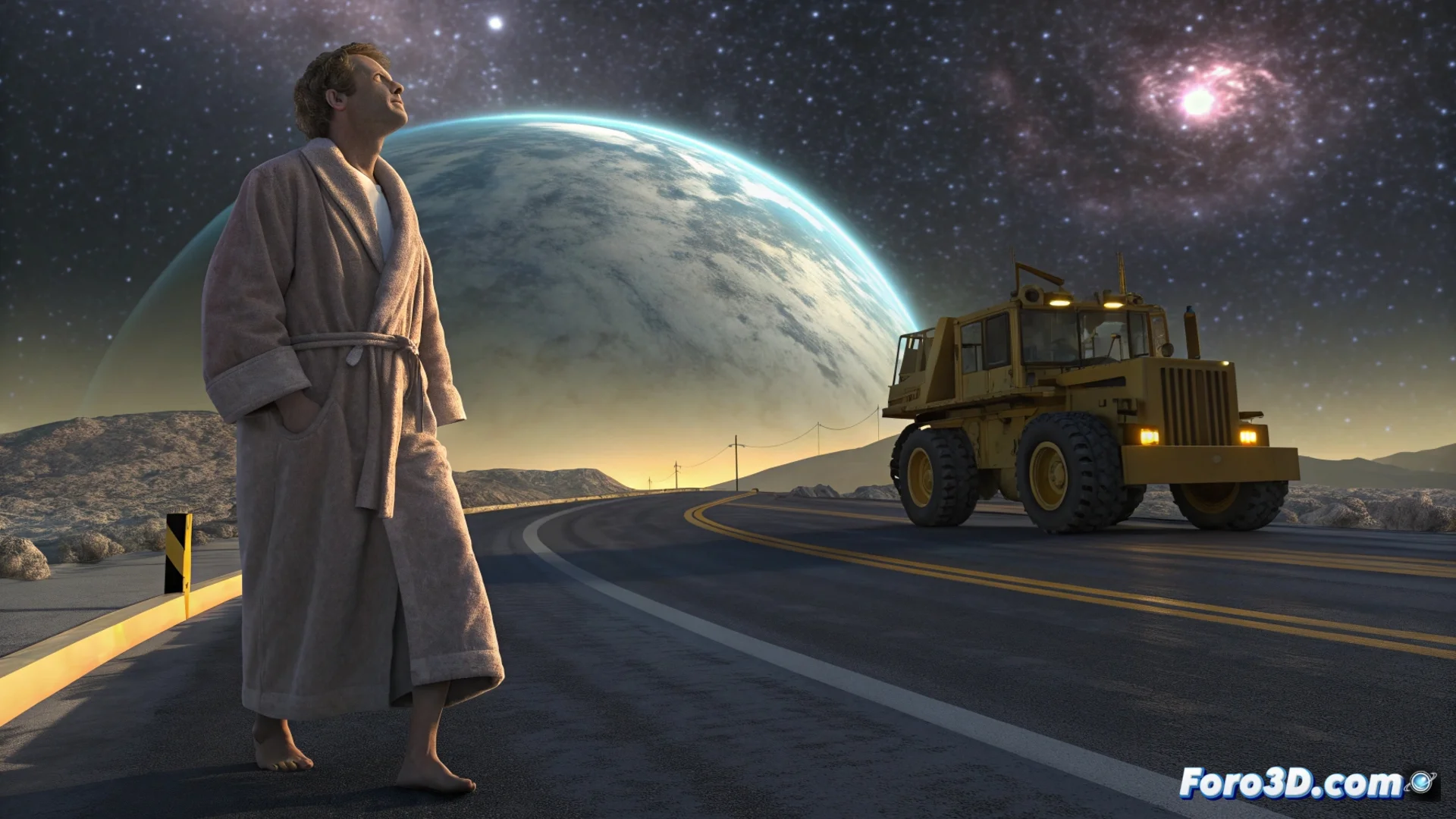
The Hitchhiker's Guide to the Galaxy: a comic science fiction novel
Douglas Adams presented this seminal work to the world in 1979. The story begins with Arthur Dent, an ordinary earthling, whose world is turned upside down upon learning that his friend Ford Prefect is a researcher from another planet. Together they narrowly avoid the Earth being demolished to build a hyperspace highway, escaping by hitchhiking on a spaceship. 🚀
An absurd journey through the cosmos
The narrative works as a penetrating satire that addresses bureaucracy, technology, and philosophy. Characters like Zaphod Beeblebrox, the galactic president, and Marvin, the depressive android, populate this universe. The plot humorously seeks the answer to the ultimate question about life, the universe, and everything.
Central elements of the absurd:- The Guide: An electronic book with a cover that advises "Don't Panic", presented as the only manual that understands an illogical cosmos.
- The improbability drive: A device that allows instantaneous travel to any point in the universe.
- The towel: An object elevated to an artifact of supreme utility for a galactic hitchhiker.
Don't Panic. - The most valuable and friendly advice from the entire Guide.
Style and enduring legacy
Adams' prose stands out for its dry humor and witty observations about the human condition. His writing style transforms everyday concepts into central pieces of cosmic comedy.
Adaptations and expansion of the universe:- The work first originated a highly successful radio series.
- Subsequently, it was adapted into a television series.
- The narrative universe was expanded with several sequel novels, consolidating a cult phenomenon.
A classic that redefines a genre
More than a simple science fiction novel, The Hitchhiker's Guide to the Galaxy is an exercise in intelligent humor that questions how we perceive reality. Its legacy endures not only in literature but in multiple formats, maintaining its relevance and ability to make people laugh and think equally. 🤔