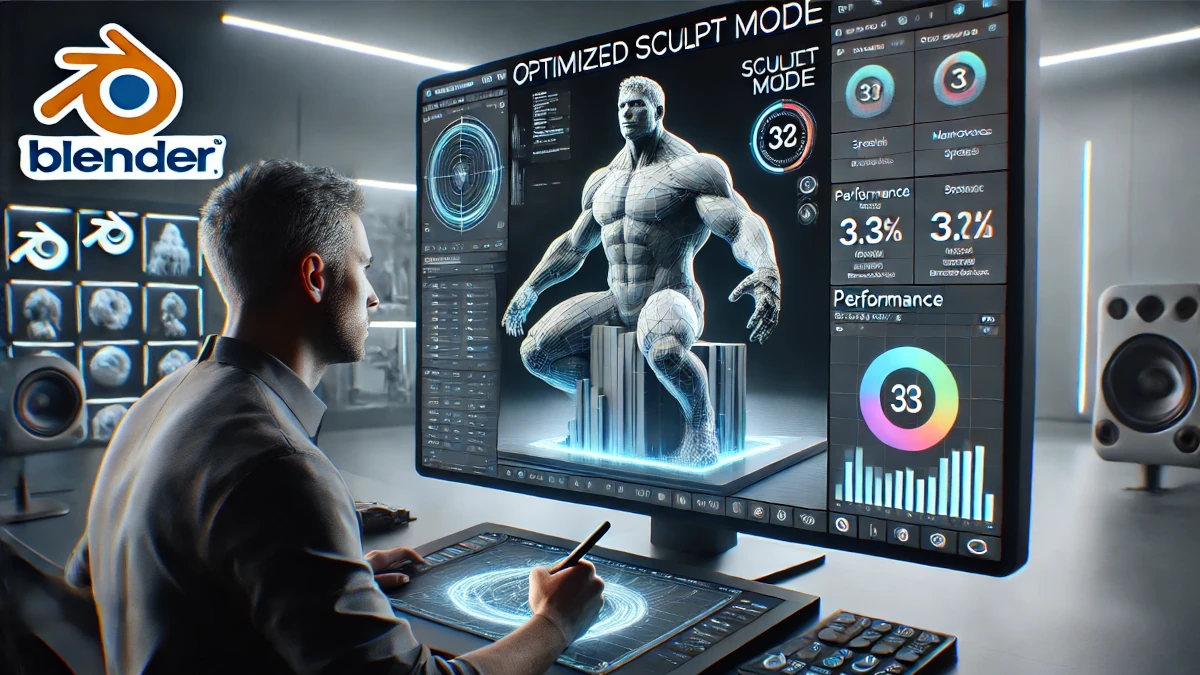
The 3D modeling software Blender has undergone a deep optimization in its sculpting mode, significantly improving its performance without altering the interface. Although these changes are not visible at first glance, they have been fundamental in streamlining the workflow of digital artists. Thanks to a code restructuring, the sculpting mode now loads up to five times faster and uses less memory.
The Problem of Slow Access to Sculpting Mode
One of the main drawbacks in previous versions was the activation time of the sculpting mode, especially on large meshes. This issue arose because certain processes, such as building the BVH tree, were executed on a single thread, creating bottlenecks. With the implementation of parallel processing, the transition to this mode is now up to five times faster, allowing for a much smoother workflow.
“Optimizing the code without altering the interface allows improving performance without affecting the user experience.”
Optimization in Graphical Representation
The amount of graphics data sent to the GPU represents a constant challenge in sculpting mode. Before the optimizations:
- The drawing system duplicated unnecessary tasks, overloading the hardware.
- Memory usage was high due to redundant processes.
- Model rendering during sculpting was not entirely efficient.
Now, with the code optimization, Blender has significantly reduced the memory load and reorganized the way data is stored, achieving greater efficiency in real-time rendering.
Restructuring of the BVH Tree
The BVH tree, used to accelerate collision detection and geometry manipulation, has been completely optimized. Previously, it contained redundant information that required constant updates, affecting performance. With the new implementation:
- The BVH only maintains essential information, reducing memory load.
- A clearer, more efficient, and easier-to-maintain code has been achieved.
- Collision and selection calculations are now faster and more precise.
Improvements in Brush Evaluation
The brush evaluation process has also been optimized, eliminating unnecessary processes that slowed down the application of deformations on the mesh. With the new structure:
- Deformation calculations are processed in blocks instead of vertex by vertex.
- Latency in brush application has been reduced.
- The system better leverages cache memory, improving response speed.
A Promising Future for Digital Sculpting
These optimizations have not only improved Blender's performance in its current state but have also laid the foundation for future innovations. With a more efficient and modular code structure, the development of new tools and features will be much more agile, benefiting both digital artists and developers.