The Electric Bill of Artificial Creativity
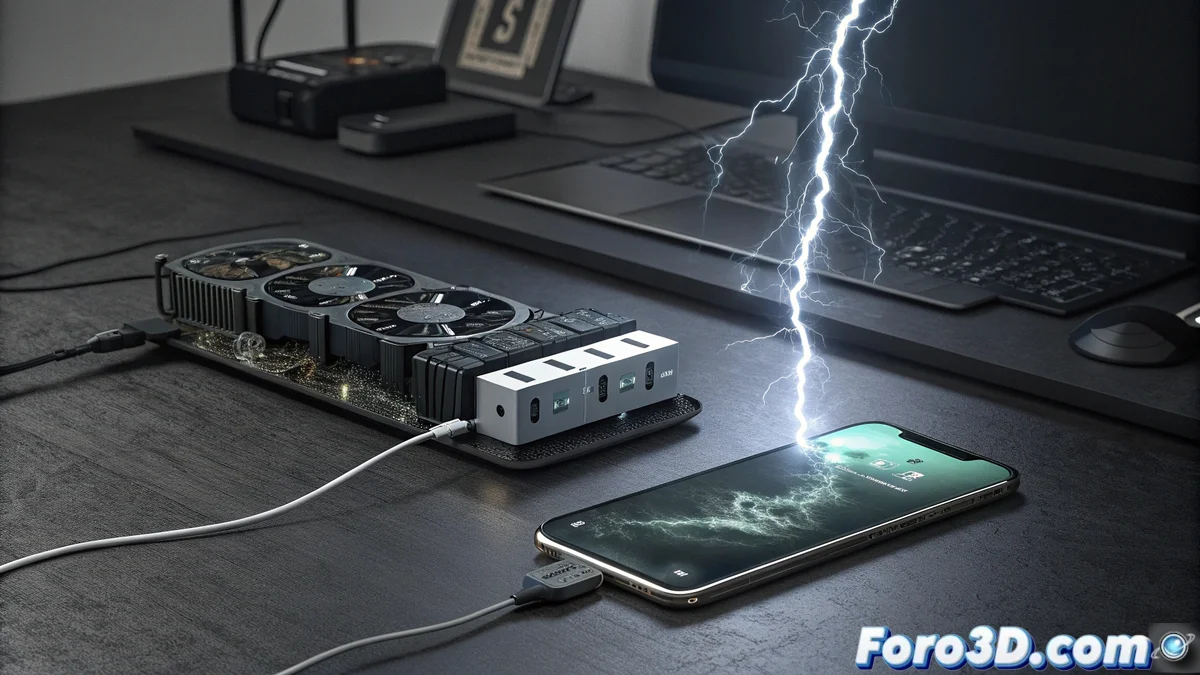
A sustainability report has uncovered a surprising reality: generating a single image with artificial intelligence can consume an amount of energy equivalent to fully charging a smartphone's battery. 📱 This seemingly small figure takes on a colossal dimension when you consider that millions of images are generated daily on platforms like Midjourney or DALL-E. For the creative community, accustomed to evaluating performance and quality, a new parameter is now added to consider: the energy footprint of each creation. The magic of AI, it seems, doesn't work with a wand, but with voltage.
Why Does an Artificial Pixel Consume Like a Phone?
The answer lies in the architecture of AI models. Generating an image is not a simple act; it involves performing trillions of mathematical operations in graphics processing units (GPUs) located in large data centers. Although for the user the process only lasts a few seconds, the infrastructure behind it works at full capacity. 💡 Every time a prompt is written, a complex system is set in motion that accesses a massive training database and executes intensive calculations to predict and render each pixel. It's a monumental computational effort packaged into a minimal wait.
The immediacy of image generation hides an energy reality that is much less efficient than traditional methods.
The comparison with everyday devices helps put the consumption into perspective. If charging a smartphone requires approximately between 5 and 10 watt-hours, that is the energy invested in creating a stylish cat or a surreal landscape. The problem, as experts point out, is not the unit cost, but the cumulative effect on a global scale. Millions of images generated per day represent an energy consumption comparable to that of a small city, a fact that invites reflection on the use of these tools.
The Path Towards a Greener AI
Faced with this scenario, the industry is already seeking solutions. Optimizing algorithms is a main avenue; more efficient models that achieve the same results with fewer operations. In parallel, progress is being made in the development of specialized hardware that performs these calculations with lower energy expenditure. 🍃 Furthermore, there is a growing push to power data centers with renewable energy sources, thereby mitigating the associated carbon footprint. However, end-user awareness is equally crucial. More deliberate and less impulsive use can make a big difference.
Some of the key strategies being explored are:
- Model Compression: Reducing the size of models without significant loss of quality.
- Efficient Inference: Improving the software that runs the already trained models.
- Liquid Cooling: More efficient systems to dissipate heat from servers.
- Usage Policies: Limiting low-quality generations or promoting the reuse of results.
In the end, the conclusion is clear: AI-driven creativity has a real cost that goes beyond the monthly subscription. The next time an image is generated, it might be worth asking if it is really necessary or if the process can be optimized. After all, the most sustainable art might simply be the one that isn't generated unnecessarily. A modern irony where the most advanced technology reminds us of a very ancient principle: nothing is free. 😅